
Among the many recent series about the space race, few begin as interested in the emotional consequences of power as Star City. Set within the universe of For All Mankind, Apple TV’s new production returns to the moment the Soviet Union wins the race to put a man on the Moon, but chooses to tell that story from a perspective rarely explored: the women, agents, and families trying to survive inside a system built on surveillance, silence, and control.
Rather than turning space into heroic fantasy, Star City operates almost like a psychological thriller about paranoia and survival. The Soviet space program sits at the center of the narrative, but the series understands that behind the technological dispute of the Cold War were people desperately trying to preserve some sense of identity within a structure that demanded absolute obedience.
And perhaps no relationship represents that better than the one between Ludmilla Raskova and Irina. Anna Maxwell Martin plays the KGB agent responsible for protecting the Soviet space program, while Agnes O’Casey portrays the young Irina, a character For All Mankind fans already know in her older form. There is something inevitably tragic about that construction: even before she becomes the cold and powerful political figure seen in the original series, Star City makes clear how that environment slowly begins shaping her emotionally.
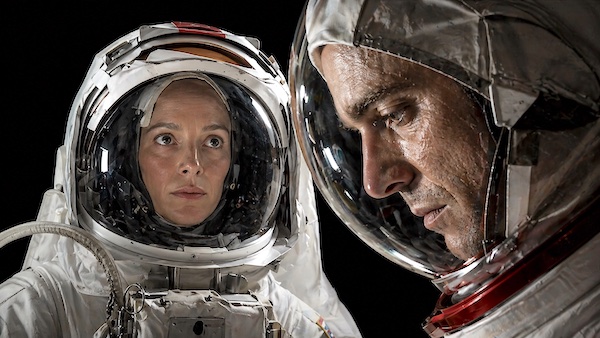
But there is an especially clever detail in the way the series builds that trajectory. For viewers who have not seen For All Mankind, it is possible not to immediately connect this young Irina to the woman audiences already know from the future. And that makes the experience even more fascinating, because the series completely reverses the way we see the character. Instead of the distant and calculating political figure introduced in the original show, we meet someone still vulnerable, insecure, and impressionable, trying to survive inside a system that seems to slowly consume every trace of humanity.
That is where the writing reveals one of its greatest strengths, elevated by Agnes O’Casey’s performance, which balances fragility, intelligence, and ambition without ever turning Irina into an obvious character. The audience understands that something dangerous is being built there, but the series leaves enough room for empathy to exist.
Alongside her, Anna Maxwell Martin delivers perhaps one of the most unsettling performances of her career. Known for characters that are often warmer, more vulnerable, or deeply human, the actress appears here in an almost terrifying form. Her voice never needs to raise her voice to feel threatening. The discomfort comes precisely from her calmness, restraint, and the constant sensation that she is always observing more than she reveals.
During the conversation with CLAUDIA, Anna Maxwell Martin and Agnes O’Casey discussed the complex dynamic between their characters, the psychological weight of living inside a system sustained by fear, and the series’ decision not to reduce its protagonists to the fact that they are women in positions of power. Instead, both actresses emphasized how Star City treats these characters first and foremost as people trying to survive in an environment where even affection, admiration, and trust can become instruments of control.
CLAUDIA: Congratulations on the series. Anna, I have to say I’ve been a fan of yours for years, and I don’t think I’ve ever been as scared of one of your characters as I was here.
Anna Maxwell Martin:
Yes, exactly! That’s what I’m like in real life. Everything else was acting, but this is the real me.
CLAUDIA: Your characters are usually so sweet. And Ludmilla still has something sweet about her, but she’s also terrifying. And because I know what Irina eventually becomes, I was afraid of her too.
Anna Maxwell Martin:
They make such a great pair, don’t they? We really had an amazing time playing these characters together. I think they’re incredibly exciting characters to portray.
CLAUDIA: One of the things that struck me most about the series is this atmosphere of oppression and a logic of fear, of not fully trusting people, of measuring what can or cannot be said. There’s a very interesting scene where your character talks about equality within the system, but we realize it doesn’t truly exist. There are still rigid social hierarchies. And while watching, I kept wondering: how much does Raskova actually know about Irina?
Anna Maxwell Martin:
That’s the great contradiction of communism, isn’t it? There’s this idea of equality, but there is never real equality. There will always be leaders, hierarchies, and people in superior positions. Different ranks inside the KGB, people who served in the war, and people with higher status. So the idea of equality is already subverted from the start.
And that question about what Ludmilla knows about Irina is really interesting. I’d never thought deeply about it before, but maybe she knows more than she lets on. I think Ludmilla is fascinated by Irina. Maybe because she sees someone she wants to shape into her own image. Maybe it’s fascination, curiosity, or even projection.
The way Agnes and I worked together was by trying to make that relationship as complex and surprising as possible.
CLAUDIA: Agnes, anyone who has watched For All Mankind already knows what Irina becomes in the future, but I still found myself rooting for her and then hating myself for it.
Agnes O’Casey:
That’s wonderful! Because we know where she ends up, but there’s still something deeply dramatic and emotional about that journey. It’s almost tragic.
It’s like watching Romeo and Juliet. You know exactly how it ends, but you still hope somehow it won’t happen that way.
Playing Irina was exciting precisely because I got to follow that transformation step by step. You watch her learning everything gradually.
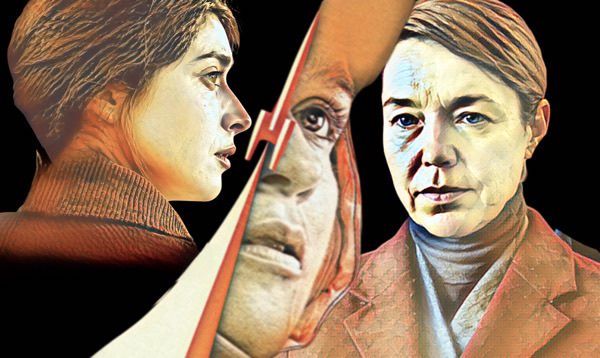
CLAUDIA: I also found it very interesting how the series portrays women inside such a rigid power structure. It never feels like the show reduces these characters to simply being women in that environment.
Anna Maxwell Martin:
There are many layers to that. First, I feel a great deal of compassion for Ludmilla because she’s a product of that environment. At the end of the day, she’s simply trying to do her job. And failing to do your job in that system is dangerous.
I never felt like I was specifically playing “a female character.” Maybe it’s because of the uniform, maybe because of how she was written, but I never thought about her in terms of gender. I just saw her as a person inside that system.
Matt Wolpert and Ben Nedivi treated it that way, too. There wasn’t some explicit agenda around it. The fact that she occupied that position was never treated as extraordinary, and I was really grateful for that.
Agnes O’Casey:
I felt exactly the same way. It was incredibly liberating. I never had to constantly think about Irina’s gender while playing her. I think that comes directly from the way the scripts were written.
CLAUDIA: And the most interesting thing is that, despite its connection to For All Mankind, Star City feels much more like a political and psychological thriller.
Anna Maxwell Martin:
Exactly. Of course, there’s the For All Mankind legacy, but Star City isn’t exactly a space show. It’s a thriller.
It’s about the conflict between people trying to build something creative, people who genuinely care about the space program, and the other side trying to protect that program at any cost. Even if that destroys the very creativity needed to make it exist.
The real conflict of the series is fear, security, and paranoia.

CLAUDIA: Did you both do a lot of historical research for the roles?
Agnes O’Casey:
A lot. The research was extremely important because that world couldn’t be more different from the world I grew up in. And that’s one of the best things about the job: learning new things.
Anna Maxwell Martin:
Yes, immersing yourself in another culture, other ideas.
Agnes O’Casey:
When I was younger, I used to say I wanted to be an actress because it seemed like a profession where you would keep learning forever. And this project really gave me that feeling.
CLAUDIA:
Thank you so much. The interview was incredible. And I’m still scared of both of you.
Anna Maxwell Martin:
Perfect. Thank you very much.
Agnes O’Casey:
Thank you! I’m glad you enjoyed it.
Descubra mais sobre
Assine para receber nossas notícias mais recentes por e-mail.

