
Whenever science announces a breakthrough related to consciousness, the reaction usually swings between two extremes. Some people see these advances as evidence that we are getting closer to fully explaining the human mind, while others interpret any attempt to locate consciousness in the brain as an oversimplification of something that belongs to the realm of subjectivity, philosophy, or even spirituality. The truth is probably somewhere between those two positions.
A study recently published in Nature Human Behaviour has attracted considerable attention after identifying a specific pattern of activity in the thalamus, a small structure located deep in the center of the brain that is responsible for integrating information from different neural regions. The research team discovered an oscillation between 20 and 45 Hertz that appears exclusively during two very particular states: when we are awake and when we are dreaming during REM sleep. The signal disappears completely during deep non-REM sleep, precisely the period in which conscious experience appears to be most diminished.
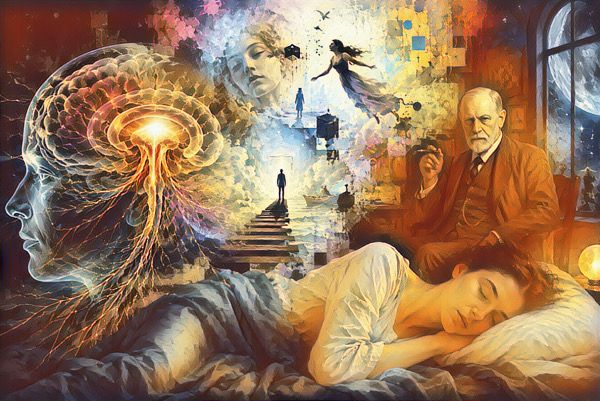
The authors of the study believe they may have identified something close to a biological signature of consciousness, an objective marker capable of distinguishing moments in which subjective experience is present from those in which it appears absent or significantly reduced.
The discovery is important, although perhaps not for the reasons many people imagine.
Our fascination with consciousness exists because it remains one of the greatest mysteries of the human condition. We know that the brain produces thoughts, emotions, memories, dreams, and perceptions, yet we still do not fully understand how a network of cells and electrical impulses becomes the intimate experience of being. We still do not know why a collection of biological processes produces what we call the self. We still struggle to explain how matter becomes subjective experience.
When researchers identify a neural pattern associated with consciousness, they are not answering those questions. They are answering a different, though equally important, one: which brain mechanisms make conscious experience possible?
That distinction is essential because it helps explain why discoveries like this are so interesting to both neuroscience and psychoanalysis, albeit for entirely different reasons.
Freud would probably have followed this study with enormous curiosity. Before creating psychoanalysis, he was a neurologist who spent much of his early career trying to understand the mind through the workings of the brain. In 1895, he wrote the Project for a Scientific Psychology, an ambitious attempt to develop a theory of the mind grounded in biology. Freud himself acknowledged that the science of his time lacked the tools necessary to support such a project, which is why he ultimately developed a primarily psychological model.
The dream of building bridges between brain and mind, however, never disappeared.
More than a century later, technological advances have allowed scientists to observe deep brain structures with a level of precision Freud could scarcely have imagined. Yet one question continues to run through the entire history of psychoanalysis: even if we discover the mechanisms of consciousness, will that be enough to explain human experience?
The answer is probably no.
The most intriguing aspect of this study is the fact that the same neural pattern appears both during wakefulness and during REM sleep. In other words, the brain seems to employ a similar type of activity when we are observing the world around us and when we are immersed in vivid dreams.
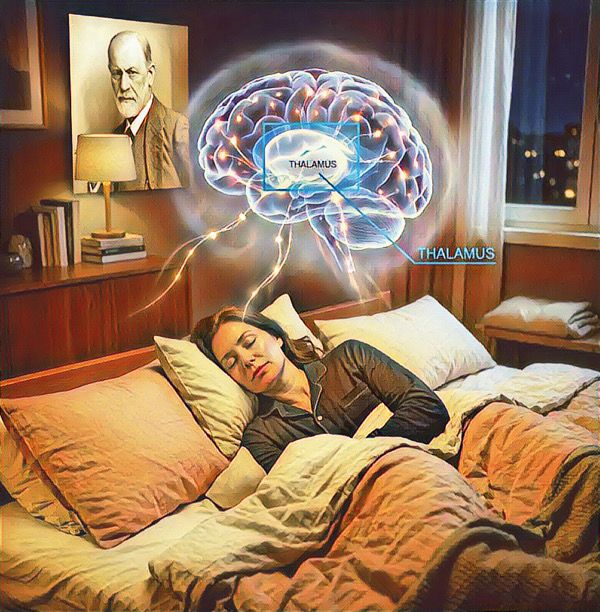
This observation creates a surprisingly interesting dialogue with one of psychoanalysis’s most famous insights. Since The Interpretation of Dreams, Freud argued that dreaming does not represent a shutdown of the mind but rather a different mode of psychic activity. While we sleep, desires, conflicts, fantasies, and memories continue to operate, although they are governed by rules different from those that organize waking life.
Naturally, the study does not prove Freud’s theory of dreams. It would be intellectually careless to transform a neuroscientific finding into automatic validation of a psychological theory. Even so, something is fascinating about the idea that the brain maintains a signature associated with consciousness precisely during the moments in which we are dreaming. In some respects, the research reinforces the notion that dreaming is far from being a passive state or a temporary suspension of mental life.
At the same time, the discovery also highlights the limits of any purely biological explanation of human experience.
A neuroscientist may identify the circuits involved in consciousness, but that does not explain why someone repeatedly dreams about a person they lost decades ago. It does not explain why certain traumas continue to return. It does not explain why some romantic relationships seem to reproduce the same script throughout an entire lifetime. Nor does it explain why different individuals assign radically different meanings to similar experiences.
This is precisely where psychoanalysis continues to find its place.
While neuroscience seeks to understand the mechanisms that make consciousness possible, psychoanalysis is concerned with investigating the meanings generated by consciousness and, perhaps even more importantly, by everything that remains outside it. After all, since Freud, we have known that a large portion of psychic life operates in territories that escape conscious control. The subject is never entirely identical to what they know about themselves. There are desires, conflicts, fears, and fantasies that continue to exert influence even when they are not consciously recognized.
This may be the most provocative question the study raises for psychoanalysts.
If researchers have truly identified a biological signature of consciousness, what are we to do with everything that cannot be reduced to consciousness? What are we to do with the unconscious, with symptoms, with slips of the tongue, with the seemingly irrational repetitions that shape so many human choices?
The discovery of this neural rhythm does not eliminate those questions. If anything, it may make them even more visible.
There is a contemporary tendency to frame neuroscience and psychoanalysis as rival disciplines engaged in a battle over who possesses the “true” explanation of the human mind. That opposition may be far less productive than it appears. After all, both fields continue to investigate the same object from different perspectives.
Neuroscience seeks to understand how conscious experience emerges from the brain. Psychoanalysis seeks to understand how that experience acquires meaning within the unique history of an individual subject.
Neither question invalidates the other.
On the contrary, both seem increasingly necessary as our understanding of the brain continues to deepen.

Researchers may indeed have identified one of the mechanisms that helps keep the flame of consciousness burning. We may be looking at a discovery capable of transforming the treatment of neurological disorders and deepening our understanding of wakefulness, sleep, coma, and perception.
Even so, the question that continues to fascinate philosophers, writers, neuroscientists, and psychoanalysts remains fundamentally the same: even when we fully understand how the light of consciousness is switched on, we will still need to explain everything that it illuminates.
Descubra mais sobre
Assine para receber nossas notícias mais recentes por e-mail.

