
I have to admit: I approached Elle with a fair amount of skepticism. Not because I consider Legally Blonde untouchable, quite the opposite. Part of its enduring charm has always been its willingness to play with its own clichés. But the idea of following the teenage years of Elle Woods, a character whose appeal has always rested on her apparent lack of depth, felt unnecessary. Especially because, after the failure of The Carrie Diaries, one might reasonably have assumed that Hollywood had learned its lesson. After all, turning already established female icons into the protagonists of coming-of-age dramas often ends up revealing precisely the aspects of those characters that never needed explaining in the first place.
Teenage Carrie Bradshaw didn’t work because part of the character’s appeal was the illusion that she had somehow always been Carrie Bradshaw. And yet, Hollywood persists. Elle, which has just arrived on Prime Video, proves exactly that. The difference is that, unlike The Carrie Diaries, this new series seems to understand that we are not watching to discover who Elle Woods “really” was. We are watching to reconnect with the fantasy we always believed we already knew. And somehow, it won me over.

Much of the credit belongs to Lexi Minetree. The young actress accomplishes what should be an almost impossible task: playing Elle Woods without attempting a Reese Witherspoon impersonation. There are familiar gestures, expressions, and vocal rhythms, but there is also something distinctly her own, a vulnerability and sincerity that keep us watching even when the plot follows entirely predictable paths.
Perhaps because Minetree understands something that part of the critical response seems to have overlooked: Elle Woods was never meant to be a realistic character. She is a very specific American fantasy. Rich, beautiful, white, popular, and utterly convinced that the world works in her favor.
The humor of Legally Blonde never emerged from a sophisticated critique of privilege. On the contrary, it came precisely from Elle’s inability to recognize her own privilege. The franchise’s most famous line — “What, like it’s hard?” — remains funny more than twenty years later because Elle has absolutely no idea what she’s revealing about herself. Her empathy was never social or political. It was emotional, personal, and selective. That was always part of the joke.
Which is precisely why I found it fascinating to place this character within the cultural universe of the 1990s. There is something deeply unsettling about watching someone so optimistic, so protected, and so certain of her place in the world moving through a decade whose aesthetic identity was built on disillusionment, irony, and the rejection of excess.
The soundtrack, meanwhile, may be one of the show’s greatest strengths. It is essentially an emotional playlist of the 1990s. As a longtime Garbage fan, I have to admit that I smiled when I heard “Only Happy When It Rains” over the closing credits. There is something deliciously ironic about associating Elle Woods with a song whose narrator appears to embody everything Elle is not: cynical, melancholic, self-destructive, and deeply suspicious of happiness.
Or perhaps not.
Because one possible reading of Elle Woods has always been that her relentless positivity is itself a kind of performance. A conscious decision about how to move through the world. The series flirts with this idea, even if it never quite has the courage to explore it fully.
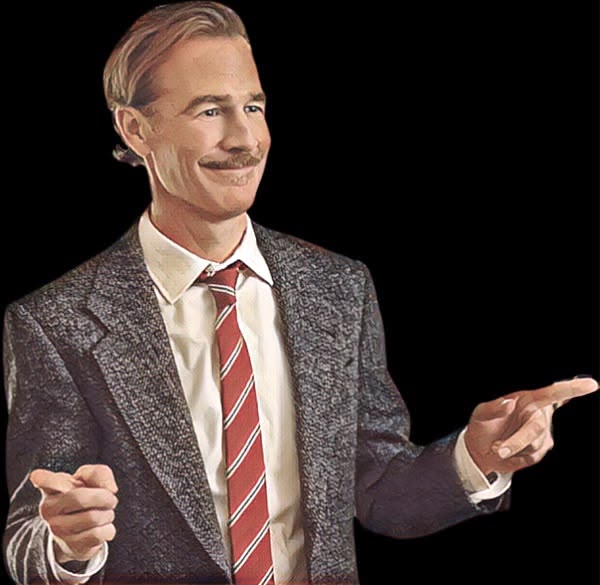
There is another element that makes Elle more interesting than some critics have acknowledged. The series marks the final screen role of James Van Der Beek, one of the defining faces of 1990s teen television. And there is something almost perfect — or perhaps cruelly perfect — about the fact that his acting career ends in a high school series, the very genre he helped define for an entire generation.
Because, for many viewers, James Van Der Beek never entirely stopped being Dawson Leery. Dawson’s Creek helped transform teen drama into its own genre, where friendships, romances, and existential crises were treated with the gravity of Greek tragedy. Watching Van Der Beek conclude his acting career with Elle feels like more than a nostalgic Easter egg. It feels like a circle completing itself.
In fact, the entire series seems to operate that way: as a carefully curated collection of emotional references. There are posters, songs, costumes, and countless little winks aimed at viewers who either lived through the 1990s or wish they had.
Not every storyline works equally well. Elle’s rebellion against her mother may be the clearest example of how Elle sometimes creates conflict simply because she believes teen dramas are supposed to have conflict. Their dynamic often feels like an elaborate exercise in manufacturing drama because someone decided drama was required. And yet, it works.
It works because Elle’s mother is played by June Diane Raphael, forever Brianna Hanson for those of us who consider Grace and Frankie one of the great American comedies of recent years. There is something wonderfully appropriate about watching her play a mother who is every bit as dazzled, privileged, and, in many ways, as clueless as her daughter. If Elle still cannot see beyond her own golden bubble, her mother does not appear particularly interested in doing so either — and perhaps that is the most convincing explanation for the woman Elle Woods eventually becomes.
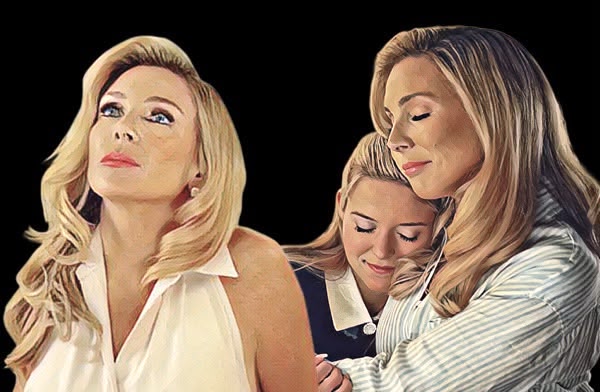
In the end, I think the main criticism leveled against the series also turns out to be its greatest strength. Yes, Elle is built on clichés. Its romances are predictable, its conflicts familiar, and its teenage dramas remain far removed from the social and cultural realities that defined that generation. But perhaps that is because Elle is not interested in recreating the real 1990s. It is interesting to recreate our emotional memory of the 1990s.
The songs, the posters, the clothes, the pop culture references, the teen romances, and the fantasy of a youth that never quite existed in the way we remember it. It is a carefully assembled collection of clichés designed to provide comfort. And honestly, I’m not entirely sure Elle Woods would want it any other way.
After all, ignoring the world’s complexities to keep believing in your own brilliance may always have been her greatest talent.
Descubra mais sobre
Assine para receber nossas notícias mais recentes por e-mail.

