
When Dwayne “The Rock” Johnson landed in Rio de Janeiro this week to promote the live-action adaptation of Moana, the visit lasted only a few days. There was a press conference, a special event for guests at Ilha Fiscal, interviews, and a brief stay in the city before the actor continued to the next stop on Disney’s global promotional tour. Even so, his presence in Brazil marked the final chapter of a journey that began more than three years ago and, since its announcement, has generated as much skepticism as anticipation.
After all, Moana may be the most unlikely project Disney has ever chosen to remake as a live-action film.
When the studio officially announced in April 2023 that it would transform the 2016 animated feature into a live-action production, the initial reaction was one of bewilderment. The original film had been released only seven years earlier, remained one of the most-streamed titles worldwide, and continued to occupy a prominent place in the imagination of children and families around the globe. In truth, there had never been a moment when Moana had disappeared from popular culture.
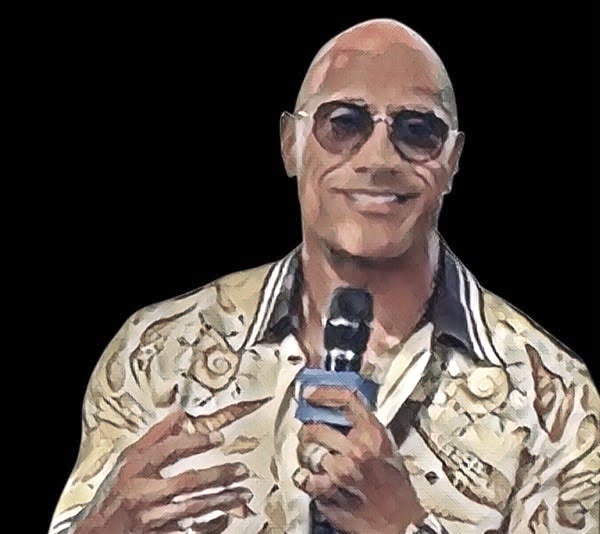
It was Dwayne Johnson himself who announced the project. In a video recorded in Hawaii and surrounded by family members, he revealed that he would return as Maui, the character he had voiced in the original animated film and who, according to Johnson, had always represented a tribute to his maternal grandfather, the legendary Samoan wrestler and community leader Peter Maivia. From that first announcement, it was clear that this would not be just another Disney remake for Johnson.
A few months later, Disney hired Thomas Kail to direct the project. The choice surprised Hollywood: Kail was known primarily for the theatrical phenomenon Hamilton and had never directed a narrative feature film for cinema. The decision suggested that the studio intended to preserve not only the adventure of the original story, but also its emotional and musical dimensions.
The production, however, faced its first major obstacle during Hollywood’s writers’ and actors’ strikes in 2023. The original schedule had to be postponed, auditions were interrupted, and the release date was ultimately moved from June 2025 to July 2026.
At the same time, Disney faced another challenge: finding a new Moana.
The role ultimately went to Catherine Laga’aia, a young Australian actress of Samoan descent who, until then, had very limited on-camera experience. The casting process involved more than 32,000 candidates and, according to the actress herself, included several rounds of auditions held between Australia and the United States. When she learned she had been cast, Catherine was only 17 years old. Now, at 19, she is making her debut in one of the largest film productions in the world.
The casting also brought an important change from the original film: Auli’i Cravalho, who voiced Moana in the 2016 animation, chose not to reprise the role and instead became an executive producer on the project. The decision was celebrated by the actress herself, who said she believed a new generation should have the opportunity to represent Moana on screen.
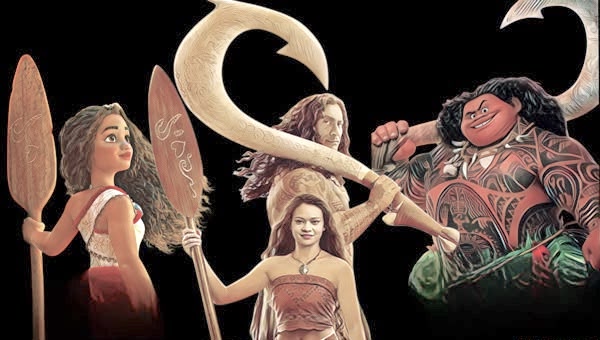
Filming officially began in July 2024, split between studios in Atlanta and locations in Hawaii, and concluded in November of the same year. The goal was ambitious: to recreate on a real-world scale not only the islands and ocean from the original film, but also the mythological dimensions of Polynesian culture that helped transform the animated feature into a global phenomenon.
Throughout production, several creative decisions attracted attention from fans. Some characters returned with new performers, while others were redesigned for the live-action format. The screenplay remained close to the original story, while the soundtrack once again brought together key collaborators from the franchise, including Lin-Manuel Miranda as a producer and musical consultant.
But perhaps the greatest transformation happened to Dwayne Johnson himself.
During his visit to Rio, the actor repeated something he has been saying throughout the global promotional campaign: physically portraying Maui was far more difficult than simply lending his voice to the character. For the first time, he had to sing, dance, and emotionally inhabit a character who, for nearly a decade, had existed primarily in his imagination. “It was much more challenging than I expected,” he admitted.
Johnson also emphasized during the press conference the importance of Polynesian representation in a production of this scale and said that Maui has come to represent, for him, a more mature vision of masculinity: someone who is strong, but also vulnerable; powerful, yet deeply shaped by his own fragilities.
There is an interesting irony to this story.
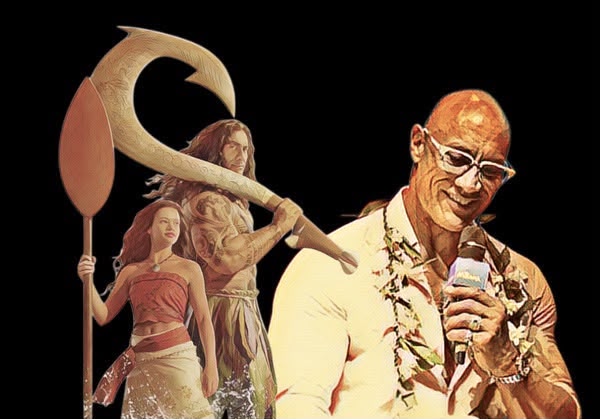
When Disney announced a live-action Moana, many considered the decision premature. Today, however, it may be easier to understand what the studio saw before everyone else: Moana was never a work from the past that needed to be rediscovered. It simply never stopped existing.
And perhaps that is precisely why Dwayne Johnson — after superheroes, billion-dollar franchises, disaster movies, and impossible car chases — ultimately found in Maui not merely a character, but the most personal role of his entire career.
Descubra mais sobre
Assine para receber nossas notícias mais recentes por e-mail.

