
With spoilers for House of the Dragon Season 3.
Lady Jeyne Arryn is no longer just a name mentioned in passing in House of the Dragon. The Lady of the Vale, who plays an important political role in Fire & Blood, now returns to the center of the story as an uncomfortable ally for Rhaenyra Targaryen — and perhaps as one of the most dangerous pieces on the Blacks’ board.
In the book, Jeyne’s position is clearer. She rules the Vale, one of the most protected regions in Westeros, and supports Rhaenyra not only out of loyalty but also because of blood, convenience, and political calculation. Rhaenyra is the daughter of Aemma Arryn, which gives her a direct connection to House Arryn and to the Vale. But, as almost everything in Westeros proves, blood does not mean automatic obedience.
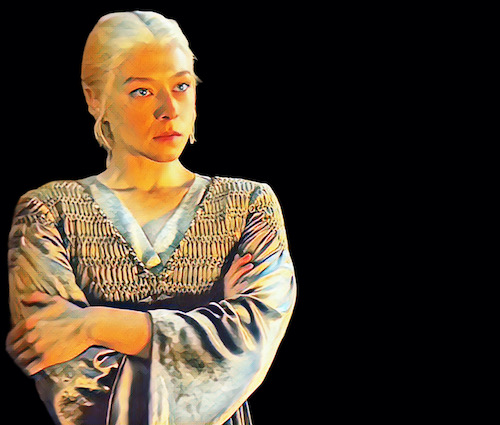

In the series, Lady Jeyne has been written more ambiguously. She never felt like a warm or fully committed supporter of Rhaenyra. From the moment Rhaenyra sent Rhaena Targaryen to the Vale with her youngest sons, Aegon and Viserys, the arrangement seemed fragile. The Eyrie was supposed to function as a safe refuge. Rhaena was not there merely as a companion. She had been given an enormous responsibility: to protect the princes, the dragon eggs, and, in a sense, the future of House Targaryen.
Jeyne’s reaction, however, was never exactly enthusiastic. The Lady of the Vale expected military support, real protection, perhaps even the presence of a dragon capable of intimidating her own enemies. What she received was a young Targaryen without a mounted dragon, two small boys, and a delicate mission being treated almost as a matter of hospitality. From the beginning, the show suggested that Jeyne was not willing to take risks only out of devotion to Rhaenyra’s cause.
That is where the situation becomes more complicated. Jeyne did not deliver exactly what had been promised. Nor does she seem to have kept Rhaenyra fully informed. The queen’s sons, who were supposed to be under her protection in the Vale, are no longer there. Rhaena, who was supposed to accompany and guard the princes, has also taken another path. And Sheepstealer, the wild dragon who belongs to Nettles’ story in the book, has now been folded into Rhaena’s arc in the series, completely changing the political and emotional weight of her absence.


Now Daemon arrives in the Vale on Rhaenyra’s orders to confront Lady Jeyne Arryn. In theory, the mission is simple: demand that the promised support finally be delivered, even if that support now comes in the form of money. In practice, it is one of the worst possible choices. Daemon is hated in the Vale. He was married to Rhea Royce, whose death still hangs over him, and his presence before Jeyne Arryn does not feel diplomatic. It feels provocative.
That is why Rhaenyra’s decision feels less like a strategy and more like a narrative necessity. Daemon has to go to the Vale because the story needs him to discover certain things there. It needs him to learn that the princes sent for Jeyne’s protection are no longer where they should be. It needs to place him on the path toward the revelation that his daughter’s choices contributed to the chain of events that led to Jacaerys’ death. And it needs to bring him closer to Rhaenyra’s grief, now transformed into a desire for punishment.
All of that may be dramatically important, but the political stitching is fragile. Daemon goes because the plot needs him to go, not because the decision makes sense on the Westerosi board.
And that is the real bomb in this storyline. Rhaenyra sent her sons to the Vale because she believed they would be safe. But if the princes are no longer there, then someone made decisions without the queen’s knowledge, or without her ability to stop them. That moves Lady Jeyne from the margins of the story to the center of the crisis. She is no longer simply the Lady of the Vale who promised support. She becomes the failed, silent, or calculating guardian of an agreement that involved the future of the Targaryen dynasty.

In the book, Jeyne Arryn has a more direct political importance. In the series, her role has been more obscure, but perhaps that is exactly what makes her dangerous. She is not an obvious villain, nor is she a reliable ally. She is a ruler protecting her own interests in a war that did not begin in the Vale, but has now arrived at her gates. And if Rhaenyra expected automatic obedience because of blood ties and old promises, she may be about to discover that no great house in Westeros moves only out of gratitude.
Daemon’s arrival may finally clarify what Jeyne did, what she hid, and how far she is willing to go to preserve the Vale. But it also exposes another flaw in Rhaenyra’s politics. If the queen needed to pressure a delicate ally, why send the man most hated by that court? If she needed to guarantee her children’s safety, why did it take so long to realize they were no longer where they were supposed to be? And if Rhaena abandoned her mission, how did no one notice sooner?
Lady Jeyne Arryn, then, returns to the story not only as a doubtful ally but as a symptom of a larger problem. Rhaenyra has the crown, the dragons, and a legitimate claim. But her alliances look fragile, her information arrives too late, and her envoys do not always make sense. In the Vale, Daemon will not find only a debt to collect. He will find the consequences of a war that the Blacks thought they controlled better than they actually did.
Descubra mais sobre
Assine para receber nossas notícias mais recentes por e-mail.


1 comentário Adicione o seu