
Bonnie Tyler has died at 75, taking with her one of those voices that needed no introduction. All it took was the first rough, dramatic, almost desperate note to recognize the Welsh singer who turned “Total Eclipse of the Heart” into one of the great sentimental anthems of the 1980s.
The artist, born Gaynor Hopkins on June 8, 1951, died on July 8, 2026, in a hospital in Portugal, the country where she spent part of the year, in the Algarve. According to a statement published on her official website, her death happened unexpectedly, as a result of the illness for which she had been receiving treatment. In May, Bonnie had undergone emergency intestinal surgery in Faro, was placed in an induced coma, and, although she later came out of the coma, she remained very unwell and in intensive care.

It is a farewell that feels strangely in tune with her most famous song. Bonnie Tyler will forever be remembered for a song about excess, loss, passion, and darkness. “Total Eclipse of the Heart,” released in 1983, was not just a romantic ballad. It was almost a pop opera. It had the grandiosity of Jim Steinman, the songwriter associated with Meat Loaf’s theatrical universe, and it had Bonnie’s voice, which seemed to sing every line as if standing at the end of the world.
The song reached number one on the charts in both the United Kingdom and the United States, became a hit in several countries, and gained a gothic, strange, and unforgettable music video, played endlessly in the early years of MTV. There was wind, corridors, glowing eyes, students in the atmosphere of a romantic nightmare, and Bonnie at the center of it all, like a melodramatic heroine with teased hair and a wounded voice. Four decades later, the song kept coming back to life: in karaoke bars, soundtracks, memes, parties, solar eclipses, and playlists made by people who may not even have been born when it was released.
That husky voice, in fact, came from an accident of fate. After surgery to remove nodules from her vocal cords in 1977, Bonnie did not rest as she should have. She screamed during her recovery, prolonged the healing process, and acquired that raspy tone that could have been a problem, but became her signature. Instead of softening the difference, she turned it into a trademark.
Before “Total Eclipse of the Heart,” Bonnie had already found success with “Lost in France” and, especially, “It’s a Heartache,” a country-rock-leaning song that took her to the international charts in the late 1970s. But it was when she began working with Jim Steinman that her career found the theatrical scale that seemed to have been waiting for her. He saw in that voice something that had not yet been fully explored. He was right.
Other important moments followed. “Holding Out for a Hero,” released on the “Footloose” soundtrack, became another absolute classic, one of those songs that cross generations because they seem to demand a scene of running, courage, or redemption. Bonnie also recorded the original version of “The Best” before Tina Turner transformed the song into one of her greatest anthems. Bonnie herself would later admit, with the frankness that also made her so beloved, that Tina did it better.
That simplicity may help explain part of her staying power. Bonnie Tyler had a huge voice, but she never seemed to behave like someone unreachable. In interviews, she spoke about her career, marriage, failures, successes, and scares with a naturalness rarely seen in artists associated with songs so monumental. In 2023, she was appointed MBE for her services to music, an official recognition of a career that had long since been consecrated by the public.
Her relationship with Brazil had a special curiosity. Although her songs had been known there for decades, Bonnie took a long time to perform in the country. Her most recent visit — and, by all indications, the great Brazilian memory of her concerts — took place in November 2022, when she arrived with a South American tour postponed because of the pandemic. There were eight concerts in Brazil: Tubarão, Florianópolis, Curitiba, São Paulo, Porto Alegre, Rio de Janeiro, Goiânia, and Salvador. After that, the singer went on to Montevideo, Uruguay.
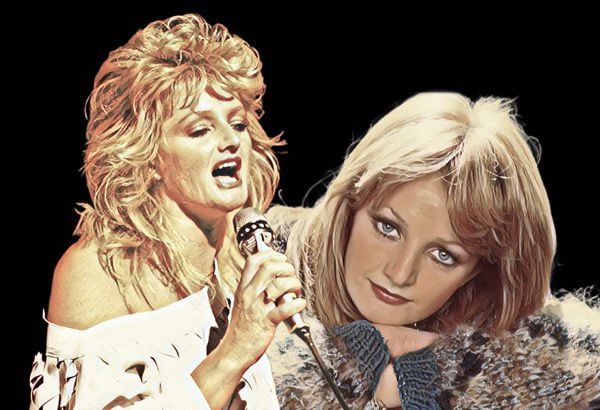
For Brazilian audiences, there was another layer of affection: in 1987, Bonnie recorded “Sem Limites pra Sonhar” with Fábio Jr., a Portuguese-language version of “Reaching for the Infinite Heart.” The duet helped bring her voice closer to a generation that already knew her from the radio, but began to associate her also with Brazil’s romantic repertoire. It was Bonnie Tyler entering, in another way, the country’s sentimental soundtrack.
In recent years, she remained active. She released “The Best Is Yet to Come” in 2021, kept a concert schedule, and still seemed willing to sing her biggest hits without treating them as a burden. She used to say she never got tired of “Total Eclipse of the Heart,” perhaps because she understood that some songs eventually stop belonging only to the artist. They begin to belong to the people.
Bonnie Tyler is survived by her husband, Robert Sullivan, to whom she had been married since 1973, and by a body of work marked by intensity, theatricality, and permanence. Not every artist has a song that crosses decades without aging. Even fewer manage to turn a wounded voice into destiny. Bonnie did both.
In the end, her greatest hit still sounds like a farewell no one wanted to hear now. A total eclipse of the heart, yes. But also a light that insists on returning.
Descubra mais sobre
Assine para receber nossas notícias mais recentes por e-mail.
 miscelana.com