
Warning: this article contains spoilers for House of the Dragon and Fire & Blood.
In a series accustomed to announcing its biggest twists with dragons, battles, and severed heads, one of the most important revelations of House of the Dragon’s third season happened over a dress that would no longer fasten.
Alicent approaches her daughter, notices her belly, and says only her name: “Helaena?” Nothing more needs to be explained. The former queen immediately understands that Helaena is pregnant and, more importantly, understands the danger surrounding that child.
The series has yet to confirm the baby’s sex or name. Everything suggests, however, that we will finally meet Maelor Targaryen, the third child of Aegon II and Helaena, whose absence from Blood and Cheese prompted George R. R. Martin’s harshest criticism of the adaptation.
This is not simply the belated arrival of yet another Targaryen prince. It is an attempt to correct a change that threatened to dismantle several future tragedies.

The correction that cannot erase Blood and Cheese
Since 2024, I have argued that removing Maelor was not the same as cutting a child with no dialogue or trimming another branch from the complicated Targaryen family tree. Maelor is small, but his existence connects Helaena, Daeron, Rhaenyra, Alicent, and the people of King’s Landing.
In the book, Helaena and her three children are ambushed by Blood and Cheese. The assassins demand that she choose which of her sons must die: Jaehaerys, the heir, or Maelor, the youngest. Desperate, Helaena points to Maelor, probably believing he is too young to understand what is happening.
Blood kills Jaehaerys anyway. Before leaving, Cheese tells Maelor that his own mother had chosen him to die.
The violence is not limited to the beheading. It lies in the psychological sentence imposed on Helaena: she loses one son and must continue living with the other, knowing that, for a few seconds, she offered his life in exchange for his brother’s.

In the series, Maelor did not exist. Blood and Cheese did not force Helaena to choose which child should be sacrificed; they merely demanded that she identify which of the twins was the boy. She correctly pointed to Jaehaerys and fled with Jaehaera while the men began killing him.
The scene remained brutal. As I wrote at the time, Helaena endured a second trauma when, while searching for help, she found Alicent with Criston Cole. The family’s complete helplessness was also exposed: Aegon ignored his wife, the Kingsguard failed to protect the heirs, and no one seemed to remember that the Red Keep was filled with secret passages.
But Maelor’s absence eliminated the impossible choice. George R. R. Martin praised the strength of Phia Saban’s performance and even considered the show’s Helaena a richer character than the one he had created, but he warned that there was much to say about “Maelor the Missing.” He later explained that he considered Helaena’s choice the most visceral element of Blood and Cheese.
The pregnancy cannot repair that. Maelor will arrive too late to be part of that night, and the show’s Helaena will never carry the guilt of having chosen him.
What a pregnancy can do is prevent the mistake from continuing to multiply. More than that, it creates an opportunity to preserve the larger tragedy still to come while adding new and even more painful details—which is, after all, the Game of Thrones signature.

The solution Ryan Condal had promised George R. R. Martin
According to Martin, Condal assured him that Maelor would not be eliminated, only postponed. Helaena could become pregnant at the end of the second season and give birth during the third. The author accepted the solution because it would preserve at least the most important future consequences.
The problem arose when Martin learned that the plan had changed again and Maelor would not be born at all. He then published the subsequently deleted post “Beware the Butterflies,” warning about the butterfly effect of the decision. Without Maelor, Bitterbridge, Daeron’s revenge, Helaena’s death, and the uprising that marks the beginning of the end of Rhaenyra’s rule in King’s Landing would all have to be removed or substantially altered.
The third season appears to have returned to exactly the arrangement Condal originally presented to the author: Helaena became pregnant before Aegon was gravely wounded and will give birth to Maelor during Rhaenyra’s occupation of King’s Landing.
It is a late correction. But it is also a silent admission that Martin was right: this child could not simply disappear.
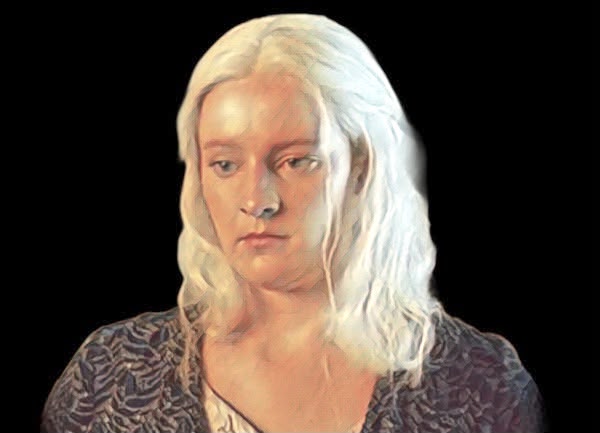
Helaena and Rhaenyra have finally become characters in the same story
Indirectly, they were united by the same grief. Lucerys was killed by Aemond, Helaena’s brother, even though she bore no responsibility for it. Jaehaerys was killed by men hired by Daemon, Rhaenyra’s husband, even though Rhaenyra had never ordered the child’s death. Two mothers lost sons because of decisions made by the men around them, and came to represent opposing sides of a cycle of vengeance neither woman had begun.
The third season finally broke that silence.
Alicent surrendered King’s Landing, believing she would be able to escape with Helaena and give her daughter a chance to be happy. The plan failed. Both women were captured and brought before Rhaenyra after Otto Hightower’s execution.
In the following episode, Helaena finally spoke directly to her half-sister. Their first conversation was not about affection, family, or reconciliation. Helaena asked whether Rhaenyra felt better after having Otto killed.
It is a simple and devastating question because it strikes directly at the mechanism of war: Does revenge truly ease any pain?
Rhaenyra lost Jace and wanted the death of the man she considered responsible. Helaena lost Jaehaerys and knows that no execution will bring her son back. When she asks whether killing Otto made Rhaenyra feel better, she is not merely defending her grandfather. She is asking the question she understands personally: how many more people must die before anyone finally feels avenged?
The sisters who never had the opportunity to know each other finally meet when they are already separated by dead children, different fathers, rival crowns, and far too much blood.

Helaena is no longer merely the silent victim
In my earliest articles, Helaena appeared primarily as the sweetest and most passive character in a monstrous family. She was a daughter ignored by Viserys, politically exploited by Alicent and Otto, married to a brother who despised her, and destined to pay for the crimes of men who rarely listened to her.
All of that remains true, but the series has expanded the character.
The Helaena of Fire & Blood is cheerful, gentle, loved by the people, and passionate about flying Dreamfyre. She does not possess the adaptation’s peculiar behavior or prophetic gift. Those characteristics originated in the writers’ room, and Martin himself acknowledged that they made her a more fascinating character.
In the second season, Helaena refused to ride Dreamfyre into war alongside Aemond. In the third, she noticed Alicent’s anxiety and revealed something no one else dared to admit: Aemond fears Rhaenyra and will die if he confronts her. The warning led Alicent to seek out Ormund Hightower.
Helaena still does not control her own destiny, but she is no longer an entirely passive presence. She sees what others cannot, refuses to participate in violence, and confronts Rhaenyra with the futility of revenge.
The most tragic aspect is that seeing the future does not give her the power to change it.
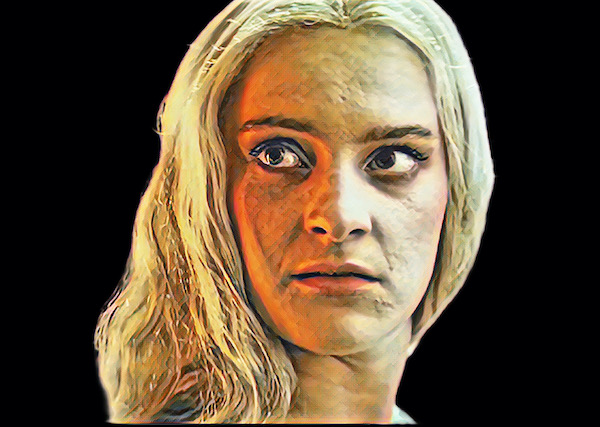
Is the baby Aegon’s or Aemond’s?
The pregnancy has inevitably revived one of the series’ most popular theories: the possibility that Aemond is the true father of Helaena’s children.
Before the second season, I collected eight clues cited by fans. Aemond showed Helaena more kindness than he offered anyone else, defended his sister when Aegon called her strange, appeared bothered while she danced with Jacaerys, and said he would gladly perform his duty had Alicent married him to Helaena instead.
There was also the provocation created by Blood and Cheese: if Aemond killed Lucerys, why would “a son for a son” mean killing Aegon’s child? The theory that Jaehaerys was biologically Aemond’s son made the revenge symmetrical and dramatically irresistible.
Later developments, however, significantly weakened that romantic interpretation. After Jaehaerys’s death, Aemond showed little sensitivity toward his sister’s grief. Later, he demanded that she mount Dreamfyre and join the war. Helaena refused. Their relationship became defined less by desire than by power, fear, and prophecy.

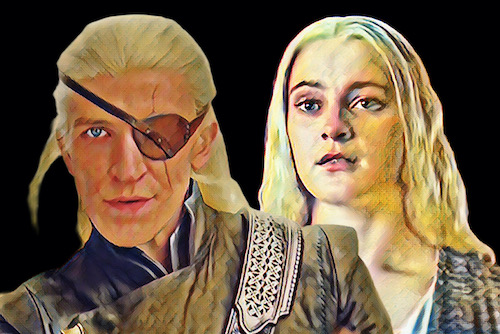
The pregnancy makes the theory seductive once again, but Aegon remains the most likely explanation.
Their marriage was cold, unhappy, and probably involved only occasional intimacy, but that does not mean they never had sex. The series has also not confirmed how far along Helaena is. Her visible belly suggests approximately five or six months, but that remains only an estimate.
The chronology allows the baby to have been conceived before Rook’s Rest, where Aegon suffered the injuries that left him physically and emotionally devastated. There is therefore no need to invent a secret relationship with Aemond to explain the pregnancy.
That does not prevent House of the Dragon from choosing to make such a change, of course. It only means that, for now, this remains a popular theory rather than a revelation.
Why the baby represents an immediate threat
Should the baby be a boy and be acknowledged as Aegon’s son, Maelor will become the new heir to the Greens’ claim. He will stand ahead of Aemond and Daeron in the line of succession defended by their faction.
Rhaenyra is already dealing with Aegon’s disappearance, Aemond at Harrenhal, and Daeron being manipulated by Ormund. Now, inside the Red Keep itself, another prince may be born with a direct claim to the throne. And unlike Joffrey, this child will not live under the shadow of illegitimacy.
Helaena’s reaction to being discovered suggests that she understands the risk. After seeing Jaehaerys murdered because he was Aegon’s son and heir, she knows that another child will never be regarded as simply her baby.
He will be an heir, a hostage, a threat, or a bargaining tool before he is even born.

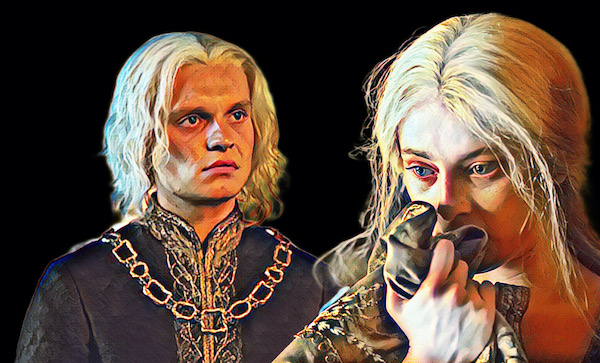
Maelor’s fate in the book
After the fall of King’s Landing, the Greens attempt to remove Helaena’s surviving children from the city. Maelor is taken toward Oldtown under the protection of Ser Rickard Thorne, but he is recognized at Bitterbridge.
A crowd gathers, and the child dies amid the chaos. As with almost everything in Fire & Blood, the accounts of what happened vary, but none is any less horrifying. Maelor is torn apart by collective violence and ceases to be a child, becoming a political symbol instead.
Daeron responds by attacking Bitterbridge. Helaena, already destroyed by Blood and Cheese, learns that she has lost a second son. Not long afterward, she falls from a window in Maegor’s Holdfast and dies at the age of 21.
Her death provokes widespread outrage. Rumors spread that Rhaenyra ordered her murder, and the uprising contributed to the collapse of the queen’s control over King’s Landing. Some versions even claim that Mysaria pushed her to her death. The truth ceases to matter. To the people, Helaena was the gentle queen who lost two sons while under the power of her half-sister.
Maelor, therefore, is not important because of anything he does. He is important because of everything his death causes.

The series corrected the future, but not the past
Helaena’s pregnancy is an intelligent solution because it works within the story constructed by the adaptation. The baby may have been conceived before Rook’s Rest, may be born during Rhaenyra’s occupation, and may become an even more immediate threat than he was in the book.
It also adds a new layer to the tragedy. Helaena is trapped in the city ruled by her half-sister, Aegon is missing, and Alicent no longer possesses the authority to protect her. Maelor will be born in the worst place, at the worst moment, under the watch of people who understand exactly how much political value a Targaryen boy carries.
But acknowledging that the solution works does not mean erasing the earlier mistake. Maelor can never restore the choice removed from Blood and Cheese. Helaena will not have to look at her youngest son knowing that she offered him up to die, and that specific guilt—central to the book—has been lost.
The third season did not prevent Blood and Cheese, but it prevented one bad decision from also destroying Bitterbridge, Daeron, Helaena, and Rhaenyra’s downfall.
In 2024, I said that I could not believe House of the Dragon would remove such an important passage. For a while, it seemed that I had been wrong. Fortunately—or unfortunately, considering what this means for Helaena—Maelor is coming.
And we are now officially guaranteed many tears.
We will be crying too.
Descubra mais sobre
Assine para receber nossas notícias mais recentes por e-mail.
 miscelana.com