
When we think of The Odyssey, it is natural to imagine a great adventure about a man trying to return home after a war. Odysseus crosses storms, faces monsters, resists seductions, visits the world of the dead, and spends years trying to reunite with Penelope, Telemachus, and the island of Ithaca.
From the perspective of Carl Gustav Jung’s analytical psychology, however, this journey can be understood in another way. Odysseus does not travel only across seas and islands. He travels through regions of his own psyche.
Each character he encounters seems to present a different possibility of existence. The Cyclops reveals a life governed by narcissism and the absence of limits. Circe threatens to transform men into animals. Calypso offers an eternal happiness that would require abandoning the real world. The Sirens promise an absolute knowledge capable of destroying anyone who hears it. Athena guides, Penelope waits, Telemachus searches for his father, and the dead demand to be acknowledged before the journey can continue.
The richness of The Odyssey lies precisely in the fact that none of these characters needs to be understood only as someone Odysseus encounters outside himself. Each one also represents something he must encounter, confront, and integrate within himself.
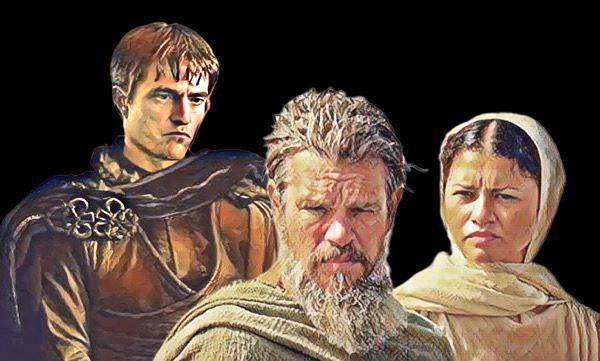
Archetypes are not ready-made characters
Jung used the concept of the archetype to describe universal patterns that structure human experience. This does not mean that there is a collection of mythological characters living inside us, waiting to appear. The archetype is not a ready-made image, but a tendency of the psyche to create certain images, stories, and conflicts.
The hero, the mother, the wise old man, the shadow, the child, and the figure of the guide appear in very different mythologies because they represent fundamental human experiences. We all need to leave somewhere, face what threatens us, abandon certain illusions, and construct an identity capable of holding our contradictions.
The images change according to culture and time, but the psychic movement remains recognizable.
For this reason, Jung would not treat Odysseus merely as a Greek man lost at sea. He could be understood as a representation of the ego setting out toward the unknown and, throughout the journey, having to establish a relationship with unconscious contents it cannot control.
This process is close to what Jung called individuation.
The journey as a process of individuation
Individuation is the process through which a person progressively becomes what they are. It does not mean achieving perfection, eliminating conflict, or constructing a completely harmonious personality. It means recognizing that we are shaped by contradictory forces and establishing a more conscious relationship with them.
At the beginning of the journey, Odysseus relies mainly on his intelligence. He is the man of strategy, calculation, and language. It was his cunning that created the Trojan Horse and contributed to the Greek victory. At sea, however, his intelligence is no longer enough.
He must understand that he does not control time, the gods, the desires of his companions, the movements of nature, or the consequences of all his choices.
This is one of the first wounds life inflicts on the ego. We may plan, predict, and organize, but we remain subject to forces that do not obey our will. For Jung, the unconscious is one of those forces. It is not merely a repository of repressed contents. It also contains possibilities, images, and aspects of the personality that consciousness has not yet recognized.
Odysseus’s journey can be read as the gradual encounter between an ego that believes it knows its path and a psychic world far larger than itself.
The sea and the experience of the unconscious
On land, Odysseus usually knows where he is. At sea, he is carried by storms, currents, and divine decisions. His fate no longer depends exclusively on his own will.
The sea can be understood as an image of the unconscious precisely because it dissolves boundaries and threatens the stability of the ego. In it, Odysseus loses companions, direction, time, and identity. He is frequently forced to abandon what he believed he possessed.
The experience of the unconscious produces something similar. When dreams, symptoms, fantasies, fears, or unexpected desires arise, we discover that we are not entirely masters of our own house. There are inner movements that were not consciously chosen, yet still participate in our decisions.
Odysseus’s task is not to drain the sea or control it. It is to learn how to cross it without being completely destroyed by it.
The analytic process also does not offer the subject absolute control over the psyche. It allows a person to recognize the forces moving through them and to find less destructive ways of relating to them.
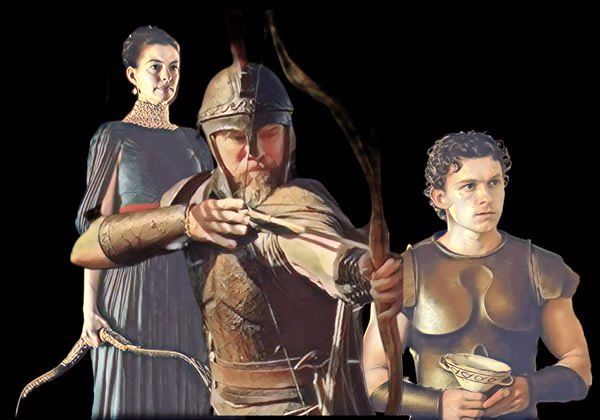
The Cyclops and the hero’s shadow
Polyphemus is one of the best-known figures in the story. The Cyclops lives in isolation, does not recognize the laws of hospitality, and devours the men who enter his cave. He has only one eye, as though he were incapable of accepting any perspective other than his own.
In a Jungian reading, Polyphemus can be associated with the shadow.
The shadow gathers aspects of the personality that the ego does not recognize or prefers to reject. It is not composed only of morally negative characteristics. It may also contain desires, aggression, creativity, strength, or vulnerability that a person has learned to exclude from their identity.
The problem arises when we believe that the shadow belongs only to the other.
Odysseus sees brutality, selfishness, and the absence of law in the Cyclops. After escaping, however, he too is overcome by pride. Although he survived by saying that his name was “Nobody,” he cannot bear to remain anonymous. He reveals his true name to receive recognition for his victory and, in doing so, provokes Poseidon’s revenge. Christopher Nolan’s film does not include this moment, but even after escaping, Odysseus still decides to wound Polyphemus once again.
The hero who defeats the monster reveals, in that moment, something of the same inability to restrain his own ego.
This is one of Jung’s most important ideas: what we do not recognize in ourselves tends to appear projected onto others. We see the arrogance, cruelty, or weakness of others with extraordinary clarity, yet remain blind when those same forces take different forms within us.
Odysseus does not need to defeat only the Cyclops. He needs to recognize the Cyclops within his own need to be admired.
Circe and repressed animality
Circe transforms Odysseus’s companions into pigs. The scene seems to materialize the fear that the human being might abandon consciousness and be governed only by instinct.
Jung did not believe that instinctual impulses should be eliminated. On the contrary, he believed that a consciousness excessively removed from the body, sexuality, aggression, and nature could become rigid and impoverished.
The problem is not having instincts. It is being possessed by them.
The men transformed by Circe lose their human form because they cease to maintain any distance from immediate gratification. They represent a regression to a state in which desire finds no mediation, language, or limit.
Circe, however, does not remain merely an enemy. After being confronted, she becomes a guide. She feeds the men, restores their form, and directs Odysseus toward the next stages of the journey.
The change is significant. An unconscious force initially experienced as a threat can become a source of knowledge once it is acknowledged. The instinct that dominated the subject begins to contribute to their orientation.
Jung called this movement integration. It is not a matter of destroying what seems dangerous, but of establishing a conscious relationship with that energy.
Calypso and the fantasy of not having to change
Calypso offers Odysseus something apparently irresistible: love, protection, and immortality. He could remain on her island forever, preserved from aging, loss, and death. Even so, he wishes to return to Ithaca.
Calypso’s offer represents a deeply human fantasy: the possibility of suspending time and living in a place where nothing needs to change. It would be an existence without separation, without risk, and without the need to face what was left behind. Yet a life without loss would also be a life without transformation.
Odysseus chooses to return to a mortal woman, to a son who grew up without him, and to a kingdom that may no longer recognize him. He chooses time, finitude, and uncertainty.
From Jung’s perspective, individuation requires the subject to abandon certain fantasies of completeness. There is no final condition in which all our lacks will be filled. Maturity begins when we stop searching for a life without conflict and begin to build a possible relationship with reality.
Calypso does not represent pleasure alone. She represents the temptation not to continue the journey.
The Sirens and the seduction of the absolute
The Sirens do not promise pleasure alone. They promise knowledge. Their song seems to offer man the possibility of knowing everything, understanding everything, and finally eliminating doubt. That promise is deadly.
Odysseus wants to hear them, but he knows he will not be able to trust himself once he falls under the spell of their song. He therefore orders his men to tie him to the mast and not release him, even if he begs.
The scene reveals a profound psychic truth: knowing the danger does not make us immune to it. Consciousness has limits. We may understand perfectly well that a certain desire, relationship, or behavior harms us and still remain attracted to it.
The mast represents an external structure capable of protecting the subject when willpower fails. It may be a law, a commitment, a bond, a routine, or analysis itself.
Odysseus does not deny his desire to listen. Nor does he blindly trust his own ability to resist. He recognizes his vulnerability and creates a limit.
From a psychological point of view, this gesture may be more mature than any display of strength.
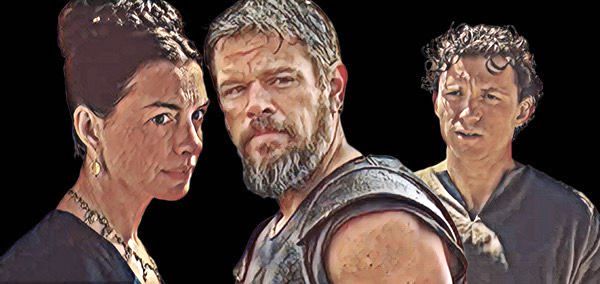
The descent into the world of the dead
Before returning, Odysseus must visit Hades. He encounters dead companions, listens to Tiresias, and speaks with his own mother, whose death he did not know about. In the film, once again, it is different. No journey of transformation would be complete without an encounter with what has been lost.
For Jung, the plunge into the unconscious frequently appears symbolically as a descent. The subject must enter dark regions, temporarily abandon the safety of consciousness, and encounter contents they would rather keep at a distance.
The descent into the world of the dead can also be understood as an image of mourning. The past does not disappear simply because time has passed. The people, relationships, and versions of ourselves that no longer exist continue to occupy places in psychic life. Odysseus does not resurrect the dead. He speaks with them.
That distinction is essential. Working through a loss does not mean undoing what happened or recovering what existed before. It means allowing the experience to find a place in the subject’s history so that it no longer governs them silently.
Only after listening to the dead can Odysseus continue toward the living.
Athena and the function of the guide
Athena accompanies Odysseus and Telemachus, changes appearances, advises, protects, and creates opportunities. She does not prevent them from suffering, but helps them cross situations they still cannot understand on their own.
Athena can be associated with the archetype of the guide or of wisdom. She represents a psychic function that offers orientation when the ego is lost.
In analysis, this function does not belong exclusively to the analyst. The analyst may help the subject hear something they were not yet able to formulate, but should not decide their path. The deepest orientation must gradually become internal.
Athena also does not eliminate conflict. She offers the means to confront it.
Wisdom, in this sense, does not consist of having all the answers. It consists of recognizing the moment to speak, to wait, to hide, to act, or to accept that action is not yet possible.
Penelope and the work of elaboration
Penelope is usually remembered as the wife who remained faithful during her husband’s absence. Her function in the narrative, however, is more active and complex.
She weaves during the day and unravels her work at night to delay marriage to one of the suitors. By doing so, she creates time. She does not accept Odysseus’s death, but neither does she surrender completely to the illusion that nothing has changed.
Her weaving can be understood as an image of psychic work. To elaborate an experience means constructing a narrative, undoing it, and constructing it again. The subject returns repeatedly to the same event because they are still trying to find a way to integrate it.
Penelope is not simply waiting. She is working with an absence.
When Odysseus finally returns, she does not recognize him immediately. She must test him through the secret of the bed built around an olive tree. Only shared memory can confirm his identity.
The reunion, therefore, does not happen because everything remained the same. Odysseus and Penelope must recognize what survived the transformations they both underwent.
This may be the true meaning of returning home: not recovering intact what once existed, but discovering what can still be recognized after change.

Telemachus and the construction of identity
Telemachus grew up in the shadow of an absent father. At the beginning of the narrative, he is still unable to occupy his place fully within his own house. The suitors consume his inheritance, pressure his mother, and treat the young man as someone incapable of reacting.
His search for Odysseus is also a search for himself.
In psychology, the father is not only a concrete person. He also represents origin, transmission, belonging, limit, and authority. Telemachus needs to construct an image of his father to understand what he received from him and what he will need to create on his own.
His maturation, however, begins before the reunion. He travels, questions witnesses, faces risks, and begins to speak in his own name.
This shows that finding the father does not mean remaining childishly dependent on him. A true inheritance must be transformed. The son does not become an adult by repeating the father, but by deciding what to do with what he received, including the absences and failures left behind.
Ithaca and the encounter with the Self
In Jungian psychology, the Self represents the totality of the psyche. It is not the ego, but a broader center that includes consciousness and the unconscious. The process of individuation brings the subject closer to that totality, although it can never be completely mastered or known.
Ithaca can be seen as an image of the Self, provided it is not understood as a perfect place to which Odysseus simply returns.
The island he finds is not the same one he left. His house has been occupied, his son has become an adult, his father has grown old, and his wife has learned to live with absence. He himself arrives in disguise, transformed by the experiences he has crossed.
Return requires recognition. Odysseus must discover who he still is, who the others have become, and what place he may now occupy.
This is the difference between returning and repeating.
Individuation does not take us back to an original, pure, and untouched identity. It allows us to construct a broader relationship with our history, including everything we would rather exclude: our losses, desires, contradictions, fears, and failures.
Odysseus does not return because he managed to remain the same. He returns because he survived the experience of becoming someone else.

The monsters are not only outside
A Jungian reading of The Odyssey does not turn every character into a diagnosis, nor does it reduce mythology to a psychological manual. Its strength lies in showing that myths offer images for experiences that remain difficult to name.
We all cross seas we cannot control. We encounter Sirens who promise definitive satisfaction, islands on which we would like to remain so that we do not have to confront time, and shadows we recognize easily in others but rarely in ourselves.
We also need to speak with our dead, undo and remake narratives, abandon certain fantasies, and discover what it means to return to a home that is no longer the same.
Odysseus spends years searching for Ithaca, but his journey is not merely an attempt to recover the past. It is the process through which he becomes capable of inhabiting his own life again.
Perhaps that is why The Odyssey remains so close to the analytic experience. In both cases, the subject initially believes they are searching for a path back to the place from which they departed. Gradually, they discover that the true journey is learning how to recognize the person who is returning.
Descubra mais sobre
Assine para receber nossas notícias mais recentes por e-mail.

