
“He’s avoidant.” “I have anxious attachment.” “My mother is a narcissist.” “I’m repeating a trauma.” We have never talked so much about mental health, toxic relationships, defense mechanisms, and childhood wounds. On some level, this is a positive development. The more we can name our pain, the less we need to hide it as a personal defect or moral failure.
The problem begins when concepts created to investigate human complexity are turned into instant answers. The supposed psychoanalysis of social media is, in many ways, the antithesis of analytic work: it offers definitions before any real investigation has even begun.
Everything can be explained in a matter of minutes. You are suffering because you have a particular attachment style. He disappears because he fears intimacy. You struggle to set boundaries because of trauma. Your romantic difficulties began with your parents’ emotional absence.
Perhaps this is true. But it may also be wrong—or represent only one part of a much more complex story.
The Seduction of Finding an Answer
It is natural to look for an explanation when something hurts. We want the pain to stop, preferably as quickly as possible. Finding a term that seems to describe exactly what we feel brings relief because it organizes the chaos. If the pain has a name, perhaps it also has a solution.
This is partly why attachment theory has become such a phenomenon. Developed in the 1950s by British psychiatrist and psychoanalyst John Bowlby, it proposes that our earliest experiences of care help shape what we expect from relationships. We learn very early whether other people are trustworthy, whether intimacy is safe, or whether depending on someone represents a risk.
On social media, a complex theory has been reduced to a collection of easily recognizable styles. Videos teach us how to identify our own and, above all, how to determine the attachment style of the person we are dating.

This popularization is not necessarily a bad thing. Someone may finally understand why an unanswered message causes so much distress. Another person may recognize a tendency to pull away precisely when they begin to care. The danger lies in turning that initial recognition into a definitive diagnosis.
Bowlby did not create a personality test, and attachment patterns are not fixed identities. They can vary from one relationship to another and change through new experiences. Someone may feel secure in a friendship and profoundly threatened in a romantic relationship. A person may also appear avoidant simply because they do not want that particular relationship.
Not every withdrawal is a fear of intimacy. Sometimes, it is a lack of interest.
The Work Begins Where the Definition Ends
Psychoanalysis would not be satisfied with concluding that someone runs from intimacy. It would ask what that intimacy represents to this particular person. Dependence? The risk of abandonment? Loss of freedom? The fear of being truly known and then rejected?
The visible behavior may look similar in different people. The unconscious history supporting it does not.
This is why analytic work requires time, willingness, and openness. Psychoanalysis does not offer a list of behaviors that will lead to a cure, nor does it provide a single explanation for the origin of every conflict. Before relieving certain forms of pain, it may bring us closer to older wounds carefully protected by the defenses we have built.
Freud understood that we do not repeat only what is good for us. We also recreate frustrating relationships and choices we swore we would never make again. Not necessarily because we want to suffer, but because what is familiar, however painful, may feel less threatening than what we have never experienced.
We may also repeat because of an unconscious fantasy that, this time, we will finally achieve a different ending: make the unavailable person choose us, persuade someone to stay, or transform a present relationship into the repair of everything that came before.
Knowing the name of the pattern does not interrupt the repetition. I may know everything about anxious attachment and continue desiring precisely the person who fuels my insecurity. Information can organize suffering intellectually without necessarily reaching what sustains it.
When Knowledge Becomes a Defense
There is also a certain narcissistic comfort in diagnosing someone else. Defining a person as avoidant may mean: I was not rejected; he is incapable of forming attachments. The explanation protects our self-image and shifts into a psychological category, something that should be examined as a relationship.
We begin researching how to deal with a particular “type” of person instead of asking why we remain in a relationship that does not offer what we want.
Understanding someone’s history does not oblige us to stay in a relationship that hurts us. Nor should we transform every absence into a symptom. In some cases, using a sophisticated theory merely helps us avoid a simple and painful truth: that person may not want to stay.
This is precisely where psychological trends on social media reveal their greatest contradiction. They offer recognition without necessarily requiring transformation. We discover the origin of the pattern, share a video about it, and continue repeating the same story.
The more a theory must be simplified to circulate, the greater the risk that it will stop functioning as a tool for understanding and become a trap. The concept that should open a question begins to close it.
Social media psychoanalysis says, “This is who you are.” Analytic work asks, “Why does this happen in this particular way to you?” The first answer offers an identity. The second returns the subject to their singularity—and also to some degree of responsibility for what continues to happen.
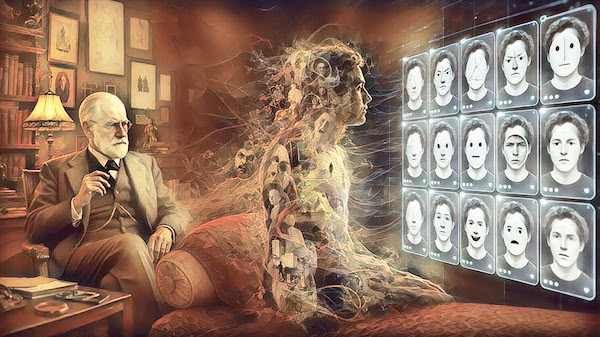
Attachment theory is useful when it functions as a map. It becomes dangerous when it turns into an identity, an excuse, or a sentence. Giving suffering a name may be the beginning of an investigation, but it should never be its endpoint.
Between recognizing a pattern and managing to stop repeating it lies everything social media must eliminate to fit the subject into a video: time, resistance, contradiction, desire, and responsibility. There is also the most uncomfortable discovery of all—that we are not always merely the victims of the stories that repeat themselves. On some level, we also help keep them alive.
Perhaps this is precisely why psychoanalysis remains necessary. It does not offer the immediate comfort of telling us who we are, but the far more difficult possibility of understanding why we continue to be this way.
A label soothes the pain by declaring, “This is who you are.” Analysis begins when we are finally able to ask, “Why do I still need to be this way?”
Descubra mais sobre
Assine para receber nossas notícias mais recentes por e-mail.

