
As published on Blog do Amaury Jr./Splash UOL
It is curious to think that we often know what is being filmed in the United States, France, or South Korea, while still knowing very little about the cinema produced by countries that share the same continent with us, similar political histories, and social issues that cross borders. Bonito CineSur was created precisely to help close that distance, and its fourth edition ended by showing that bringing these film industries together is not only possible, but necessary.
Held in Bonito, in the Brazilian state of Mato Grosso do Sul, the festival concluded with the presentation of the Pantanal Trophy to the winners of its competitive sections. In 2026, it received a record 905 film submissions, compared with 657 in its first edition, and selected 32 productions from ten countries: Brazil, Argentina, Peru, Paraguay, Colombia, Venezuela, Uruguay, Bolivia, Ecuador, and Chile. More than 150 national and international guests came to the city for a free program that included screenings, debates, workshops, and meetings between artists, producers, and filmmakers.
For Nilson Santos, the creator and director of CineSur, the choice of Bonito is not merely geographical, but part of the festival’s identity.
“Bonito is at the heart of South America. It borders two countries, and the festival had to take place here. Little by little, we are building a meeting place for these South American cinemas,” he said.
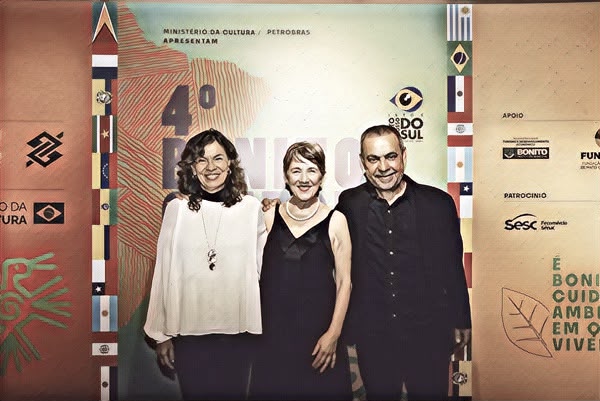
The audience chose Higa Ke – Eye for an Eye, directed by Conrado Roel, as the best film from Mato Grosso do Sul. In the environmental cinema section, the winners were the Ecuadorian short film Buen Vivir – Ñutse Canseye, by Zoé Kugler, and the Colombian feature Páramos II: El Origen, directed by Alejandro Calderón.
Among the South American productions, the audience award for best short film went to the Brazilian production The Life of Jerônimo Inside and Outside the Shell, directed by Andrews Nascimento. The feature selected by the public was the Peruvian film Naira, directed by Gabriela Quiroz.
The official jury followed a different path in some categories. Natasha, directed by Ana Ostapenko, Willerson Amorim, Thiago Rotta, and Rafael Rotta, was named the best film from Mato Grosso do Sul, while Four Pantanal Moons, directed by Ana Carla Loureiro, received an honorable mention.
In the environmental competition, the winning short film was Colombia’s Hippos, Escobar’s Ark, also directed by Alejandro Calderón. The filmmaker left the festival with two awards for Páramos II: El Origen, selected as the best environmental feature by both the official jury and the audience.
The Colombian production Sukua, directed by Omar E. Ospina, won best South American short film. The top award among the feature films went to Who Killed Narciso?, by Paraguayan filmmaker Marcelo Martinessi, represented at the festival by lead actor Diro Romero. Naira also received an honorable mention for the performances of its young protagonist and her co-star.
Based on a true story that took place in Asunción in 1959, Who Killed Narciso? revisits the life of a figure who challenged the rules of a society marked by the early years of Paraguay’s dictatorship, one of the longest in Latin America.
“I like to think that Narciso came to me,” Diro Romero said. “When the casting call was announced, I felt it was an opportunity to play a historical figure, someone who truly represents an entire community.”
More than telling a specific story from Paraguay’s past, the actor believes that the film will resonate throughout the continent.
“The film portrays a society in 1959 with which many Latin Americans will be able to identify. We have a great deal in common. This period of Paraguayan history was also repeated in several countries across Latin America.”

The fourth edition also honored Chilean actress Paulina García, Argentine filmmaker Luis Puenzo, and documentary filmmaker Vincent Carelli. Over nine days, the program brought together environmental films, regional productions, feature films, and short films from different parts of South America.
The trophies naturally help bring visibility to the winners, but the importance of Bonito CineSur also lies in what happens before and after they are handed out. It lies in the possibility of a Paraguayan film reaching a Brazilian audience, of a Peruvian production being discovered in Mato Grosso do Sul, or of a Colombian filmmaker finding partners from other countries. On a continent that shares so much and still knows so little about itself, creating this meeting place may be the festival’s greatest prize.
Descubra mais sobre
Assine para receber nossas notícias mais recentes por e-mail.

