
A little more than a year after Colin Firth starred in Lockerbie: A Search for Truth, the arrival of The Bombing of Pan Am 103 on Netflix may prompt an inevitable question: Do we really need another dramatized series about the explosion of the plane that came down over a small Scottish town in 1988? The answer lies less in repeating the facts than in a complete change of perspective. The two productions deal with the same tragedy, but they do not tell exactly the same story.
The series starring Colin Firth followed Jim Swire, who lost his daughter Flora in the attack and devoted decades to searching for answers, eventually questioning both the conviction and parts of the official account established by the authorities. In The Bombing of Pan Am 103, the focus shifts away from the individual journey of a father and toward the investigation itself. The production follows Scottish police officers, FBI agents, public officials, Lockerbie residents, and families trying to understand how a plane bound for New York exploded in the sky only 38 minutes after leaving London.
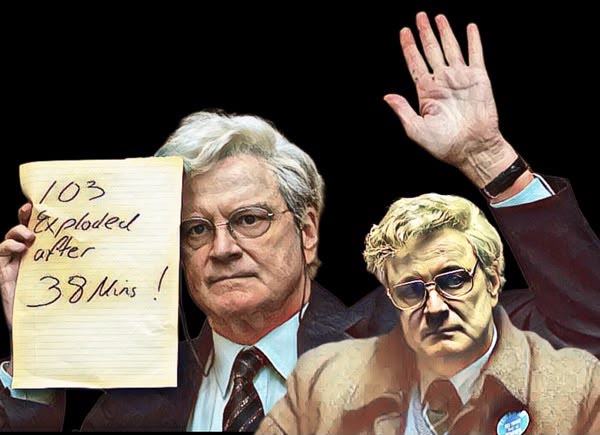
It is an essential distinction because the new series does not present itself as the story of one man confronting governments and institutions, but as the reconstruction of an enormous collective effort marked by conflicts, mistakes, power struggles, and small breakthroughs. Instead of beginning with the doubts that remained after the trial, it returns to the night of December 21, 1988, when Pan Am Flight 103 exploded over Lockerbie, killing all 259 passengers and crew members, as well as 11 people on the ground. The victims came from 21 countries, and the wreckage was scattered across approximately 850 square miles, turning the Scottish countryside into one of the largest crime scenes ever examined.
The scale of the tragedy is one of the most striking elements of the six episodes. Before investigators could ask who had placed the bomb on the plane, they needed to recover bodies, identify victims, collect fragments, and attempt to reconstruct an aircraft that had been destroyed in midair. Every piece of metal, fabric, luggage, or electronic equipment could represent a clue, but it was also part of the life of someone who had boarded the flight to spend Christmas with family, return home, or begin a journey.
The series finds its strength precisely in the balance between the police investigation and the human dimension of the tragedy. There is room for the investigators who spent years following tiny fragments of a bomb across several countries, but also for the residents who saw bodies and wreckage fall onto their homes. Among the stories it recounts is that of the women of Lockerbie who volunteered to wash, organize, and package the personal belongings found among the debris. Anything that held no evidentiary value was carefully returned to the families, accompanied by small sprigs of Scottish heather. In a case dominated by governments, intelligence services, and international accusations, that simple gesture may be one of the most painful images in the entire story.
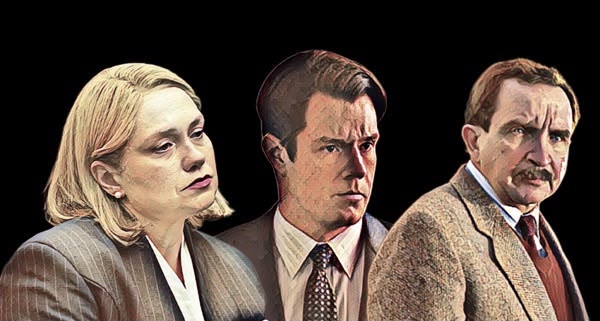
Connor Swindells plays Ed McCusker, the Scottish police officer who becomes one of the main links with the United States, while Patrick J. Adams portrays FBI agent Dick Marquise. Merritt Wever plays Kathryn Turman, who works with the American families, and Peter Mullan appears as Chief Constable John Orr. The decision to distribute the narrative among several characters reinforces the idea that no single person could understand or solve a crime of such magnitude. The investigation required cooperation between countries, but that cooperation was far from simple.
The Scottish and American authorities had different methods, priorities, and political pressures. The series shows how information was withheld, how suspects were investigated by parallel agencies, and how the search for justice also became a dispute over who would control the investigation. Initially, suspicion fell on Palestinian groups and a possible act of Iranian retaliation. Gradually, fragments of a radio, pieces of a timer, and clothing purchased in Malta led investigators toward agents connected to Libyan intelligence.
Each discovery is treated as a small victory within an investigation that took more than a decade to reach a trial. In 2001, Abdelbaset al-Megrahi was convicted of the bombing, while Lamin Khalifah Fhimah was acquitted. Megrahi received a life sentence but was released on compassionate grounds in 2009 after being diagnosed with cancer, and he died in Libya in 2012. Throughout that period, families, journalists, and investigators continued to debate whether the conviction had truly clarified what happened and whether everyone responsible had been identified.
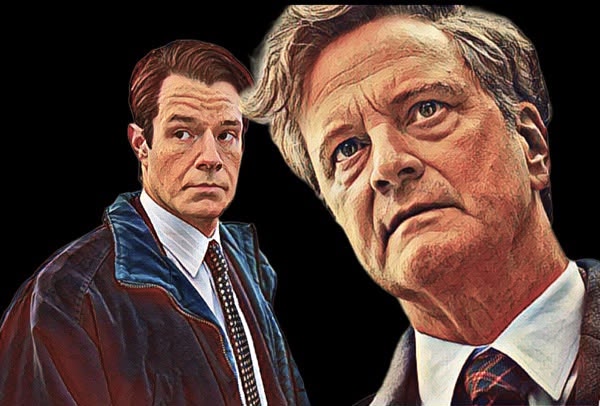
This is where The Bombing of Pan Am 103 differs even more clearly from Lockerbie: A Search for Truth. The production starring Colin Firth begins with Jim Swire’s doubts and his conviction that Megrahi may have been wrongfully convicted. The Netflix series remains much closer to the investigators and to the official path that led to Libya. That does not mean it ignores failures, contradictions, or political interests, but its attention is directed toward how the case was built rather than primarily toward dismantling it.
Perhaps for that reason, the series is less emotionally concentrated than the previous production, but much more effective at explaining the scope of the case. Jim Swire gave the audience an accessible protagonist: a devastated father who refused to accept incomplete answers. Here, the protagonist is the investigation itself, spread across dozens of characters, countries, and apparently insignificant clues. The narrative demands more attention, but it also allows us to understand why Lockerbie became such a complex case and why, almost 38 years later, it remains impossible to describe it as definitively closed.
The series arrives on Netflix just as a new trial promises to place the bombing back at the center of public attention. Abu Agila Mohammad Masud, accused by the United States of building the bomb used in the attack, is expected to stand trial in Washington, with jury selection scheduled to begin on August 25, 2026. Formally charged in 2020, detained in 2022, and brought to the United States, he has pleaded not guilty. Prosecutors intend to use a confession Masud allegedly made in Libya in 2012, but the defense argues that the statement was obtained through threats, violence, and coercion.
So far, Megrahi remains the only person convicted of the bombing. If Masud’s trial proceeds, it will be the first time someone accused of the attack on Flight 103 has answered for the crime in an American courtroom. The proceedings may also reopen discussions about the origin of the suitcase carrying the bomb, Pan Am’s security failures, information that may have been available before the attack, and the possibility that other participants were never held accountable.
The timing of the Netflix release and the new trial give the series an immediacy that could hardly have been planned more precisely. What might otherwise appear to be simply another dramatization of a distant tragedy now functions as preparation for a legal process capable of adding a new chapter to the case. The series ends after showing the suspects finally brought to trial, but reality insists on reminding us that the story did not end there.
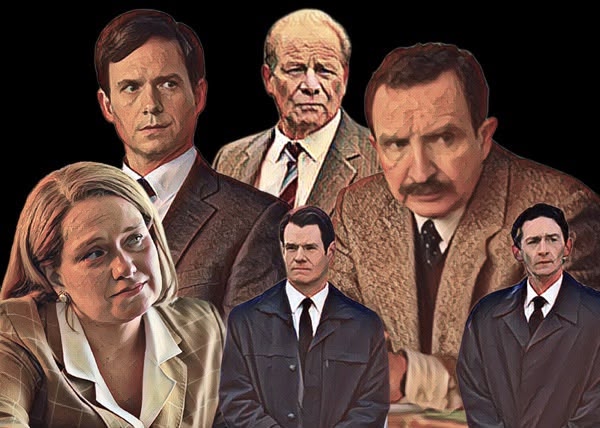
Despite its focus on police work, The Bombing of Pan Am 103 avoids turning the investigation into an entertaining puzzle. The destruction is always present, as is the reminder that every clue was recovered from the remains of 270 lives. The investigators’ work may drive the series, but the victims, their families, and the residents of Lockerbie prevent it from becoming merely another story about agents pursuing terrorists.
That may be its greatest achievement. By revisiting the bombing through the perspective of those who had to gather its fragments, the series shows that investigation can also be an attempt to reconstruct what can never truly be restored. Police officers tried to rebuild an airplane, families tried to rebuild their lives, and a small town was forced to learn how to live forever with the name of an international tragedy.
Almost four decades later, we know how the bomb probably entered the baggage system, we know the names of the accused agents, and we have one conviction. Even so, questions remain about who ordered the attack, how many people were involved, which governments knew more than they admitted, and whether the truth presented in court corresponds to the full story. The Bombing of Pan Am 103 does not answer every one of those questions, but it explains why so many people have spent so many years trying to answer them.
The Netflix series does not replace Lockerbie: A Search for Truth, nor does it attempt to correct the production starring Colin Firth. The two complement each other precisely because they occupy different positions. One follows the man who came to distrust the investigation; the other follows the people who tried to build it. Between the investigators’ convictions and the families’ doubts remains the story of Pan Am Flight 103, a crime that resulted in a conviction but has still not found its true ending.
Descubra mais sobre
Assine para receber nossas notícias mais recentes por e-mail.

