
As published on CLAUDIA
Exactly one year ago, when the new chapter of Ted Lasso was still only a promise, I wrote in my column for CLAUDIA about the importance of the series choosing women’s football as the centre of its story. At the time, the discussion focused on the growth of the sport, the inequality that still separates men and women, and the power of popular culture to inspire cultural change.
Now, with the new season under way, a fact mentioned almost in passing helps explain why women’s football still has to fight so hard for space: in England, women were excluded from grounds affiliated with the Football Association between 1921 and 1971.
Fifty years.
The fact may sound like a historical curiosity, but it dismantles the idea that women’s football has less tradition, a smaller audience or less commercial power because it was slow to develop. It was not slow. In many countries, it already existed and was beginning to thrive when sporting institutions and governments decided to stop it.
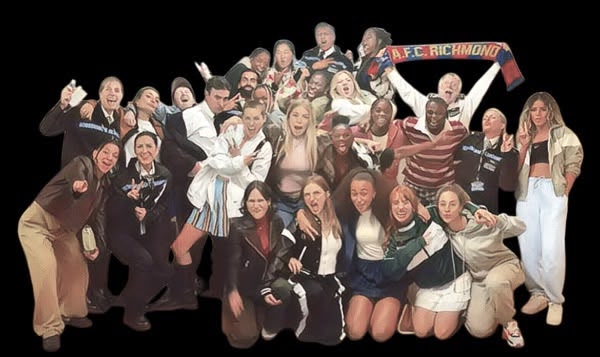
In England, the women’s game grew rapidly during the First World War. While men were sent into battle, women took their places in factories, formed teams and played matches that also raised money for charitable causes. Some games attracted tens of thousands of spectators.
In 1921, however, the Football Association declared that football was unsuitable for women and banned its affiliated clubs from allowing women’s matches to be played on their grounds. Referees associated with the organisation were also forbidden from working at the games. It was not a crime for a woman to kick a ball, but women were expelled from the infrastructure a sport needs in order to grow: stadiums, clubs, competitions, investment and player development.
Anyone who has seen A League of Their Own may recognise the mechanism. The 1992 film, starring Madonna and Geena Davis, was inspired by the professional women’s baseball league created in the United States during the Second World War. Women were invited to keep the sport alive while the men were away fighting. They attracted crowds and became professionals, but were required to play in skirts, attend etiquette classes and prove that they remained sufficiently “feminine.”
The opportunity existed because there was an emergency, not because society had fully accepted their presence. When the men returned, women were expected to hand back their jobs, their playing fields and their visibility. In English football, because the women’s game continued to grow, the response was not to welcome it into the established structure, but to bring it to a halt.
In Brazil, exclusion came directly from the state. In 1941, during the government of Getúlio Vargas, a decree established that women could not practise sports considered incompatible with the supposed “conditions of their nature.” In 1965, the National Sports Council explicitly included football among the forbidden activities.
The ban was only revoked in 1979, and the sport was not formally regulated until 1983. For almost four decades, the country that turned football into part of its national identity officially decided that this symbol did not belong to women. Afterwards, it expected them to recover quickly everything they had been denied for generations.
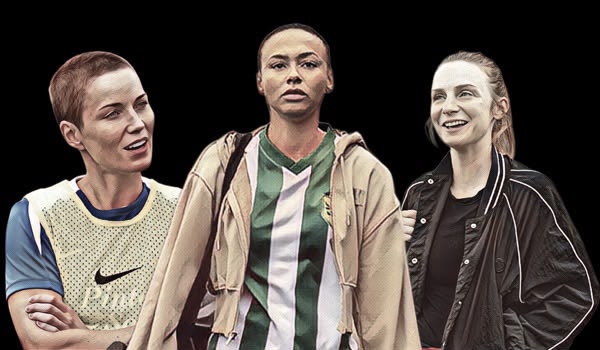
The United States had no similar nationwide ban, but exclusion appeared through the lack of access to school teams, coaches, playing fields, competitions and university scholarships. Change only began in 1972 with Title IX, which prohibited sex discrimination in educational programmes receiving federal funding and helped build the foundations of women’s sport.
The first official national team was formed in 1985. Six years later, the United States won the inaugural Women’s World Cup. The difference was not some natural talent possessed by American women. It was opportunity.
From its first episode, the fourth season of Ted Lasso makes it clear that the problem did not remain in the past: the new team faces limited investment, difficulty attracting spectators and a constant obligation to prove its commercial viability. That situation is real, but describing it simply as rejection hides the extent to which disinterest has also been manufactured.
Women’s football receives less promotion, less consistency and less infrastructure. It consequently attracts smaller audiences, and those smaller audiences are then used to justify continued underinvestment. It is a vicious circle: commercial success is demanded before the necessary conditions for producing it have been provided.
In England, major club games and national-team matches have already demonstrated that an audience exists. The challenge is to transform the excitement surrounding finals into a weekly habit. In Brazil, it can be genuinely sad to watch matches on television being played in front of almost empty stands. Broadcasting them is an achievement, but broadcasting alone does not solve the equation.
The audience for men’s football was built over generations through continuous competitions, daily programmes, sporting idols, rivalries and stories passed down within families. Nobody is born knowing their club’s starting line-up. They learn because that narrative surrounds them from childhood.
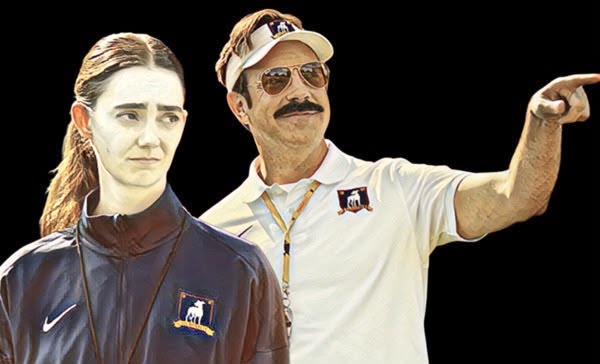
Women’s football, by contrast, is still presented as though it is always starting from scratch. Match times and venues change, calendars are interrupted and important players remain unknown. Then the public is expected to develop an interest spontaneously.
There is misogyny too. Part of the audience compares women’s strength and speed with those of men and concludes that the game must therefore be inferior. Yet no one demands that a men’s match in the lower divisions reach Champions League standards before it deserves supporters, investment and television coverage. Women are compared only with the richest and most established version of the sport.
For a long time, stadiums and the mastery of football’s rules also functioned as territories of male authority. When female players, coaches, referees, commentators, presenters and supporters occupy those spaces, some people react as though women were invading something that does not belong to them — precisely the belief that decades of prohibition helped to create.
This is why the new chapter of Ted Lasso may prove so important. The series has always used football to talk about masculinity, mental health, leadership, power dynamics and belonging. By placing Ted in charge of a women’s team, it is not simply replacing male players with female ones. It is entering a history shaped by bans, erasure and institutional inequality.
Popular culture cannot replace investment, reliable schedules, salaries or training facilities. But it can provide faces, conflicts, emotions and stories, bringing people closer to a world that many still observe from a distance.
It was therefore particularly valuable for the series to begin by offering the necessary context and reminding us that women did not arrive late to football. They are simply still racing to recover the time, the pitches and the history that were taken from them.
With less than a year to go before the 2027 Women’s World Cup — the first to be held in Brazil and South America — Ted Lasso and its distinctly Lasso-like philosophy have arrived at exactly the right moment. To change the game, perhaps we must begin by changing the way we tell its history.
And we believe in Ted Lasso.
Descubra mais sobre
Assine para receber nossas notícias mais recentes por e-mail.
 miscelana.com