
I use artificial intelligence every day. I use it to research, organize my thoughts, test questions, locate information, and, very often, to see more clearly an idea that is still confused inside my own head. So I am not writing this from outside the phenomenon, looking down on people who have decided to entrust their feelings to a machine.
Quite the opposite. I completely understand the appeal.
Artificial intelligence is always available. It does not seem tired, distracted, or impatient, and we can turn to it at three in the morning without that having any consequences. We can ask the same question repeatedly, erase what we wrote, tell the story again, change a word, and try one more time. It answers immediately and, most of the time, in language that feels reassuring, organized, and apparently interested in us. On top of that, it costs little or nothing at all.
In a country where the price of treatment remains one of the main barriers for people who need help, it would be naive to ignore what this means. The 2026 Mind Health Report shows that 39% of Brazilians who do not seek professional care cite the cost of consultations and treatment as the main obstacle. Another 23% mention limited access to professionals, while 18% say they simply cannot fit care into their routine. It is not difficult to understand why the machine begins to occupy that space.

The more provocative figure, however, is another one. According to the survey, 70% of Brazilians have already used some form of artificial intelligence to deal with psychosocial issues, and, among users, 40% say they trust technological platforms more than professionals when seeking guidance. This is the point at which the story stops being only about artificial intelligence and begins to say something about desire.
What are we looking for when we tell our secrets to a machine?
Almost a century ago, Freud was already drawing attention to a contradiction that still feels remarkably current. In Civilization and Its Discontents, when discussing the technological advances achieved by humanity, he observed that technology had dramatically expanded our powers without necessarily making us happier. We became capable of doing things that once seemed unimaginable, shortened distances, accelerated processes, and increased our ability to intervene in the world, yet none of this eliminated suffering.
Technology changes, but discontent remains. Artificial intelligence may simply be the most sophisticated version yet of an old promise: that if our tools become powerful enough, we may finally be able to eliminate whatever troubles us. The difference is that we are no longer asking technology only to transport our bodies, perform calculations, cure disease, or transmit information. We are beginning to ask it to organize our anxieties as well.
Freud built much of his theory around the idea that we seek to reduce tension. The pleasure principle pushes us toward satisfaction and away from displeasure, while reality imposes waiting, limits, and frustration. Not everything can be solved immediately, not every desire can be fulfilled, and not every form of suffering can be eliminated. Artificial intelligence appears precisely within a culture that is becoming increasingly intolerant of waiting.
If I have a question, I ask and receive an answer. If I do not like the answer, I ask for another. If I want music, a film, a text, food, a purchase, or information, I have become accustomed to waiting less and less. We also want content, knowledge, and services, while developing a growing resistance to paying for them. What once required the labor of another person now appears before us in seconds, almost as though it had no cost, no process, and no author.
But somebody always pays the price, and this is where the other side of our relationship with technology appears. We fear that artificial intelligence will eliminate jobs, replace professions, destroy business models, and make skills built over decades less valuable. At the same time, we want it to write, translate, research, solve, recommend, and produce for us. We want the convenience it offers, while feeling anxious about the possibility that this same convenience could make people expendable.
The AXA report itself shows that financial instability, job insecurity, and uncertainty about a rapidly changing world are among the factors most affecting Brazilians emotionally. A curious circuit begins to form: technology accelerates change, change produces anxiety, and we turn back to technology to relieve the anxiety those transformations helped create. It is not difficult to recognize something of what Freud understood as repetition here, an attempt to return to what unsettles us in the hope that, this time, we might somehow master it.
But there is another reason artificial intelligence is so attractive, and from a psychoanalytic perspective, it may be the most interesting one. Lacan used the expression “subject supposed to know” when thinking about transference. When someone enters analysis, they place in the analyst, in some sense, the assumption that there is some knowledge there about what is happening to them. The analyst, however, should not simply occupy the position of the person who has all the answers. Analytic work happens precisely because this supposed knowledge is gradually displaced and because the subject begins to encounter something of their own truth in what they say.
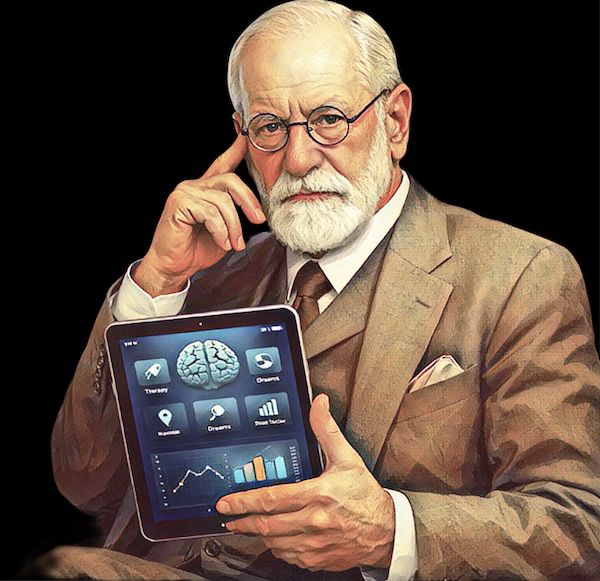
With artificial intelligence, however, we find something like a technological version of this fantasy. We ask because we assume it knows, and it almost always answers. It can explain why my boyfriend behaved in a particular way, interpret the message I received, tell me whether my reaction was appropriate, list the signs of an abusive relationship, organize my feelings, suggest what I should reply, and even find words for something I had not yet managed to name. The more capable the tool becomes, the easier it is to attribute to it an almost limitless knowledge.
There is, however, a fundamental difference. In analysis, transference is worked through. With artificial intelligence, it can simply be reinforced, not because there is a consciousness on the other side deliberately manipulating the person asking the question, but because the very function of the tool is to produce an answer. Silence, which can carry enormous meaning in analysis, tends to look like failure on a platform.
Perhaps this is precisely where part of its seduction lies. The machine does not simply appear to know. It appears to know without wanting anything from us. A human being sitting across from us has desires, limits, opinions, fatigue, and a history. We can disappoint that person, want to please them, feel ashamed, angry, dependent, admiring, or rejecting. In analysis, all of this matters because the relationship we build with the analyst is not something external to treatment. Very often, it is precisely where our patterns emerge again.
We may seek approval, fear abandonment, need to control the other person, interpret silence as rejection, try to become the perfect patient, or feel angry when we do not receive what we wanted. What we do outside analysis can reappear within it, and it is precisely because there is another person there whom we cannot entirely control that something may become visible to us.
With a machine, the fantasy is different. We can switch it off, erase the conversation, rewrite the prompt, ask it to be kinder, more objective, harsher, or more understanding. We can request a second answer, a third interpretation, another reading of the same facts until we find one that satisfies us. It is difficult to imagine an object better suited to a culture built around personalization.
Artificial intelligence can, therefore, become a kind of extraordinarily sophisticated mirror. It does not merely reflect what we give it. It returns that material organized, articulated, and often more convincing than it was when it arrived. This can be extremely useful. But even the most sophisticated mirror is not necessarily an encounter.
That may be the essential difference between using artificial intelligence to think and using it as a substitute for a therapeutic relationship. In psychoanalysis, we are not merely looking for an explanation of what we feel. We are trying to understand why we repeat certain choices even when we know they hurt us, why we desire what we insist we do not want, why an apparently insignificant sentence can destabilize us, or why we forget precisely what we claimed mattered most. The unconscious often begins where our conscious explanations stop working.

This is also why analysis should not be a machine for dispensing advice. Its purpose is not to tell a patient how to live better, but to allow that person to hear something of their own desire. And this includes an experience that may be especially difficult in the contemporary world: accepting lack.
Lacan placed lack at the center of his understanding of desire. We desire because something is not complete, and no object, person, purchase, achievement, or explanation can permanently eliminate that lack. Much of contemporary logic tries to convince us of exactly the opposite. If something is missing, buy it. If you are lonely, connect. If you are anxious, ask. If you do not know, search. If you do not like it, replace it. If it did not work, generate it again.
Within this landscape, artificial intelligence can occupy the imaginary position of an Other almost without lack: available, knowledgeable, patient, and apparently inexhaustible. It is a powerful fantasy precisely because a real person inevitably fails us. And perhaps it is also that failure we are trying to escape.
None of this means demonizing artificial intelligence. That would be absurd. It can be extraordinarily useful for organizing thoughts, finding information, preparing for a difficult conversation, recognizing that a particular form of suffering deserves professional attention, and even offering some comfort during a moment of loneliness. In a country marked by inequality and limited access to mental health care, dismissing that possibility would itself be a form of privilege.
The problem begins when we confuse one thing with another. Information is not analysis, reassurance is not necessarily treatment, a convincing answer is not the same as an interpretation, and availability is not presence. Perhaps the most interesting question raised by the study is not whether artificial intelligence will eventually replace therapists, because that question still belongs to the logic of efficiency: who can answer better, faster, and more cheaply?
Psychoanalysis proposes a different question: why do we want so badly for it to be able to replace us?
Perhaps because a machine available twenty-four hours a day seems to promise something no human relationship can offer: an other who knows but demands nothing, listens but desires nothing, answers but never abandons us, remains available but can be switched off the moment it begins to bother us. Another thing we imagine we can control.
Yet an important part of our anxiety may lie precisely in the impossibility of controlling the other, the future, work, love, and even ourselves. Artificial intelligence can help us find words for that anxiety, organize our thoughts, and even provide some relief. That is not insignificant.
But psychoanalysis begins precisely when we discover that finding the words does not necessarily mean finding the answer.
Descubra mais sobre
Assine para receber nossas notícias mais recentes por e-mail.

