
Rosalía arrives in Rio de Janeiro for the LUX Tour at an interesting moment in her relationship with Brazilian audiences. Plenty of people may not follow every step of her career, know her albums from beginning to end, or be particularly familiar with her increasingly daring mix of flamenco, electronic music, sacred music, opera, and pop. But chances are they recognize her voice. And there is a very Brazilian reason for that: Rosalía has become a recurring presence on Globo telenovela soundtracks.
It is an interesting trajectory. When she appeared in Vai na Fé in 2023, Rosalía was already a global star. El Mal Querer, in 2018, had drawn attention to the Spanish singer who could deconstruct flamenco without abandoning it, but it was Motomami, in 2022, that definitively changed the scale of her career. Rosalía began occupying that strange and fascinating space of an experimental artist who can also produce enormous mainstream hits.
“Despechá” may be the best example of that.
The song practically arrived ready-made for summer, the dance floor, and, yes, radio. Rosalía sings about leaving behind a love that no longer deserves her suffering and choosing freedom, partying, and friends instead. Musically, it moves through mambo and merengue, is short and direct, and has a chorus that requires almost no effort to get stuck in your head. It became a phenomenon before it was even officially released and quickly turned into one of the biggest hits of her career.
In Brazil, it gained even more exposure when it became part of Vai na Fé in 2023, appearing especially around Lui Lorenzo, played by José Loreto, and his musical world. It was an almost obvious match: a telenovela filled with music, dance, and pop culture using Rosalía at her most immediately accessible.
But that same year, her relationship with Brazilian telenovelas had already begun to become more interesting.

“LLYLM” and the complicated romances of Terra e Paixão
Also in 2023, “LLYLM,” short for Lie Like You Love Me, appeared in Terra e Paixão. The song became particularly associated with Graça, played by Agatha Moreira, and her relationship with Daniel, played by Johnny Massaro.
And here the choice carried an almost perfect irony. “LLYLM” is about accepting a lie if it is enough to preserve the fantasy of being loved. Graça, meanwhile, spends much of the story trying to sustain exactly the kind of relationship that does not exist in the way she wants it to, eventually even lying about a pregnancy in an attempt to keep Daniel by her side.
Pop music stopped being merely background and began functioning as commentary on a character.
La Fama in Vale Tudo
Two years later, Rosalía returned to Brazilian primetime with “La Fama,” her collaboration with The Weeknd, included in the international soundtrack of Vale Tudo.
The song was not officially presented as Maria de Fátima’s exclusive theme, but it is impossible to ignore how perfectly its presence speaks to the novela. “La Fama” treats fame almost like a seductive, dangerous, and destructive lover. And few characters embody the desire for social climbing at any cost as completely as Maria de Fátima.
It is also an interesting song within Rosalía’s own career because, although more accessible than much of what she would do later, it already carries one trait that would become increasingly clear: she rarely seems interested in repeating the same formula.
Rosalía knows how to make a hit. “Despechá” proves it. The point is that she does not seem particularly interested in spending her entire career making another “Despechá.”
Sexo, Violencia y Llantas changes the game
That is why the use of “Sexo, Violencia y Llantas” in Quem Ama Cuida may be the most interesting case of all.
The track opens LUX, the most ambitious and musically complex album of Rosalía’s career so far. It is not exactly a song designed for radio. It changes texture, intensity, and language, and belongs to an album that combines orchestral arrangements, religious references, classical music, flamenco, electronic sounds, and vocal demands far removed from the traditional structure of a pop hit.
Even so, it became Adriana’s theme, the character played by Letícia Colin, and began accompanying some of the most important moments in her story, including her conviction, her arrival in prison, and also her relationship with Pedro, played by Chay Suede.
And something curious happened: the telenovela helped make one of Rosalía’s least obvious songs familiar to Brazilian audiences.
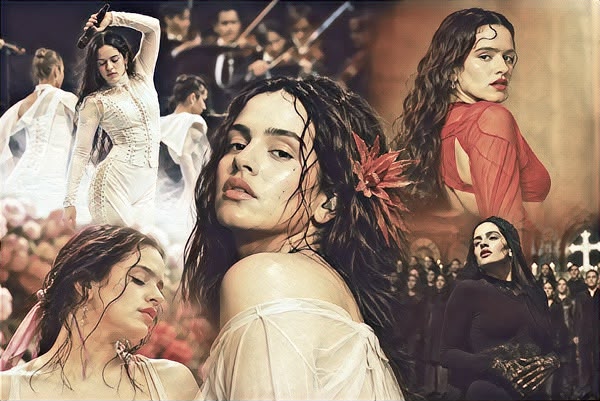
Perhaps that is the best way to understand the relationship she has built with Brazil. In 2023, Globo put on television a massive hit that the rest of the world already knew. Three years later, a Brazilian telenovela is helping popularize an experimental track from an album that could hardly be described as radio-friendly.
It is almost the reverse journey.
Rosalía no longer needs to prove that she knows how to make popular music. “Despechá,” “Con Altura,” and much of Motomami already did that very well. What LUX seems to ask is how far a pop artist can go after winning over that audience without needing to simplify her music in order to keep it.
In Brazil, curiously enough, part of that answer may be unfolding in front of the television.
Anyone who heard “Despechá” in Vai na Fé, “LLYLM” in Terra e Paixão, “La Fama” in Vale Tudo, and now “Sexo, Violencia y Llantas” in Quem Ama Cuida may have followed, without even realizing it, Rosalía’s own transformation.
From songs made to conquer audiences instantly to songs that demand that we stop and listen.
And now they all fit inside the same arena.
Descubra mais sobre
Assine para receber nossas notícias mais recentes por e-mail.
 miscelana.com