
There is an understandable temptation to call Rosalía innovative. Still, perhaps that is not even the fairest word to describe what she does with LUX and, especially, what she manages to achieve onstage. Combining music, dance, fashion, visual arts, theater, and a full orchestra is hardly new. David Bowie, Madonna, Pet Shop Boys, Björk, and many other artists turned the pop concert into a visual and performative work decades before her. Rosalía was not the first, either, to blend classical music, electronic sounds, and pop. Sarah Brightman, to cite an obvious example, built much of her career by crossing precisely those boundaries. Rosalía’s originality, then, is not in the ingredients but in the syntax.
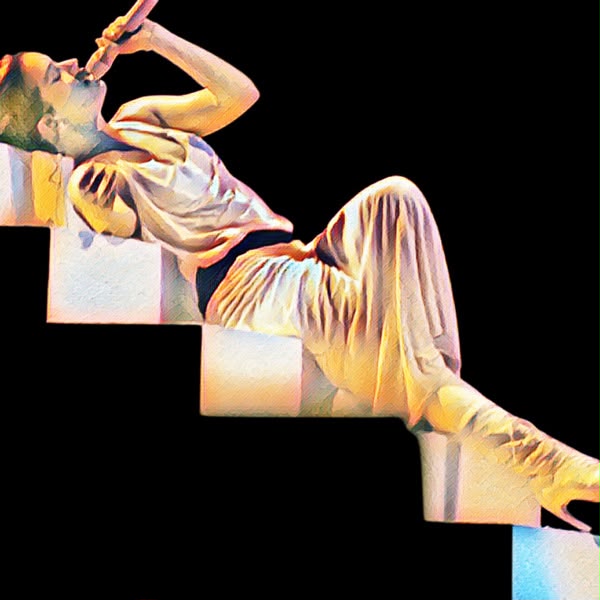
She rearranges recognizable references in such a personal way that, once everything comes together, it no longer feels like a collection of influences. It feels like Rosalía. The orchestra is not there to lend prestige to pop, the dancing is not simply filling the stage, fashion is not merely decorative, and the religious iconography is not just beautiful scenery. Everything belongs to the same language and, more importantly, everything seems to spring from the same artistic restlessness.
LUX had already made that clear. It is an ambitious, complex album with no interest in making things easy for the listener. Rosalía moves through flamenco, orchestral music, electronic sounds, pop, religious and mystical references, sings in different languages, and builds an album that demands attention at a moment when much of the music industry seems to be competing for precisely the opposite: who can grab someone fastest before the next video, the next song, or the next distraction. Perhaps her greatest audacity lies exactly there, because Rosalía manages to be demanding without losing a generation accustomed to immediacy.
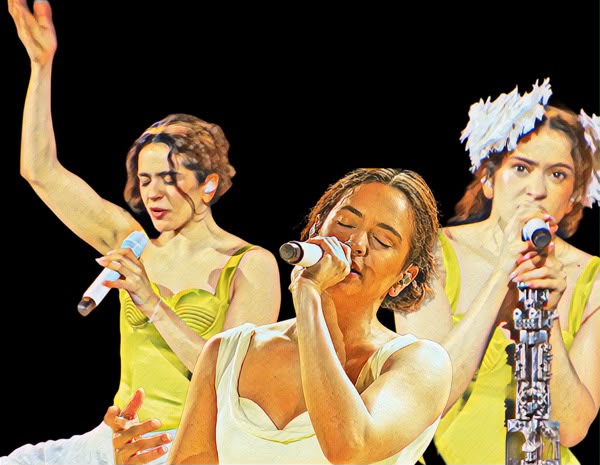
But it was seeing LUX onstage that made all of this make even more sense to me. The show lasts exactly two hours, and virtually nothing seems left to chance. There is dance, meticulously planned movement, musicians, an orchestra, costume changes, lighting, images, and scenes arranged almost like tableaux. Everything depends on an enormous machine operating with precision, yet strangely, precision was not what I felt while watching it. It was freedom.
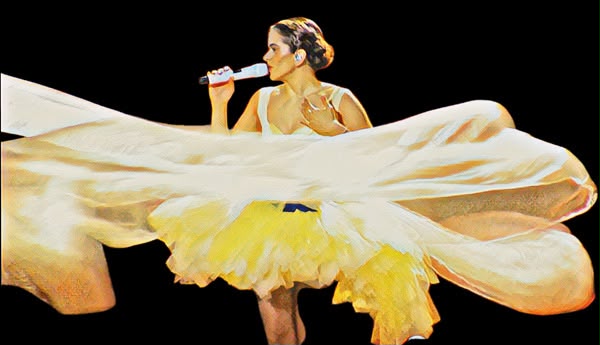
Perhaps because I know firsthand the amount of work that lies behind choreography, I am always impressed when the effort disappears, and Rosalía accomplishes exactly that. Two rigorously rehearsed hours unfold before our eyes without ever feeling as though we are watching someone hit their marks. Nothing about this show should feel spontaneous, and yet almost everything does. For me, that was the real magic of the night.
Rosalía laughs, jokes, talks, looks out at the audience, and seems genuinely happy to be there. There is an enormous machine operating around her, but the machine never swallows the person. Quite the opposite: the bigger the spectacle becomes, the clearer her ability to create an almost intimate connection with thousands of people. That is a much rarer quality than it may sound, particularly in huge productions that often call attention to their scale and impress through money, technology, giant screens, effects, or the sheer number of people involved. Rosalía has all of that at her disposal, yet somehow the main thing you remember is not the size of the apparatus. It is her.
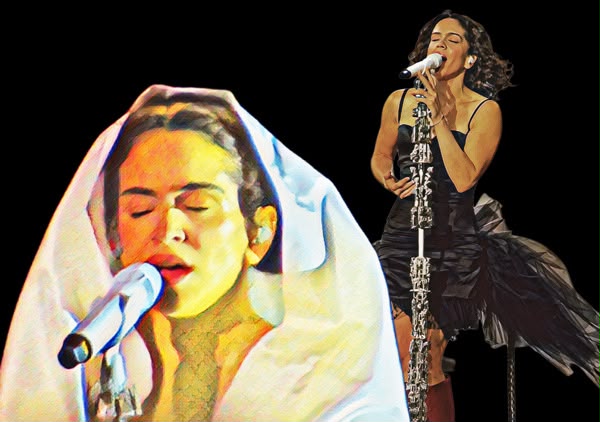
Her voice, her body, her restlessness, her humor, and the almost voracious curiosity with which she moves between different artistic languages keep LUX from becoming one of those projects too conscious of its own importance. There is a great deal of research, symbolism, and religion, as well as references to painting, dance, classical music, and flamenco, and all of it could easily become an exercise in pretension. Rosalía escapes that trap because there is warmth in the middle of all this elaborate construction. There is sensuality, irreverence, and pleasure, and above all, the sense that she genuinely enjoys doing it.
Her stop in Brazil only reinforced that impression. Rosalía chose Rio de Janeiro as the only Brazilian city on the tour, another unconventional decision at a time when São Paulo seems like an almost mandatory stop for any major international artist. There were two sold-out nights, and during the two hours she spent onstage, she gave absolutely everything without ever seeming as though she were merely fulfilling another obligation on a tour schedule.
She spoke Portuguese, and spoke it very well, talked to the audience, and played with a few Brazilian songs that clearly belong to her own musical references. She tried a few notes from “Águas de Março” and “Luiza,” by Tom Jobim, as well as “Construção,” by Chico Buarque. They were not prepared numbers designed to fit officially into the show, and perhaps that is exactly why they worked so well with the feeling that, even inside a massive and rigorously choreographed production, something could still happen only there, in that moment, in that city, and with that particular audience.
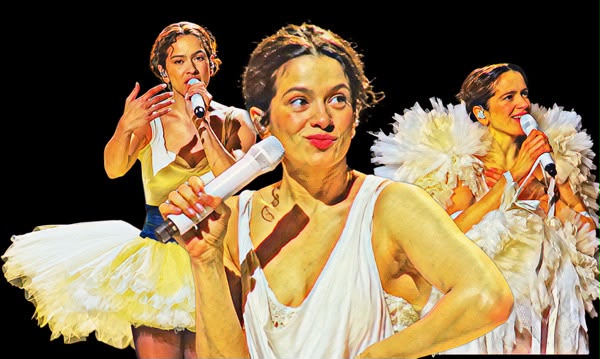
When she mentioned the possibility of working on a bossa nova album, the idea immediately seemed less unlikely than dangerous. I hope she does it, but not because we need another foreign singer making a respectful tribute to bossa nova. Rosalía hardly seems capable of simply visiting an artistic language. She enters it, researches it, takes it apart, mixes it, absorbs its structures, and tries to discover what she can do with them.
Her Portuguese is already excellent and, if she truly dives into Brazilian music with the same curiosity she brought to flamenco, electronic music, and now the orchestral universe of LUX, perhaps she will not simply make a bossa nova album. Perhaps she will create her own bossa nova, with an identity that will not need to imitate Jobim, João Gilberto, or anyone else to prove that she understands where it came from.
That is why “innovative” still feels like too small a word to describe her. No great artist needs to invent every element of their language alone to be original. Originality may instead be the ability to make all the references we can identify no longer sufficient to explain the final result.
After two hours of LUX, you can recognize many of them, but none can fully explain Rosalía. And perhaps that is exactly the measure of what makes her singular.
Descubra mais sobre
Assine para receber nossas notícias mais recentes por e-mail.
 miscelana.com