
There are films I admire, films I recognize as essential to cinema history, such as Blow-Up. I love Blow-Up, perhaps precisely because, sixty years later, it still politely refuses to tell me what really happened and is as relevant as ever. Michelangelo Antonioni built a story so apparently simple that it can be summarized in a few lines and, at the same time, created an enigma that six decades of essays, theories and repeated viewings have never managed to close.
A photographer sees a couple in a park and begins taking pictures of them without permission. Later, while developing the photographs, he notices that the woman appears to be looking at something outside the frame. He enlarges that part of the picture, then enlarges it again and again, until something begins to emerge from the grain: perhaps a man hidden among the trees. There may be a gun. In another photograph, perhaps a body. Thomas returns to the park at night and actually finds a corpse. When he comes back later, however, it is gone. His photographs have been stolen, the woman disappears, and the apparent murder is never explained.
In almost any other movie, this would be the beginning of the thriller. For Antonioni, it is the entire point. What remains so disturbing about Blow-Up is that the very thing that should take us closer to an answer — looking harder, enlarging, studying every detail — does exactly the opposite. The more Thomas searches for truth inside the photographs, the more reality dissolves in front of him. Watching the film today, surrounded by phones, security cameras, manipulated images, artificial intelligence and an almost automatic faith in anything introduced with the words “it was recorded,” it is difficult not to realize how early Antonioni arrived at a question that remains completely contemporary: is seeing something the same as knowing it?
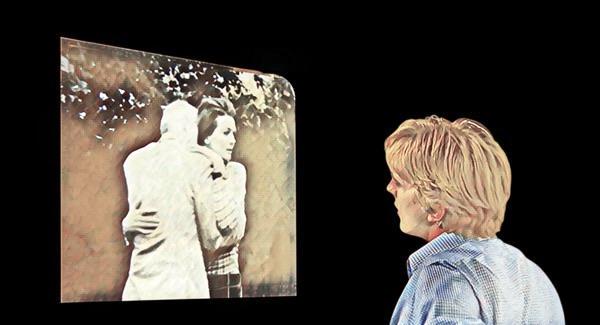
Before London, there was Antonioni
By the time he made Blow-Up, Michelangelo Antonioni had already built his reputation by dismantling precisely what conventional cinema usually promised its audience. In L’Avventura, from 1960, a woman disappears during a trip, and what initially appears to be the center of the story gradually stops being the real issue. Antonioni is less interested in discovering what happened to her than in observing what happens to the people who remain. La Notte, L’Eclisse and Red Desert deepened that exploration of alienation, desire, silence and the difficulty of communication in a modern world moving faster than his characters seemed able to understand.
Blow-Up transported those obsessions somewhere completely different. It was Antonioni’s first entirely English-language feature and the first of three films he would make outside Italy under his deal with producer Carlo Ponti and MGM. When he returned to London in 1965, he found a city radically different from the one he had previously known. Fashion, music, photography, sexual behavior and youth culture had transformed the British capital into the symbolic center of what became known as Swinging London. Antonioni described what he was witnessing as a revolution in life, customs and morality, and he immersed himself in that world while remaining unmistakably an outsider looking in.
That distance matters because Antonioni never films London like a man completely seduced by the party. He is fascinated by it, certainly, but also suspicious. The result is one of the defining portraits of the 1960s and, at the same time, one of its most skeptical. Thomas possesses almost everything that should represent success in that London — youth, money, women, fashionable clothes, a Rolls-Royce, creative freedom — and nevertheless seems terminally bored by most of it.
Before Thomas, there was Julio Cortázar
There is another origin that cannot be ignored. Blow-Up was loosely inspired by Argentine writer Julio Cortázar’s 1959 short story Las babas del diablo, usually translated as The Devil’s Drool. Antonioni read the story in Italian translation and kept its extraordinary central idea while changing almost everything around it.
Cortázar’s protagonist is Roberto Michel, a translator and amateur photographer in Paris who takes a picture of an older woman with a teenage boy beside the Seine. At first he believes he has interrupted a seduction and perhaps rescued the boy. Later, after enlarging the photograph and hanging it on his wall, he begins to perceive something he failed to understand when he actually witnessed the scene: another man, outside the apparent center of the image, may have been involved in something much darker.
Antonioni takes that idea — the camera recording something its operator did not consciously see — and transforms it into a meditation on photography itself. He moves the action from Paris to London, makes the photographer a successful fashion professional, and replaces Cortázar’s disturbing encounter with a possible murder. More importantly, he turns the process of enlargement into the structural center of the film. The short story gave Antonioni the seed. Blow-Up grew into something entirely his own.
There is even a fascinating literary footnote. Antonioni sent an early treatment to Italo Calvino and invited him to collaborate on the screenplay. Calvino declined, but encouraged him to expand the discovery through the photographs and develop the sense of a search for a mystery. Antonioni apparently took the advice. The enlargement sequence would become not merely a plot device but the reason the movie exists.
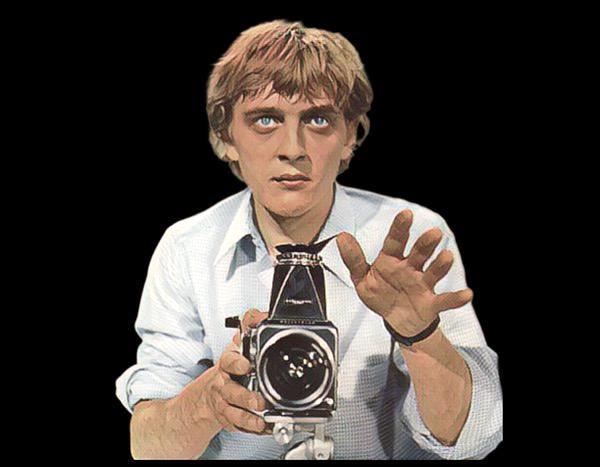
The photographer who existed, or rather, the photographers
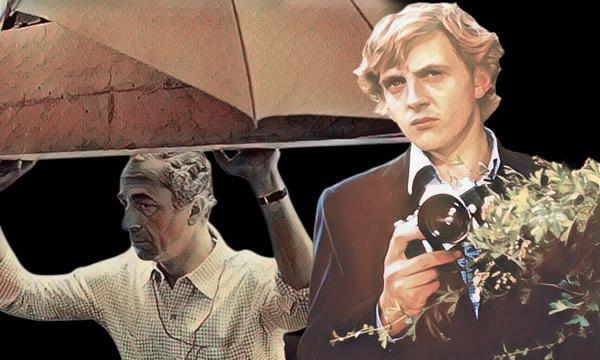
Thomas is often described as being based on David Bailey, one of the photographers who transformed British fashion in the 1960s. That is true, but incomplete. The project itself had initially begun with Carlo Ponti, who read an article by Francis Wyndham about the new generation of working-class London photographers and imagined a film in which Bailey might play himself. Bailey declined, and Ponti eventually brought Antonioni into the project.
Thomas therefore became less a portrait of one man than a composite of an entire phenomenon. There is plenty of Bailey in his boyish looks, arrogance, fame and almost rock-star status, while Antonioni also studied the working habits of other photographers and circulated questionnaires asking professionals not only about their methods but about their lifestyles. The studio scenes were shot in the actual studio of photographer John Cowan, slightly altered for the production, further blurring the border between fictional Thomas and the real photographic world Antonioni was observing.
There was another photographer whose contribution is even more fascinating in retrospect. The black-and-white documentary images in Thomas’s book, including the pictures of homeless men, were made by Don McCullin, then only thirty and on his way to becoming one of the great war photographers of his generation. McCullin also took the photographs used for the crucial Maryon Park enlargements. In other words, some of the fictional evidence that Thomas studies so obsessively was created by a photographer whose real career would become synonymous with documenting realities most people preferred not to see.
Thomas is therefore not simply David Bailey under another name. He is almost an enlargement — a literal blow-up — of the celebrity photographer who had emerged in 1960s London. He does not merely photograph beautiful women; he controls the room, directs bodies, manipulates desire and converts everything around him into material. Even his name is less certain than we remember. He is called Thomas in Antonioni’s treatment and the published screenplay, but nobody actually calls him that in the finished film. The same is true of Jane, Vanessa Redgrave’s mysterious woman from the park.
Early in the film, Thomas emerges from a homeless shelter after spending the night photographing poor men for his book. He is dressed like them, almost as if he has entered their reality, yet soon afterward he slips back into his Rolls-Royce and his fashionable life. The contrast is a perfect summary of his relationship with the world. Thomas enters other people’s realities, takes what interests him and leaves. Poverty can become art, women can become compositions and intimacy can become an image. The trouble begins when one image refuses to remain merely an image.
David Hemmings almost wasn’t Thomas
The role that would define David Hemmings could easily have belonged to someone else. Bailey himself had been considered; Sean Connery was approached but reportedly declined after Antonioni would not give him the complete script, and Terence Stamp came much closer to starring. Stamp was still expected to play the photographer until shortly before production began.
Then Antonioni saw twenty-four-year-old David Hemmings onstage in Hampstead in an adaptation of Dylan Thomas’s Adventures in the Skin Trade. Something clicked. Antonioni replaced Stamp with the relatively unknown Hemmings, and the decision changed his career almost overnight.
It was inspired casting because Blow-Up does not work if Thomas becomes an uncomplicated hero. Hemmings is handsome and magnetic, but he can also be arrogant, restless, childish, bored and vaguely cruel. He invades strangers’ privacy, treats models brutally, uses women, buys objects on impulse and seems incapable of assigning lasting meaning to almost anything around him. When he realizes that he may have photographed a murder, something finally appears that cannot easily be absorbed into his appetite for novelty.
For perhaps the first time, Thomas confronts something that might be larger than himself. At exactly that moment, the man who believes he controls images discovers that reality will not obey him as easily as the women in his studio.
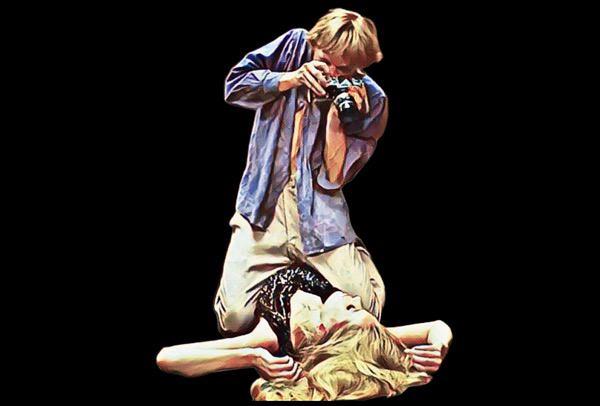
Vanessa Redgrave, Sarah Miles, Veruschka and Jane Birkin
Antonioni also found Vanessa Redgrave on the London stage, where she was appearing in the title role of The Prime of Miss Jean Brodie. She was already a major theatrical actress and was beginning to establish herself on film, but Antonioni wanted to transform her appearance for Jane. Redgrave later recalled that he asked her to dye her hair black and alter her hairline to give her a higher forehead. She agreed.
The result is one of cinema’s great enigmatic performances. Jane seems terrified when she realizes Thomas has photographed her with the older man. She chases him through the park, demands the film and later finds her way to his studio, where she tries persuasion, distraction and seduction. We understand immediately that the photographs matter to her, but Antonioni never tells us exactly why.
Is she protecting the older man? Does she know he is going to be killed? Is she part of the murder? Is she trying to prevent it? Is the apparent killer working with her or against her? Redgrave never telegraphs an answer, and that refusal is essential. Jane is not a puzzle Antonioni forgot to solve. She is part of the film’s insistence that behavior can be visible while meaning remains inaccessible.
Sarah Miles arrived with a very different status from Hemmings. After films such as The Servant, she was already one of the important young actresses of British cinema, but her memories of working with Antonioni were far less romantic. Miles later recalled becoming increasingly frustrated by his refusal to explain the exact relationships among the characters. During one intimate scene, she finally demanded to know what Patricia’s relationship was to the men around her. Antonioni essentially told her it did not matter. Miles replied that if that did not matter, then nothing did, and said she walked away from the production.
The story is almost too perfect for Blow-Up. Miles wanted precisely what audiences would spend decades demanding from the film: an explanation of relationships and meaning. Antonioni was making a movie designed to deny that comfort.
There is also Veruschka, playing a version of herself in one of the most famous fashion shoots ever filmed. Thomas moves around and over her with such physical intensity that photography, sex and power become part of the same choreography. And there is a very young Jane Birkin, alongside Gillian Hills, as one of the two aspiring models who invade Thomas’s studio and eventually tumble around with him in a scene whose nudity would become one of the film’s most notorious elements.
Birkin later admitted that bravery was not quite the reason she agreed to do it. Her then-husband, composer John Barry, had suggested that she would never dare appear nude on screen. She took the challenge. What began as a personal dare helped place Blow-Up in the middle of a much larger battle over what mainstream cinema was allowed to show.
The film that helped blow up American censorship
The nudity and sexual content brought Blow-Up directly into conflict with the American Production Code. MGM belonged to the industry organization operating under the Code and faced a problem: Antonioni’s film could not obtain approval without changes, while the filmmakers had no intention of turning it into something safer.
The solution was almost as mischievous as the movie. MGM used Premier Productions to release Blow-Up in the United States without forcing the studio into a direct confrontation with the Code. The gamble worked spectacularly. Far from being destroyed by controversy, the film became a commercial success, demonstrating just how little power the old censorship system still held over audiences. Its success became another blow to the Production Code, which would be replaced by the modern American ratings system in 1968.
There is an almost perfect irony in that history. A film about the impossibility of controlling exactly what an image means helped prove that Hollywood could no longer control which images audiences were permitted to see.
A simple story becomes impossible
The action that gives the film its title begins when Thomas enters Maryon Park and photographs Jane with an older man. At first there is nothing obviously threatening about the encounter. They look like two people meeting privately in a public place. Thomas himself initially considers the scene peaceful enough to provide a quiet ending for a book otherwise filled with harsher images.
Jane notices the photographer, however, and reacts with such panic that the pictures immediately acquire a new significance. She runs after him, demands the film, and later appears at his studio. Thomas pretends to surrender the real roll but keeps the photographs. When he finally develops them, he notices the direction of Jane’s gaze. She does not seem to be looking only at the man beside her. Something is happening outside what Thomas originally believed to be the center of his picture.
He enlarges that section. Then he enlarges it again. A shape begins to appear among the trees. In another print there seems to be a hand, perhaps holding a gun. In another, an almost abstract patch on the ground begins to resemble the body of the man who had been standing with Jane.
At that moment, photographic investigation becomes narrative investigation. Thomas pins the prints to the wall, rearranges them, follows sight lines and attempts to reconstruct a sequence of events. Without realizing it, he begins doing exactly what Antonioni is doing to us: taking isolated images and forcing them into a story.
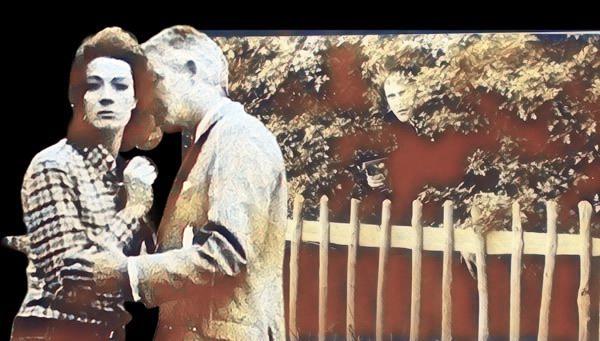
The blow-up sequence and the limits of an image
The sequence that gives Blow-Up its title remains extraordinary because Antonioni builds it with almost radical restraint. The first extended investigation lasts around eleven minutes, with virtually no dialogue and none of the Herbie Hancock music that has accompanied other moments in Thomas’s studio. There is only the photographer, the images, the silence, and our increasing determination to find something inside the grain.
The camera moves from photograph to photograph according to Thomas’s gaze, effectively turning the still images into a storyboard. Then the enlarged black-and-white pictures begin filling the movie screen, and Antonioni brings back the sound of the wind heard earlier in the park. Static photographs start to feel like moving cinema, while the color sequence we witnessed earlier is reconstructed into a different black-and-white version of the same event.
That wind matters enormously. The park has an almost physical sonic presence in Blow-Up. Before there is any murder, there is already unease in the trees, a sense that the empty landscape contains something Thomas cannot see. Antonioni had once written that if he filmed the discovery of a drowned body on a beach, he might remove the body entirely and preserve only the extraordinary tension created by the empty space and sound. Blow-Up operates according to the same principle: what is missing can become more disturbing than what is shown.
The more Thomas enlarges his photographs, however, the less they resemble objective evidence. Details lose definition and dissolve into blotches. The supposed corpse begins to look increasingly like one of the abstract paintings created for Bill’s studio by artist Ian Stephenson. Earlier, Bill explains that his paintings initially mean nothing to him, until he identifies some form inside them and the rest begins to acquire meaning.
That conversation is almost a secret instruction manual for the film. Thomas finds a shape and builds a narrative around it. The danger is obvious: has he discovered something that was there all along, or has he begun to see what he needs to find because he has constructed a hypothesis?
Three years after Kennedy, everybody knew how to examine an image
There is a historical context that makes the sequence even more extraordinary. Blow-Up arrived only three years after the assassination of John F. Kennedy, by which time the world had already become accustomed to studying Abraham Zapruder’s grainy film of the killing frame by frame, searching inside imperfect images for answers to an enormous crime.
For an audience in 1966, Thomas’s ritual of arranging and enlarging images could therefore carry an immediate cultural echo. The patient examination of visual evidence, the strange shapes that might reveal a hidden gunman and the belief that one more look might finally explain everything belonged not only to cinema but to recent history. When Thomas returns to the park and finds the body, the similarity becomes even more unsettling: the ambiguous image seems to have contained a truth after all.
Antonioni then turns that expectation against us. The promise behind examining Zapruder or Thomas’s photographs is that if we look carefully enough, the picture will eventually surrender the answer. Blow-Up proposes something much more disturbing. There may come a point when enlarging an image no longer produces information. It produces abstraction.
Sixty years before our endless commands to zoom, enhance, sharpen, upscale and reconstruct, Antonioni was already asking whether technology necessarily brings us closer to truth. Sometimes it may simply give us a larger version of our uncertainty.
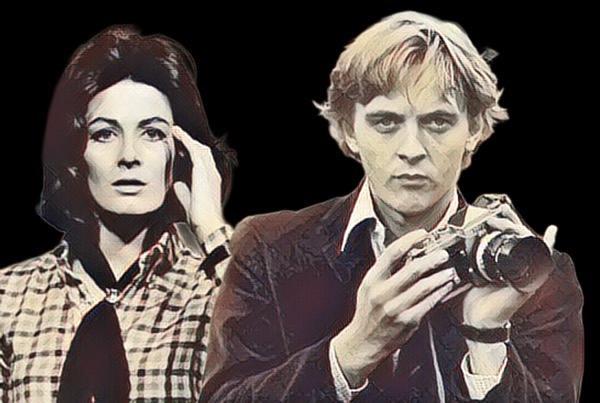
Was there really a murder?
This is the unavoidable question and perhaps also the wrong one. The most literal reading is that there was indeed a murder. Thomas returns to the park at night and sees the body. He approaches it and touches it. Antonioni gives us something far more substantial than a stain in a photograph.
The irony is that Thomas has left his camera behind. The photographer finally encounters the reality he has been trying to extract from an image and cannot photograph it. When he returns to his studio, most of the prints and negatives have been stolen. Only one highly enlarged image remains, so grainy and abstract that it could never prove anything. The next morning, Thomas goes back to the park, and the corpse has disappeared.
For decades, one recurring interpretation has suggested that Thomas might have imagined the murder. It is possible, but I have always found that explanation too easy. Antonioni himself provided a useful clue in his synopsis of the film, describing Thomas as discovering through the photographs an element of reality that really is there. His point was not necessarily that nothing happened. Reality, he suggested, has a freedom that makes it difficult to contain.
The deeper question, then, is not simply whether the crime occurred. Even if it did, can Thomas ever truly know what happened? That becomes even more interesting when we discover that earlier versions of the story were considerably clearer. Antonioni’s treatment and screenplay contained scenes showing Jane and the older man being followed, and another in which she left the park with the apparent killer. There were also suggestions that the photographer himself was being followed. Almost all of this was removed, leaving only fleeting traces in the final film.
In other words, there once was more of an answer. Antonioni deliberately moved away from it. According to the actor Ronan O’Casey, some of those reductions may have been connected to budget pressures, but they also fit Antonioni’s entire artistic logic too perfectly to be dismissed as an accident. By stripping away the mechanics of the conspiracy, he turns what could have been a clever murder mystery into something far more unsettling. The central mystery becomes not who committed the crime, but whether reality can ever be fully captured, organized, and understood.
It was never really about the murder
Antonioni eventually made that distinction himself. In a later interview, he described Blow-Up as being not about a murder but about a photographer. At the time of the film, he made an even broader distinction, saying that what interested him was not the relationship between one person and another but humanity’s relationship with reality.
That is why solving the murder would actually diminish Blow-Up. Knowing who killed the man and why might satisfy the mechanics of a thriller, but it would not solve Thomas’s crisis. What happens when an image seems to reveal something real but cannot establish what that reality means? What happens when evidence survives without explanation, or explanation without evidence?
Thomas begins the film believing that his camera gives him power over reality. The murder teaches him that the camera may know more than he does and, at the same time, may still be incapable of explaining anything.
The Yardbirds, Jeff Beck, Jimmy Page and a worthless piece of guitar
One of the film’s apparently digressive sequences takes place when Thomas wanders into a club where the Yardbirds are performing Stroll On. The lineup makes the scene an extraordinary piece of music history because both Jeff Beck and Jimmy Page are present.
Antonioni had initially wanted The Who. He had become fascinated by Pete Townshend’s habit of destroying guitars onstage and wanted that act of destruction in the movie. When The Who did not participate, the basic idea survived with the Yardbirds, and Beck attacks his malfunctioning guitar and eventually smashes it.
Until then, the audience has appeared almost unnaturally passive. As soon as the broken guitar is thrown toward them, everyone suddenly comes alive and fights for a piece. Thomas joins the struggle, wins the fragment, and runs out of the club with it.
Once he reaches the street and realizes that nobody is chasing him anymore, he looks at the object and throws it away. Another passerby finds it, examines it briefly, and discards it too. Nothing about that broken piece of guitar has physically changed. What disappeared was its context and, with it, its value.
The scene is essential because it quietly prepares us for the ending. Inside the club, a group of people agreed that the object mattered, and therefore it mattered. Outside, it was only broken wood again. Antonioni is already asking how much of what we call reality depends on a shared agreement about what something means.
And then comes the tennis ball.
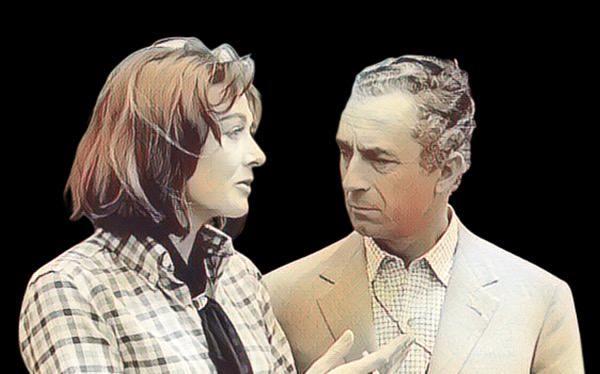
The crime nobody seems to want to hear about
After finding the body, Thomas tries to locate someone with whom he can share what he has discovered. He eventually finds Ron at a party and attempts to tell him that he has seen a dead man, but nobody around him seems capable of responding with the urgency Thomas expects.
There is something quietly sad about this section. Thomas has spent most of the film treating the world around him with indifference. Now he has finally encountered something he cannot easily convert into entertainment, desire, money or art. A man may have been murdered and, perhaps for the first time, Thomas appears genuinely disturbed by another person’s reality.
The world around him continues anyway. The party goes on, people remain distracted, and the night absorbs the possible murder as casually as it absorbs everything else. By morning, when Thomas returns to the park and discovers that the body has vanished, almost nothing remains that could prove what happened.
It is exactly when the mystery seems to have ended without a solution that Antonioni gives us the sequence that explains everything and nothing.
The ball that does not exist, but that we can hear
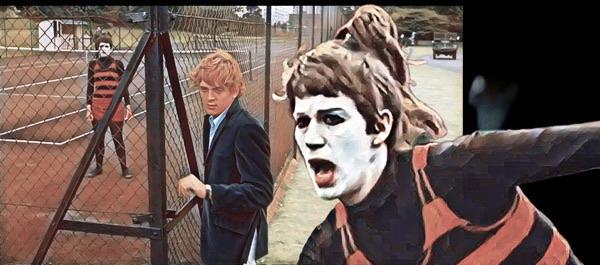
The group of mimes seen at the beginning returns at the end. Two of them enter a tennis court and begin playing a match without rackets and without a ball. Their bodies nevertheless follow the trajectory of the nonexistent object perfectly, while the other mimes watch every exchange. The camera begins to follow it too.
At one point, the imaginary ball flies over the fence and lands near Thomas. Everyone looks at him, expecting him to return it. Thomas now has a choice. He can insist on the obvious — there is no ball — or he can agree to participate in the fiction. He bends down, picks up what is not there, and throws it back.
Then something extraordinary happens. Once Thomas accepts the imaginary ball, we begin to hear it. The dry sound of tennis accompanies the players’ movements. Thomas follows its trajectory with his eyes, and we do exactly the same. The ball has not suddenly materialized, but within the reality of the movie it has acquired presence.
Antonioni’s own synopsis offers one of the most beautiful ways of approaching the scene. By the end of that strange day, he suggested, the photographer has learned a few things, including how to play with an imaginary ball. He compared Blow-Up to Zen and warned that “the moment you explain it, you betray it.”
So what does the tennis game mean?
There cannot be one definitive interpretation without betraying exactly what makes the ending so powerful. One possibility is deeply pessimistic. After failing to prove what he has seen, Thomas gives up on objective reality and accepts collective illusion. If everyone agrees that the ball exists, then the ball exists. Truth becomes a convention shared by enough people.
There is, however, another interpretation I have always found more beautiful. Thomas spends almost the entire film observing the world without truly participating in it. His camera acts as a barrier. He photographs people, directs models, spies on a couple, records poverty, and watches his friends, but always maintains some distance between himself and whatever is happening.
At the end, perhaps for the first time, somebody asks him to participate in an image that he did not create. Thomas is not controlling the frame, pressing the shutter, or turning another person into an object. He simply agrees to enter the game. Perhaps he has not surrendered reality at all. Perhaps he has discovered that seeing also requires imagination and that existence cannot always be reduced to what can be documented.
There is also a third interpretation that turns the ending into an extraordinary joke about cinema itself. We are Thomas. We have spent nearly two hours trying to decide which images are true while watching a work made entirely of images that we know are not real. Thomas does not exist. Jane does not exist. The corpse does not exist. The murder does not exist. There are actors, light, sound, editing, and our willingness to believe.
The invisible tennis ball is simply the most explicit version of the agreement we made when the film began. Antonioni gives us movement, reaction and finally sound, and our brains do the rest. If we are prepared to believe in that ball, how much more truthful should we assume a photograph to be?
And then Thomas disappears
After the match, Thomas remains alone on the grass. Antonioni moves the camera farther and farther away until the photographer becomes a small figure inside the landscape. Then Thomas simply disappears from the image.
The gesture is simple and devastating. If cinema can transform a nonexistent ball into something we can hear, it can also transform a man we have watched for nearly two hours into something that suddenly ceases to exist. The image was never a neutral window onto reality. It has always been a construction controlled by the person deciding what remains inside the frame.
That disappearance also connects Blow-Up with Antonioni’s earlier films. In L’Avventura, Anna vanishes and is never recovered. In L’Eclisse, the central characters effectively disappear before the film itself ends, leaving Antonioni to contemplate the spaces they once occupied. Empty landscapes, streets and rooms are never merely backgrounds in his cinema; they can survive their characters and sometimes seem more permanent than the people moving through them.
Thomas, a man who began by believing that he could decide what the world looked like, ends by being removed from the image entirely.
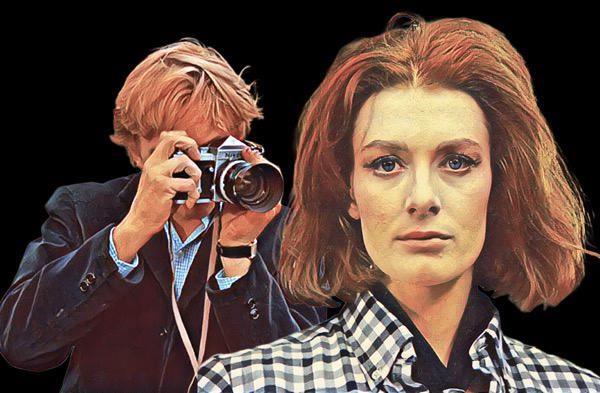
Antonioni even changed reality before photographing it
Blow-Up is often remembered as one of the ultimate time capsules of Swinging London, but Antonioni was never a documentary observer simply recording whatever happened to stand before his camera. He had already pushed color manipulation to remarkable extremes in Red Desert, and in London he continued physically modifying reality to create the image he wanted.
Buildings were repainted, roads were darkened, the grass in Maryon Park was made more intensely green, and a white fence was added to the landscape. Antonioni was not merely photographing Swinging London; he was redesigning it before photographing it.
The irony could hardly be more perfect. A film about our inability to trust images completely presents us with a London that the director himself altered before placing it in front of his camera. The city feels real precisely because Antonioni has manipulated reality to make it fit his vision.
That visual control is one of the reasons Blow-Up remains so beautiful. Carlo Di Palma’s cinematography, Jocelyn Rickards’s costumes, the new British architecture, the fashion models and Antonioni’s astonishing handling of color create an almost intoxicating surface. Yet the film continually warns us that beautiful surfaces are not the same thing as truth.
What Blow-Up changed
Antonioni also performed something radical on the thriller itself. Blow-Up contains almost everything a conventional mystery requires: a possible murder, a victim, a hidden figure who may be a killer, a witness, evidence and someone attempting to discover what happened. The only element Antonioni removes is precisely the one the genre normally promises: the solution.
That refusal initially produced both fascination and frustration, and it’s part of the achievement. Antonioni builds the machinery of suspense so efficiently that we desperately want him to finish the detective story, and then refuses. Instead of discovering who murdered the man in the park, we are left wondering what it means to discover anything at all.
The gamble succeeded. Blow-Up became Antonioni’s greatest commercial success and won the Grand Prix International du Festival, the top prize at the 1967 Cannes Film Festival. It is often retrospectively described as a Palme d’Or winner, but Grand Prix was the official name of the award that year. The film also received two Academy Award nominations, for Antonioni’s direction and for its screenplay.
From Zapruder to Watergate: Blow-Up was looking both ways
There is another reason the film became so influential. Blow-Up appeared at a moment when Western culture was becoming increasingly suspicious of official explanations and increasingly obsessed with recorded evidence. Behind it stood Kennedy and the endless examination of Zapruder’s images. Ahead lay Watergate and the great paranoid cinema of the 1970s.
Seen in that continuum, Blow-Up feels like a bridge between two eras. It absorbs the anxiety that an image might contain a hidden truth and anticipates a decade of stories about institutions, conspiracies, surveillance and evidence that can be captured without necessarily being understood. The Guardian’s Anthony Quinn connected the film not only to The Conversation but also to The Parallax View, both released in 1974, at the height of that American paranoid cycle.
Francis Ford Coppola’s The Conversation may be the most obvious descendant. Instead of a photographer repeatedly enlarging an image, Gene Hackman’s surveillance expert repeatedly listens to a recorded conversation and rearranges its emphasis, trying to determine whether the tape has captured evidence of a murder. Technology has recorded more than its operator initially understood, but interpretation changes what the evidence appears to mean.
Brian De Palma made the genealogy even more explicit with Blow Out in 1981. John Travolta plays a sound technician who accidentally records what may be evidence of a political murder. Even the title answers Antonioni directly: Blow-Up, Blow Out. In one, the photograph promises truth; in the other, sound does. Both, to my personal point of view, are flawed because they “explain” what really happened and highlight the frustration as the lack of proof as the drama.
The mechanism has since become so familiar that we barely notice its origin. Countless films and television series depend on photographs, recordings, security cameras and tiny details waiting to be isolated or enlarged. Mainstream storytelling, however, often turns Antonioni’s idea into reassurance. Enhance the photograph enough and eventually the truth will appear.
Antonioni imagined the more disturbing possibility first. Enlarge it. Look closer. Enlarge it again. Eventually, you may understand less.
Sixty years later, we are still enlarging
Perhaps that is exactly why I still love Blow-Up. The murder is almost irrelevant and yet absolutely necessary. We need to want to solve it before we can discover that Antonioni is interested in something much larger than the identity of a killer.
He is talking about images, desire, art, technology, perception, and the value we assign to things. He is talking about the distance between looking and actually seeing, but also about the arrogance of believing that if we examine something closely enough, we will inevitably understand the whole.
Thomas begins the film convinced that he controls images. He chooses the frame, directs bodies, decides what deserves to be seen, and transforms the world into photographs. Then his camera records something without his knowledge, the photograph acquires a meaning he never intended, the evidence disappears, and finally Thomas himself is erased from Antonioni’s frame.
Sixty years later, we are still staring at those enlargements. There may be a gun. There is apparently a corpse. Jane may know exactly what happened. Thomas may have come extraordinarily close to the truth. Yet the closer we move, the larger the grain becomes, the more the outlines dissolve and what appeared to be an answer returns to being an image.
Somewhere in the distance, we can still hear a tennis ball that does not exist. After everything Antonioni has shown us about photographs, evidence, and reality, the extraordinary thing is that we believe in it anyway.
Descubra mais sobre
Assine para receber nossas notícias mais recentes por e-mail.

