
If you could erase the worst version of yourself and start again, who would you choose to be? At first, Chad Powers seemed to be merely a sports comedy built around an idea as absurd as it was effective: a disgraced football player creates a new face, a new voice, and a new history in an attempt to revive his career. Beneath the prosthetics, the fake hair, and the physical comedy, however, the series has always been about an extremely contemporary fantasy: the belief that all we need to do is manufacture another image in order to become someone else.
Russ Holliday, played by Glen Powell, once had everything we tend to mistake for identity. He was handsome, talented, famous, and only a few inches away from becoming a college football hero. Then, out of arrogance, he celebrated a play too soon, dropped the ball, and cost his team the game. He might still have recovered from the sporting mistake. What destroyed his career was his reaction: unable to bear the humiliation, Russ lost control in front of the cameras and turned a failure into a scandal.
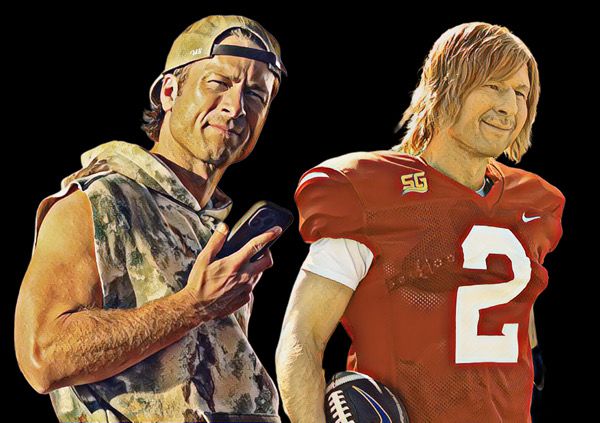
Eight years later, he was still living among trophies, resentment, and the expectation that someone would restore what he believed rightfully belonged to him. Russ did not know who he was without football because he had never needed to find out. His identity had been built from the outside in, sustained by applause, appearance, and other people’s gaze. When that gaze shifted from admiration to contempt, very little remained.
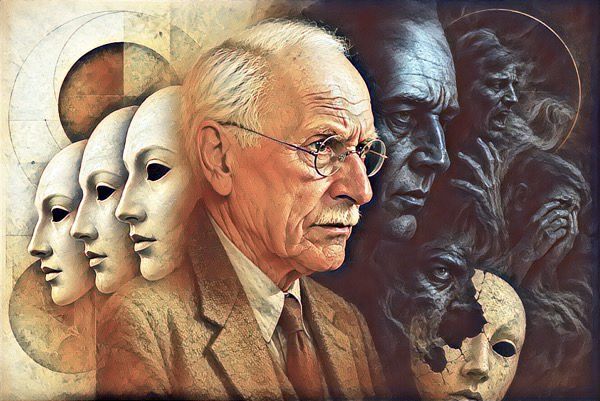
This is why the story lends itself so well to a reading through Carl Gustav Jung. For Jung, the persona is the face we present to the world, a kind of social mask that allows us to occupy roles, coexist with others, and be recognized. We all use personas. We behave differently at work, with our families, among friends, or in front of strangers, and that does not necessarily make us false. The problem begins when someone identifies completely with the mask and can no longer recognize what exists behind it.
Russ was already living that way before inventing Chad. The admired, confident, nearly invincible athlete was his first persona. He projected success, masculinity, and power, but had developed none of the inner resources required to survive their loss. His disastrous reaction was not born solely from a botched play. It came from the collapse of a man who, without the character of the winner, possessed no remotely stable sense of self.
His father, Mike, happens to be a Hollywood makeup artist. The choice is almost too obvious, but it works: Russ was raised by a man who creates faces for fictional characters and, when he can no longer bear his own face, he turns to his father’s craft. Mike loves him, but finally resorts to what we call tough love. Rather than continuing to enable his son’s paralysis, he makes Russ work and confront the life that remains. Russ responds not by processing his loss, but by stealing a possible escape. With prosthetics, a wig, and an improvised voice, he creates Chad Powers and attends an open tryout for the struggling South Georgia Catfish.
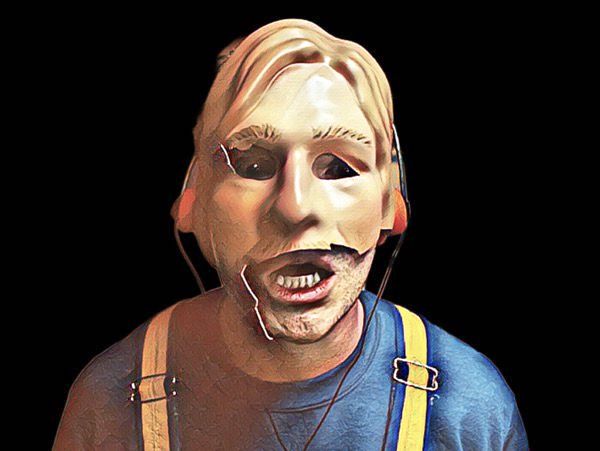
Chad was supposed to be nothing more than a disguise. Gradually, however, he becomes something much more complex. He is kind, humble, generous, innocent, and capable of forming real bonds. He is also an extraordinary player because he carries Russ’s talent without, at least apparently, carrying his narcissism. The people who would reject Russ embrace Chad. His teammates trust him, Danny becomes his accomplice, and Ricky falls in love with the man she believes exists beneath that strange appearance. This is where the series poses its most compelling question: is Chad a lie, or is he a genuine part of Russ that could only emerge while protected by a lie?
In Jungian psychology, the shadow contains aspects of ourselves that the ego refuses to recognize and therefore pushes outside consciousness. We tend to imagine it exclusively as a repository for aggression, envy, selfishness, or cruelty. But the shadow can also hold positive qualities that have been repressed because they do not fit the image we have constructed of ourselves. In Russ, arrogance, rage, and the desire to be worshipped belong to the shadow he refuses to confront. At the same time, kindness, vulnerability, and the ability to belong may also have been banished by the character of the perfect athlete.
Chad is born from this split. He is not simply Russ’s opposite, much less an entirely new person. He is an assemblage of everything Russ would like to be, everything he needs to appear to be, and possibly genuine parts of himself that he never learned to live without the shelter of a mask. Beneath the false face, Russ can ask for help, accept ridicule, and play with others rather than solely for his own glory. Paradoxically, he needs to lie about who he is in order to experience a measure of truth.
The problem is that no transformation can survive when it depends upon the complete denial of the past. Russ does not integrate Chad into his personality; he tries to use Chad to eliminate Russ. During the first season, he even contemplated permanently changing his face, as though he could kill the man who failed and preserve only the version people loved. This is the moment when the mask begins to stick to his face. Instead of helping him move through the world, the persona threatens to take the place of his identity.
The second season returns precisely when that fantasy begins to exact its price. Ricky has discovered the truth. Danny is already participating in the deception, while the people who gave Chad an opportunity realize that Russ can destroy them as well. If they expose the scheme, they lose their quarterback, their season, their credibility, and perhaps their careers. If they protect the secret, they become accomplices in a fraud they never chose. The lie ceases to function merely as an individual defense mechanism and begins to organize an entire group.
This is where Chad Powers becomes darker without abandoning comedy. The question is no longer simply whether the wig will fall off or someone will recognize Russ. What matters now is who will pay for the redemption he decided to build without anyone else’s consent. Russ may be becoming a better person, but he has done so by appropriating other people’s trust, affection, and dreams. Even his good deeds remain tainted by a narcissistic origin: Chad was created to return Russ to the spotlight he lost.
Narcissism does not need to be treated as a diagnosis here. It appears instead as a way of organizing life around one’s own reflection. Russ depends on the external gaze to exist, cannot tolerate shame, and turns people into an audience, an instrument, or a threat. Chad seemed to correct that pattern because he was capable of seeing others. Now, however, Russ will have to prove that the change is real—not while he is being celebrated, but when doing the right thing may cost him exactly what he desires most.
Individuation, another central Jungian concept, does not mean choosing between an enlightened persona and a shameful shadow. It means recognizing our contradictions, integrating what has been repressed, and abandoning the belief that we are only the version of ourselves we prefer to display. Russ will not become whole by destroying Chad, but neither can he save himself by disappearing inside him. He will have to admit that he is the arrogant man who fell, the athlete who still possesses talent, the son incapable of moving forward, and also the affectionate person who emerged when no one knew his real name.
Perhaps this is why a series inspired by an Eli Manning prank says so much about our time. Today, we do not need prosthetics made by a Hollywood makeup artist to create alternate versions of ourselves. We have profiles, filters, avatars, résumés, narratives, and identities carefully edited for every environment. None of these masks is necessarily false. Each reveals something and conceals something else. The danger lies in needing them more and more simply to endure who we are when no one is watching.
Ultimately, Chad Powers is not asking whether Russ will be exposed. It is asking what will remain when he is. If we could all create a mask capable of restoring love, recognition, and purpose, it would probably be difficult to resist. The more uncomfortable question is this: after living long enough as the person we wished we could be, would we have the courage to remove the mask and admit that it had always been part of us too?
Descubra mais sobre
Assine para receber nossas notícias mais recentes por e-mail.

