
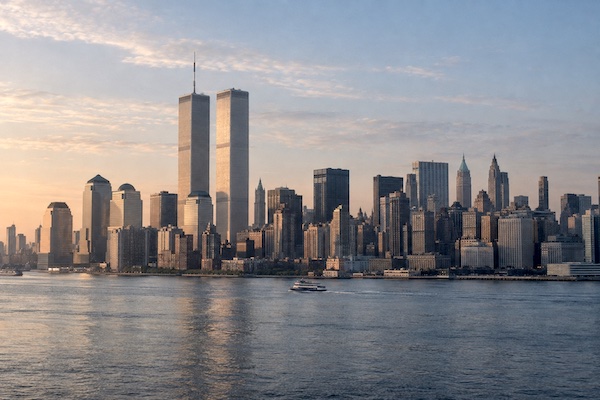
For a while, cinema did not know what to do with September 11. The real images were already so violent, so endlessly repeated, and so deeply embedded in our collective memory that any attempt to recreate them risked turning trauma into spectacle. At first, Hollywood removed the Twin Towers from posters, trailers, and completed films. Then, slowly, it began trying to understand not only what happened that morning, but also the world that emerged from it.
Twenty-five years later, no single work can explain 9/11 because the attacks did not produce only one story. There is the story of the victims, survivors, and their families; the firefighters and police officers; the failures of the intelligence services; the wars launched in their aftermath; and the Islamophobia, torture, and surveillance authorized by fear. The best films, series, and documentaries are precisely those that resist the temptation to reduce everything to a simple answer.
The Guys and Reconstruction Through Words
The Guys holds an especially personal place on this list because it grew out of the experience of Anne Nelson, my professor and mentor at Columbia University. Shortly after the attacks, Anne was approached by a New York Fire Department captain who needed to write eulogies for eight members of his company who had been killed at the World Trade Center. He knew each of them, but he could not transform his grief into words.
Anne helped him reconstruct who those men had been beyond their uniforms and the numbers. The play premiered at the Flea Theater on December 4, 2001, less than three months after the attacks, starring Sigourney Weaver and Bill Murray. In 2002, it became a film directed by Jim Simpson and starring Weaver and Anthony LaPaglia.
It is not a film about the towers falling, but about the quiet work of restoring individuality to the victims. How do you speak about someone when the collective scale of a tragedy threatens to erase their personal story? In The Guys, language does not resolve grief, but it offers a way through it.
The Looming Tower and Everything That Came Before
While The Guys addresses the immediate human consequences, the miniseries The Looming Tower tries to understand what came before. Based on Lawrence Wright’s book, it follows the rise of Al-Qaeda and, above all, the rivalry between the FBI and the CIA in the years leading up to the attacks.
Starring Jeff Daniels, Peter Sarsgaard, and Tahar Rahim, the series shows how fragmented information, institutional disputes, and egos helped prevent the authorities from recognizing the threat taking shape before them. It does not present a conspiracy capable of explaining everything, but something perhaps even more disturbing: people who possessed crucial pieces of the truth and institutions incapable of putting them together.
United 93 and the Experience of Real Time
In United 93, Paul Greengrass reconstructs the hijacking of the plane that crashed in Pennsylvania after passengers and crew members fought back against the terrorists. The film avoids conventional heroism and works through the confusion of people who still did not understand the scale of the attack.
We know what is happening because we know the history. They do not. They receive incomplete information through phone calls, learn that other planes have been turned into weapons, and gradually understand that their flight probably has a target as well. It is this difference between what the audience knows and what the passengers are only beginning to discover that makes the film so harrowing.
Greengrass offers no relief, patriotic speech, or comforting victory. What exists is a group of people trying to act when every remaining possibility is already terrible.

The Documentaries That Preserved That Morning
Among the most important records is 9/11, by brothers Jules and Gédéon Naudet with James Hanlon. The project began as a documentary about a rookie firefighter but ended up recording the life of a firehouse during the attacks. Jules captured one of the rare images of the first plane striking the North Tower and entered the complex with the firefighters.
102 Minutes That Changed America reconstructs the period between the first impact and the collapse of the second tower through footage recorded by journalists, residents, and people in the streets. The absence of a dominant narration preserves the disorientation of that moment, when no one yet had a ready-made narrative to explain what they were seeing.
9/11: One Day in America brings together testimonies from survivors, first responders, and witnesses, reconstructing the events in chronological order. The documentary restores a human dimension to images that, through endless repetition, risk becoming nothing more than historical symbols.
The Wounded City of 25th Hour
Not every important film about September 11 addresses the attacks directly. Released in 2002, Spike Lee’s 25th Hour tells the story of a man sentenced to seven years in prison who spends his final hours of freedom in New York.
The plot is not about terrorism, but the city is wounded. The void left by the towers appears in the landscape and in the behavior of the characters. Spike Lee was one of the first filmmakers to look directly at that absence without needing to turn it into the center of the story. His film understands that New York was still alive, but it had already become a different city.
The World That Came After
As the years passed, cinema began looking at the political and moral consequences of the attacks. Zero Dark Thirty follows the hunt for Osama bin Laden, but it sparked debate over the way it depicted torture and its supposed effectiveness.
The Report examines the CIA’s post-September 11 interrogation and torture program. The Mauritanian tells the story of Mohamedou Ould Slahi, who was held at Guantánamo Bay for years without being formally charged. These are films about the moment when fear began to justify practices that democracies claimed to condemn.
Worth follows attorney Kenneth Feinberg as he creates the compensation fund for the victims’ families. Its question is cruel but unavoidable: how do you determine the financial value of a human life? The film exposes the conflict between legal formulas and stories that cannot be contained by calculations.
There is also Top of the World, a documentary by Julie Cohen and Betsy West about the employees of Windows on the World, the restaurant located at the top of the North Tower. By recovering their stories, the film returns to the same principle that guides The Guys: before they became numbers associated with a tragedy, these people had jobs, families, ambitions, and routines.
A Story That Has Not Ended
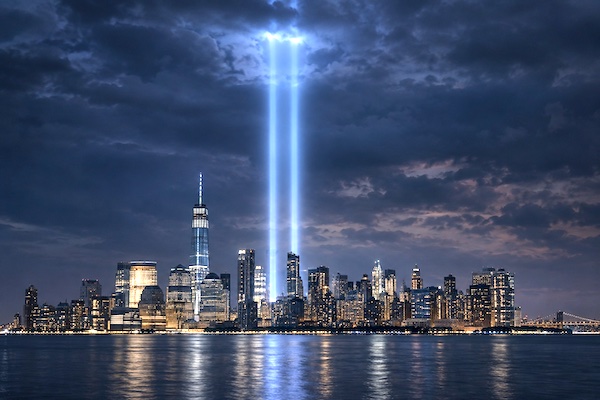
Cinema took time to understand that it did not need to recreate the planes striking the towers to speak about September 11. In many cases, the most powerful works are those that look at what came before, at the absences left behind, and at the decisions made in the name of a fear that crossed borders and generations.
Twenty-five years later, September 11 still divides history into a before and an after. These films, series, and documentaries cannot completely explain the inexplicable, but they help preserve the people behind the images and allow us to understand how that morning remains present in the world we inhabit.
Descubra mais sobre
Assine para receber nossas notícias mais recentes por e-mail.

