
On September 16, two series adapted from thriller novels arrive on streaming platforms, attempting to answer the same question: what should you do when a franchise succeeds? The coincidence makes the difference between their answers even more interesting. While Slow Horses prefers to deepen the universe it has already built, Neagley takes a character from Reacher and tries to place her at the center of a new story.
It is possible to grow inward or outward. A franchise can remain with the same characters, allowing time, loss, and consequences to accumulate. Or it can expand sideways, searching within its own cast for someone capable of sustaining a second series. Neither strategy is necessarily better. The danger begins when expansion responds more to the need to prolong a brand than to the existence of a story that genuinely deserves to be told.
Slow Horses reaches its sixth season without appearing interested in abandoning Slough House. Jackson Lamb remains Jackson Lamb: brilliant, unpleasant, offensive, and more observant than he wishes to appear. River Cartwright continues to pursue the heroism that the intelligence service insists on denying him. Catherine Standish, Louisa Guy, and the other agents have not been reorganized to turn the series into a universe of spin-offs, origin stories, and individual adventures. They remain together because the coexistence of failures, survivors, and discarded employees is precisely what gives the production its identity.
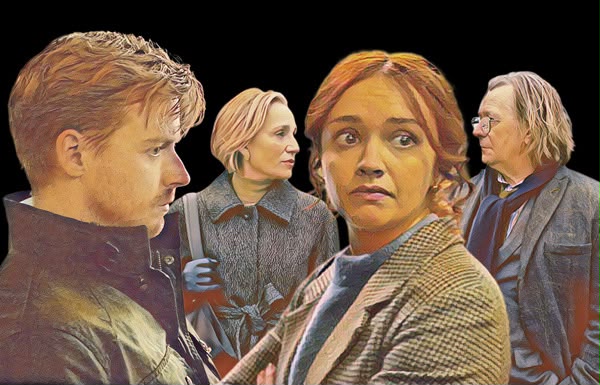
The new season adapts elements from Joe Country and Slough House, two novels by Mick Herron, and places the agents in the crosshairs of a revenge operation involving Diana Taverner. Gary Oldman, Jack Lowden, Kristin Scott Thomas, and Saskia Reeves return, as does Olivia Cooke, whose Sid Baker has not appeared since the first season. Six episodes will be released weekly through October 21.
Sid’s return encapsulates the series’ method. Slow Horses does not need to invent a new branch to create something new. It can return to its own past, recover a missing character, and discover what her presence changes in people who believed they had lost her. Continuity becomes more than simple loyalty to the cast; it becomes dramatic material.
There is also an important change behind the scenes. Gaby Chiappe takes over as lead writer after Will Smith—the British writer, not the actor—ran the first five seasons. Combining two books in a single season accelerates the adaptation and increases the risk of compression, but it does not change the series’ guiding principle: Slough House remains its center of gravity.
Neagley follows the opposite path. Frances Neagley emerged as one of the few people Jack Reacher trusts completely. Competent, reserved, independent, and disinclined to explain what she feels, she worked as a presence capable of entering the story without competing with its protagonist. Maria Sten turned that restraint into a signature.
Neagley now receives eight episodes of her own. The character is working as a private investigator in Chicago when she learns of a friend’s suspicious death and sets out to find those responsible. Prime Video will make the entire season available on the same day. Alan Ritchson guest-stars as Reacher and appears in the opening, but his presence serves a delicate purpose: reminding viewers where Neagley came from without preventing her from proving where she can go.
That is the spin-off’s real challenge. Neagley was interesting because the series did not explain her too much. Her mystery was part of her magnetism, and her remarkable competence became more impressive because it appeared in controlled doses. Sustaining eight hours requires giving her a past, conflicts, and some form of vulnerability. But explaining too much could destroy the very quality that made the character fascinating.
There is also a more obvious danger: turning her into nothing more than a female version of Reacher. She possesses military training, intelligence, resources, physical strength, and a very particular relationship with intimacy and physical contact. But repeating the structure of the solitary hero who arrives in a town, uncovers a conspiracy, and punishes the guilty would mean changing the protagonist’s body without changing the formula.
And Neagley arrives precisely as Reacher begins to show signs of exhaustion. The fourth season demonstrated that the series works best when it keeps the plot close to its hero, its characters, and conflicts viewers can understand. By pursuing increasingly grand conspiracies, it risks becoming a prisoner of the very scale intended to reaffirm its success. The spin-off could be an intelligent correction: Neagley has a profession, a city, and more stable relationships, elements capable of producing a different world. It could also simply duplicate the machine.
The expansion is so deliberate that it will extend beyond television. Zero Margin, the first novel centered on Neagley, will be published in 2027, written by Lee Child and Yasmin Angoe. This time, the television expansion is not merely adapting the literature; it is helping to create a new literary branch of the franchise. The character left the books, gained greater importance on television, and will now return to the page already promoted to protagonist.
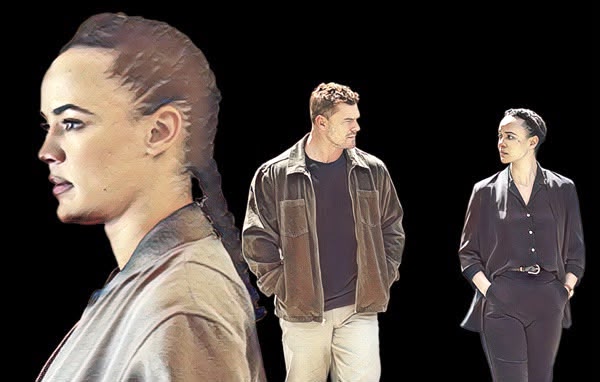
The release strategies also reveal different philosophies. The six weekly episodes of Slow Horses preserve suspense, allow each betrayal to be discussed, and keep the series in circulation for more than a month. The eight episodes of Neagley, released simultaneously, must produce an almost immediate response. Within days, we will know whether audiences genuinely wanted a series about the character or merely enjoyed encountering her beside Reacher.
Slow Horses wagers that a franchise grows by understanding its characters more deeply. Neagley wagers that it grows by discovering which of them can survive independently. One works through depth; the other through expansion. One turns the past into consequences; the other turns popularity into possibility.
Perhaps both will succeed. But the true test of a franchise is not how many stories it can produce. It is knowing whether each new story exists because someone needed to tell it—or simply because enough people still recognize the name.
Descubra mais sobre
Assine para receber nossas notícias mais recentes por e-mail.

