
For some time now, I have had the feeling that, culturally, we are stuck somewhere between the 1980s and the 1990s. I do not necessarily mean that as criticism. I lived through those decades; I love much of what they produced, and I do not need much encouragement to go back to certain films or songs. But all you have to do is look around to realize that we are not simply remembering that period. We are rebuilding it, reselling it and, in a way, trying to return to it.
Cinema may be the most obvious example. Sequels made decades later, characters brought back, actors returning to the roles that turned them into stars. Sandra Bullock and Nicole Kidman are together again in Practical Magic 2, almost 30 years after the 1998 film, a movie that was not even a major hit when it first came out and only later achieved cult status. That is exactly where contemporary nostalgia becomes interesting: we are not only reviving the great triumphs of the past; we are also bringing back what collective memory eventually decided to love.
Hollywood realized a long time ago that emotional memory is good business. The advantage of resurrecting a familiar title is obvious: before the trailer even arrives, there is already an emotional relationship with the audience. Viewers do not need to learn who these people are or why they should care about them. They arrive carrying memories. And perhaps that is precisely why so many of these projects are sold less as new stories than as reunions.
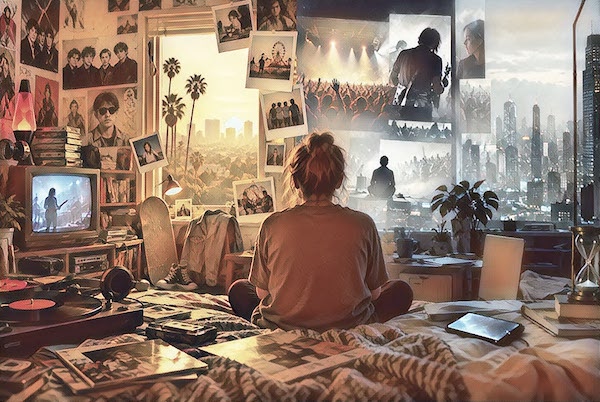
In music, however, the phenomenon seems even more revealing to me. Oasis returned to the stage in 2025, 16 years after their split, in a tour that brought more than two million people to their shows, and now that comeback has become a documentary. What for years seemed virtually impossible- Noel and Liam Gallagher sharing the same stage again- became one of the biggest recent music events.
And Oasis is far from an isolated case. New Order is returning to South America in 2026, with two shows scheduled in São Paulo in November. The Cure spent the European summer of 2026 touring festivals and arenas. Radiohead, which returned to live performance in 2025 after years away from the stage, has already announced a new run of concerts for 2027 in Australia and Japan. Bands that formed the soundtrack to teenagers growing up in the 1980s and 1990s are not quietly surviving on the nostalgia circuit. They are still filling arenas, festivals and headlines.
Perhaps because when we talk about music, we are not talking only about taste. We are talking about identity. Psychology even has a term for something closely related to this: the reminiscence bump. We tend to retain especially intense memories of the music we heard during adolescence and early adulthood, precisely at the stage when our identity is being formed. That is why a song first heard at 15 or 20 can still provoke a much stronger emotional response decades later.
That is where the phrase “music was better back then” becomes more complicated. Maybe it was, maybe it was not, but we were certainly different when we heard it. When someone goes back to The Cure, New Order, Radiohead or Oasis, they are not necessarily looking only for Robert Smith, Bernard Sumner, Thom Yorke or the Gallagher brothers. They may be reconnecting with the person they were when they first heard those songs.
Nostalgia is deceptive precisely because it seems to be about the object when, very often, it is about ourselves. We do not miss only a particular film, album, or television series. We miss where we lived, the people who were with us, those who were still alive, the body we had, the possibilities that still seemed open. A three-minute song can bring all of that back without asking permission.
But there is another element that helps explain why this obsession has gone beyond the generation that actually lived through the 1980s and 1990s. Young people born much later are discovering those songs, films, clothes and objects as if they were new. For them, there is no autobiographical memory. There is a kind of nostalgia for a time they never lived.
And perhaps that is the most fascinating part of the phenomenon.
Anyone who grew up without a smartphone can perfectly remember the annoyance of arranging to meet someone and then waiting because there was no way to know where they were. Someone born with a phone in their hand, however, may look at that disconnected world as a fantasy of freedom. Cassette tapes, analog cameras, landlines, vinyl records, and even the absence of social media acquire a romantic aura because they belong to a period when, apparently, we were not being watched, evaluated, photographed, and located all the time.
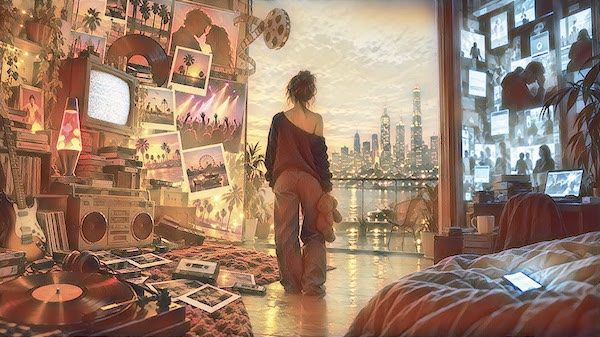
It is a fantasy, of course. The 1980s and 1990s were far from innocent. There were wars, AIDS, recessions, violence, prejudice, political crises, and an enormous number of problems that memory conveniently softens when it creates its own version of the past. Nostalgia is never a documentary. It edits.
Perhaps that is why it flourishes so easily in periods of uncertainty. Research on nostalgia suggests that it can reinforce continuity, belonging, and meaning when the present feels unstable. We mentally return to familiar moments in order to rebuild some sense of connection between who we were and who we are.
And, let us be fair, the present offers plenty of material for anxiety. We live surrounded by artificial intelligence, wars, climate crisis, social media, algorithms, information overload, and a permanent sense that everything is changing too quickly. Against that backdrop, the 1980s and 1990s begin to occupy, symbolically, the place of a “world before.” Before we were connected 24 hours a day, before every preference became data, before nostalgia itself could be detected by an algorithm and immediately sold back to us.
Which is quite ironic. We look for the 1990s to escape the algorithm, and it is the algorithm that puts Oasis in front of us again.
That is why I do not think the current obsession with the 1980s and 1990s is only about Hollywood’s creative laziness, a lack of new bands, or our cultural inability to move forward. All of that exists too, obviously, and the market has learned very well how to turn our memories into products. But there is something emotionally deeper happening.
Maybe we are not trying to go back to the 1980s or 1990s.
Maybe we are trying to go back to the feeling that we still had so much time ahead of us.
Descubra mais sobre
Assine para receber nossas notícias mais recentes por e-mail.

