
WARNING: This article contains spoilers for the first season of Neagley.
There is something Jack Reacher knows how to do surprisingly well for a man who walks through walls, breaks bones, and solves a considerable number of his problems with his fists: respect boundaries. Ever since we first met Frances Neagley, we have known that she does not like to be touched. Reacher knows it too. And for many years, that was enough.
In Lee Child’s books, Neagley’s haphephobia — also called haptophobia or aphephobia, an intense fear of touching or being touched — is a characteristic of the character, not a mystery that needs to be solved. She does not want people touching her; Reacher does not touch her, and perhaps their friendship is even more beautiful because he never demands an explanation before respecting the boundary she has established.
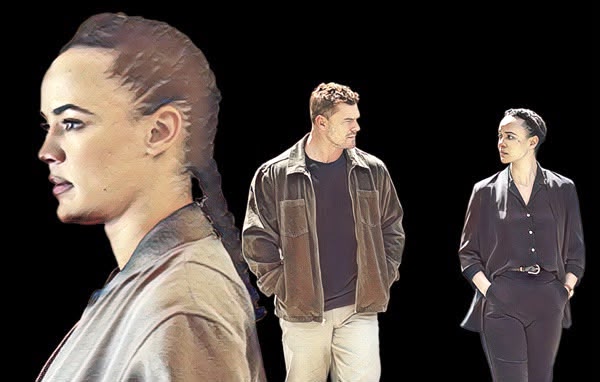
Haphephobia goes beyond simply disliking hugs or preferring more personal space. When it reaches the level of a specific phobia, physical contact can trigger intense anxiety, fear, bodily tension, or an urge to escape, and people may organize parts of their lives around avoiding situations in which they might be touched. Not everyone who dislikes physical contact has a phobia: sensory sensitivity, trauma, anxiety, and individual boundaries can produce similar behavior. Neagley, however, is portrayed at the extreme end of that spectrum. Even contact from people she trusts can be difficult, and the avoidance is persistent enough to shape how she relates to almost everyone around her.
Like other specific phobias, haphephobia can be treated. Cognitive behavioral therapy and gradual, carefully controlled exposure are among the approaches commonly used for phobic anxiety, while broader psychotherapy may be useful when the fear is connected to trauma or other emotional experiences. Medication can sometimes help manage associated anxiety, but it does not by itself explain or resolve the underlying fear. And that distinction becomes especially interesting in Neagley’s case, because the series chooses not only to name her fear but to give it an origin.
What makes this particularly interesting is that it was not an omission on the author’s part. Lee Child has been asked directly about the origin of Neagley’s condition and replied that nobody knew, not even him. He also said he could have chosen the conventional explanation and written some form of sexual violence into her military past, but that he did not want to go down that road because it felt like a cliché. For Child, there was value in allowing this part of Neagley to remain unknown.
The new series Neagley thinks differently.
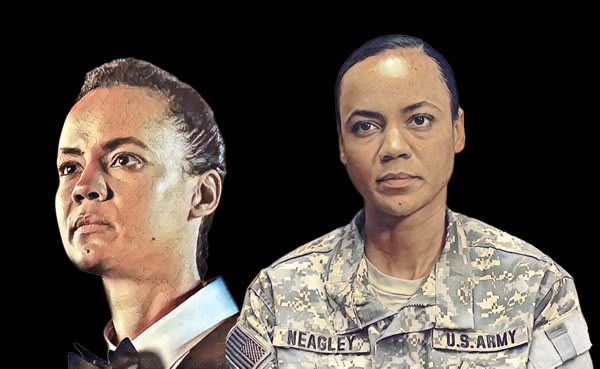
Maria Sten has explained that the characteristic has always been there in the books, but that once Neagley became the center of her own series, the writers felt they needed to answer the question of where it came from. It is an understandable choice. Putting Neagley at the center means entering her childhood, her family, and everything the main series could afford to leave at the edges. Sten has also described the season as an exploration of the different ways people experience and carry trauma. And so Neagley does exactly what Lee Child had chosen not to do: it finds an originating scene.
Over the course of the season, Frances recovers childhood memories and discovers the truth about Elliot Percy, the man she saw her father kill when she was still a child. Percy had abused Tommy, her friend, and Calvin Neagley killed him after discovering what had happened. Frances’s trauma, therefore, does not come from having been the victim of that abuse herself, but from witnessing the violence and, above all, from what happens immediately afterward: her father grabs her, shakes her, and promises that no one will ever touch her again. The series turns that moment into the point from which touch becomes associated with fear. Dramatically, it works. But I kept wondering whether it was necessary.
We are living through a period of storytelling in which knowing a character seems increasingly to mean discovering the trauma that made them who they are. It is as though no idiosyncrasy, defense mechanism, fear, or boundary can simply exist. We need to locate the moment that explains everything, return to it, name it and, preferably, offer some possibility of resolution before the final credits roll.

Literature allows more easily for the opposite. People are partly unknowable, even to those who love them. Sometimes we do not know why we are a certain way; sometimes we know only part of the reason; sometimes we build explanations afterward because living with a narrative is more comfortable than living without one. Lee Child left that space open in Neagley and, in doing so, also created something very particular in her relationship with Reacher: he does not need to understand her completely in order to accept her completely.
That is where the series does something curious because, even as it explains too much, it preserves precisely the best part of their friendship.
At the end, after her father’s death and the letter in which he acknowledges the harm he caused, Neagley offers Reacher her hand at the funeral. She is the one who initiates the contact. Maria Sten has explained that the choice makes sense because Reacher is the person who has always been there without her having to ask, someone with whom she has shared war, danger, and a trust that has never needed to be verbalized. And that changes the meaning of the gesture completely.
Reacher is not the man who finally manages to touch Neagley. He is not the special man whose presence “cures” a traumatized woman. For all these years, he has been precisely the man who did not try to touch her. He never turned her boundary into a challenge, never seemed offended by it, never demanded to know what had happened to make her this way. When physical contact finally happens, part of its power comes from the fact that it is offered, not won.
Perhaps that is why I like Reacher’s attitude more than I like the series’ explanation.

Television gives us a cause: childhood, violence, memory, trauma. There is important emotional material in that, especially because Neagley does not reduce her story to sexual abuse suffered directly by her and instead builds something more complex involving her father, Tommy, guilt, protection and fear. But Lee Child had left us with an equally powerful idea: perhaps we do not need to know the origin of every boundary in order to recognize it as legitimate.
Neagley did not need to tell Reacher why she did not want to be touched. He only needed not to touch her.
And perhaps one of the most beautiful love stories in the Reacher universe — love here in its broadest sense and, so far, rigorously platonic — has been built around exactly that: two people who understand that intimacy does not necessarily mean having unrestricted access to one another.
Descubra mais sobre
Assine para receber nossas notícias mais recentes por e-mail.

