
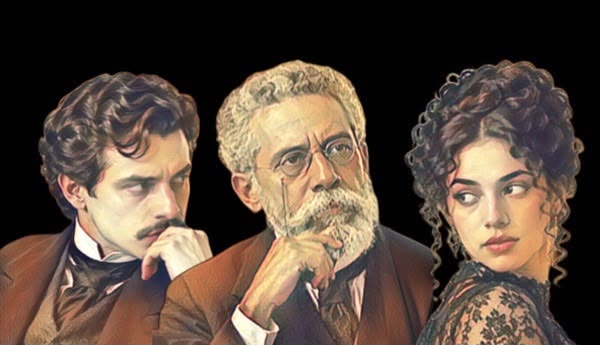
In Dom Casmurro, Machado de Assis builds one of literature’s most fascinating narratives precisely because he never gives us a truth that exists outside the memory of the man telling the story. Bentinho, now old, decides to reconstruct his life and his marriage to Capitu, the girl with the famous “undertow eyes” whom he fell in love with as a teenager. At the heart of the novel lies the suspicion that she may have betrayed him with Escobar, his best friend, and that Ezequiel, the couple’s son, may not in fact have been his.
But Bentinho’s certainty does not begin with a confession, a discovered letter, or any kind of objective proof. It builds slowly and reaches a devastating turning point at Escobar’s funeral. Standing before his friend’s coffin, Bentinho watches Capitu. She looks at the dead man with an intensity he considers excessive, a fraction of a moment of grief that, to him, seems to reveal something more than mourning. It is a look. Nothing more. Yet from that moment on, everything changes. And it is not only what happens afterward that changes. What happened before changes as well.
Old gestures, conversations that once seemed ordinary, intimacies that had never been questioned, and later even his own son’s physical features begin to take on a different meaning. Bentinho returns to the past carrying a suspicion with him and starts reorganizing his entire history around it. Capitu is no longer simply the woman he remembered before that funeral, because every memory now passes through the man who believes he has discovered something in that look.
That is one reason I consider Dom Casmurro one of the most brilliant books ever written. Every time I reread it, I arrive at a different conclusion. There are readings in which Bentinho convinces me more; in others, what I see above all is his jealousy, his insecurity, and his need to search retrospectively for proof of something he already believes in the present. Machado’s genius lies in never stepping in to solve the problem for us. There is no hidden camera at Escobar’s funeral. We have no access to Capitu’s consciousness. There is no neutral narrator interrupting Bentinho to tell us: here he is right, here he is interpreting, here he forgot, here he exaggerated.
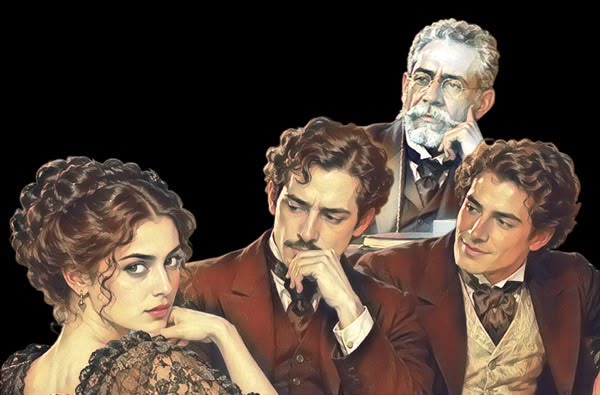
We have a man trying, decades later, to reconstruct his own life. And perhaps that is why the question that has crossed generations — did Capitu betray Bentinho or not? — is less interesting than another. Is Bentinho lying? Not necessarily. He may be telling us, with complete sincerity, what he came to believe.
That distinction matters because we tend to use “truth” and “lie” as though they were the only two possibilities available when trying to understand contradictory accounts. If two people tell opposite versions of the same event, our instinct is to look immediately for the one telling the truth and the one who is lying. Psychoanalysis introduces a much more complicated problem: a memory can be wrong without being a lie.
Lying presupposes, in principle, an intention to deceive. Someone who lies knows, or believes they know, that something happened one way and deliberately presents another version. Memory does not require that mechanism. I can tell a factually inaccurate story and be completely convinced that I am being faithful to what I lived.
That does not make facts relative. If a sentence was spoken or not spoken, if someone was in a room or was not, if an assault took place or did not, there is a material reality that exists independently of our interpretations. Two mutually exclusive factual propositions do not become simultaneously true simply because two people believe them.
What psychoanalysis adds is that between the event and the memory there is a subject. And the subject is not impartial.
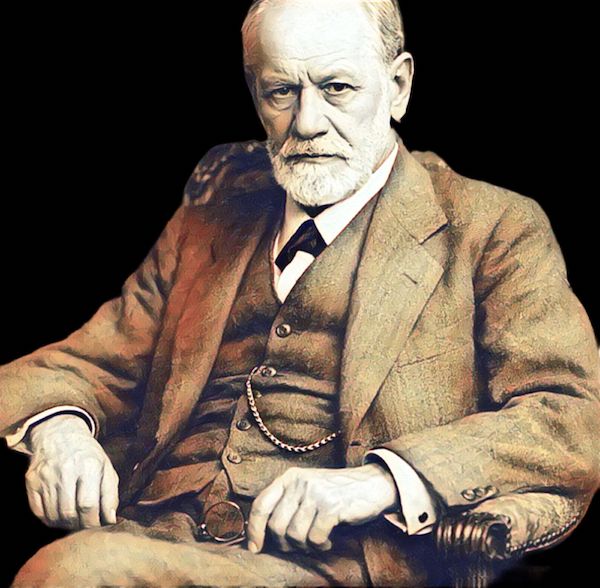
Freud understood very early that remembering did not simply mean opening some internal archive and retrieving a scene preserved intact. In his 1899 work on screen memories, he showed how apparently trivial memories can remain extraordinarily vivid because they are connected to other emotionally significant material. Memory is not selected only by the objective importance of an event; desire, conflict, and defense also help determine what remains accessible.
Later, the distinction between material reality and psychic reality would become fundamental. One thing is to ask what happened in the external world. Another is to ask how that event was experienced, interpreted, and incorporated into the individual’s inner life.
Those are not the same questions. A father may remember a particular decision as an attempt to protect his child. The child may remember exactly the same scene as abandonment. The father’s intention does not automatically make the child’s suffering false, just as the child’s suffering does not prove that the father deliberately intended to abandon them. There is an external event. But there are two subjects giving meaning to it.
Freud offers another concept that is extraordinarily useful for understanding Bentinho: Nachträglichkeit, often translated as deferred action, afterwardness, or retrospective resignification. Certain experiences acquire a new meaning after later events provide the subject with different tools for understanding them. The past does not change. The meaning of the past does. That is exactly what Machado does at Escobar’s funeral.
Capitu’s look does not change the conversations Bentinho had with her five years earlier. But it changes his interpretation of those conversations. A gesture that once meant one thing can now appear to be evidence of another. The past remains where it always was; Bentinho is the one who returns to it carrying information, suspicion, and emotion that he did not possess when that past was still the present. The past does not change. What can change again and again is the place from which we return to look at it.
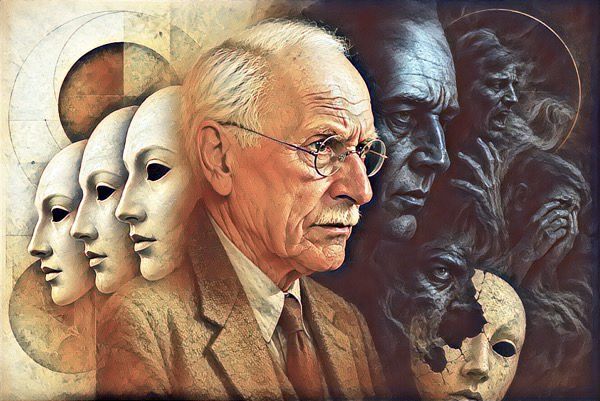
Jung arrived at a similar problem by another route. His word-association experiments helped him develop his theory of complexes, emotionally charged clusters capable of interfering with perception, associations, reactions, and the way certain experiences are organized. The theory of complexes remains one of the foundations of analytical psychology.
When a complex is activated, we do not necessarily see a situation with the same psychic availability with which we would observe something emotionally neutral. Certain themes acquire greater weight, particular words affect us more deeply, and some memories emerge before others.
Think of two people in a relationship. One carries a history marked by abandonment. The other has a history of feeling constantly accused and treated unfairly. A delay of a few hours in answering a message may activate in the first person the certainty that they are once again being abandoned. In the second, any complaint may immediately be experienced as proof that they are once again with someone who does not trust them. The external fact is tiny: there was a delay in replying. The internal experiences can be enormous. Neither experience has to be invented. But neither can we conclude, simply because it was felt intensely, that it accurately describes the other person’s intention. This is where the British Royal Family offers an almost didactic example.
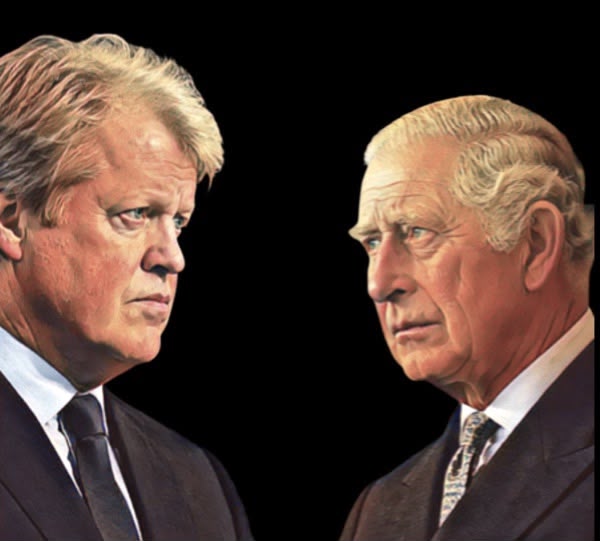
Charles Spencer has written Swan Song: Diana, My Sister, a book published nearly thirty years after the Princess’s death. In it, Diana’s brother reconstructs not only their childhood and his relationship with his sister, but also the days following the accident in Paris, including the tensions surrounding her funeral. Among the claims that generated the greatest reaction is his allegation that, during an argument over William and Harry walking behind their mother’s coffin, the then Prince Charles said something close to, “Rest assured, we’ll forget her soon enough.”
Buckingham Palace did something unusual: it responded. But the answer is psychologically far more interesting than a simple “that is a lie.” The Palace said that the King was aware that “the pain of fraternal grief can cloud reason, affect judgment and colour memory”, even many years after a loss. It is a sophisticated way of challenging Spencer because it does not exactly call him a liar. It questions the reliability of the narrator. And this is not the first time the British monarchy has answered in those terms.
When Harry and Meghan made a series of allegations about life within the Royal Family in their 2021 interview with Oprah Winfrey, Queen Elizabeth II responded with a phrase that became historic: “some recollections may vary.” The issues raised were serious, the statement said, but there were other recollections of those events.
Psychoanalytically, it is an extraordinary sentence. It can also be a weapon. Because if Charles Spencer’s grief can colour his memory, the grief of Diana’s sons can colour theirs as well. So can Charles’s. Resentment interferes. Guilt interferes. Love interferes. The need to preserve a particular image of the dead person interferes. The need to preserve one’s own image interferes. And this is where another danger appears: using the existence of psychic reality to erase material reality. This is precisely where Ferenczi becomes indispensable.
Sándor Ferenczi gave decisive importance to the reality of trauma and to what he described as disavowal or denial of the victim’s reality: something does not merely happen to the subject; what the subject experienced can later be denied or invalidated by someone on whom they depend. In his work on trauma, particularly Confusion of Tongues Between Adults and the Child, Ferenczi insisted on the importance of not automatically reducing concrete traumatic events to internal fantasy. That establishes an essential limit.
To say that psychic truth exists does not mean saying that “everyone has their own truth” and therefore nothing can ever be established. An assault does not cease to have happened because the aggressor has constructed a narrative in which they were merely “disciplining” someone. An abused child does not cease to have been abused because the adult presents another interpretation. A recording, a document, a message, or a witness may establish facts independently of the memories involved. Psychoanalysis does not replace investigation, history, or justice. But neither can it ignore the fact that, even when the event itself is established, two people may have experienced it in radically different ways.
So we return to the original question: can two opposing versions both be true? Materially, not necessarily. Psychically, yes. And there is still a third possibility: both may be factually wrong.
An entire family may repeat for decades that “we were always very close,” while its members carry memories of silence, rupture, and resentment. Another family may construct the narrative that a particular father “never showed love,” even though there are countless gestures of care that simply did not correspond to the form in which his children wished to receive it. Families build myths about themselves. Individuals do too. And repetition does not automatically turn a version into fact. It may simply make it more familiar.
Cinema perhaps created its definitive representation in Akira Kurosawa’s Rashomon. The same event is told in different ways by different characters. Their accounts do not merely disagree on minor details; each narrator reorganizes events in a way that preserves something about themselves.
The so-called “Rashomon effect” became a way of describing situations in which contradictory testimony emerges from the same event. What is brilliant about the film is that the question does not remain only “which one of them is telling the truth?” We begin to observe something else: why does each character need to tell the story in precisely that way?
Ridley Scott does something similar in The Last Duel, based on the historical case of Marguerite de Carrouges. The film returns to the same events through different perspectives, and small changes completely transform the meaning of a scene. What one man interprets as seduction is experienced by a woman as a threat. A shared event does not mean a shared experience.
And literature may do this even better because it places us directly inside the narrator’s mind.
Kazuo Ishiguro builds The Remains of the Day around Stevens, a butler reconstructing his own life while initially believing that he devoted everything to a great ideal of service. Gradually, however, his memories reveal what he needed not to see about the man he served, about his own feelings, and about Miss Kenton. He does not need to be lying to us. Much of the time, he appears to be lying primarily to himself.
In Atonement, Ian McEwan gives the question another dimension: narration itself becomes an attempt to return to the past and reorganize what can no longer be repaired in reality. Telling a story becomes a form of reparation precisely because life does not offer the same possibility of rewriting.
And so we return to Bentinho. Perhaps he truly saw something in Capitu’s look. Perhaps he saw what he needed to see. Perhaps Capitu loved Escobar. Perhaps she simply mourned a friend. Perhaps Bentinho’s earlier suspicions made that moment inevitably suspicious. Perhaps the look was merely the trigger for something that already existed within him. Machado never allows us to know. But he allows us to observe something far more valuable: how a memory becomes a narrative and how a narrative, repeated over decades, can become the story we tell in order to explain who we are. That is also part of analytic work.
In Constructions in Analysis, Freud had already moved beyond the simplistic notion that the analyst was merely an archaeologist capable of digging up an intact buried past. Analysis constructs hypotheses from fragments, repetitions, affects, associations, and gaps. The reconstruction may approach historical truth, but its value also lies in what it reveals about the subject’s psychic organization.
That is why, when a patient recounts a memory, the analyst’s first function is not to behave like an investigating judge. There are moments when it is important to establish whether something really happened, especially in cases involving violence and trauma. But in much of clinical work another set of questions matters as well: why did this memory survive? Why this detail and not another? What does this story explain about the person the patient believes themselves to be? Who needs to remain guilty within it? Who must continue to be idealized? What would happen if another interpretation became possible?
There is also an important difference between remembering incorrectly and narrating deceptively. We can remember inaccurately without any intention to deceive. We can also report only true facts and, by carefully choosing which facts to include and which to omit, construct a profoundly misleading narrative. The subject is not only what they remember. The subject is also what they select to tell.
That is why no narrator is completely impartial, whether Bentinho, Charles Spencer, Harry, King Charles, a Kurosawa character, or any one of us. Every narrator chooses a starting point. Decides which detail deserves attention. Remembers certain sentences and forgets others. Knows the ending while reconstructing the beginning. And, above all, tells the past from the position of the person they became after living through it.
Perhaps that is the difficulty in turning memory into something binary. Facts can demand binary answers. A person was or was not in a particular place. A message was or was not sent. A recorded sentence was or was not spoken. Human experience rarely obeys the same simplicity.
Two people may be sincerely convinced of incompatible stories. One may be factually closer to what happened. Both may have altered different details. One may be lying. Both may be wrong. And both may still carry important psychic truths about what the event represented in their lives.
Clinical work does not have to choose between believing everything and believing nothing. It has to tolerate that complexity. Because perhaps the most fruitful question is not only “which version is true?”, but also “what makes this the version you can tell?”
Machado understood that long before we had so many names for the process. He gave Bentinho the floor and denied us the comfort of an impartial witness. More than a century later, we are still arguing about Capitu. And every time we return to the book and reach a different conclusion, perhaps Machado is reminding us of something uncomfortable about ourselves as well: Bentinho is not the only one who changes when he looks back at the past. We change. And when we do, what we find there can change too.

Descubra mais sobre
Assine para receber nossas notícias mais recentes por e-mail.

