
There is something almost too perfect about I Play Rocky. In 1976, Sylvester Stallone wrote the story of a man no one believed in, fought to play him when no one believed he could, and ended up turning Rocky into one of the biggest phenomena in Hollywood history. Fifty years later, that same story returns to the screen, now with another relatively unknown actor trying to convince audiences that he can be Sylvester Stallone.

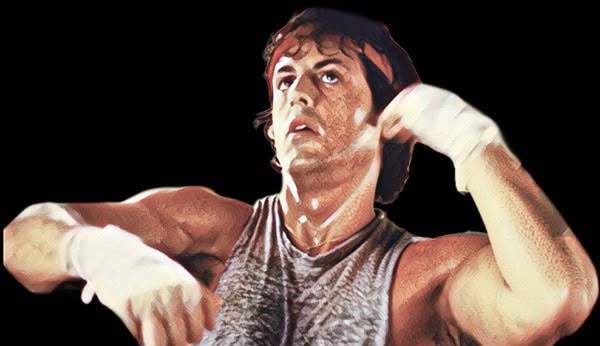
The meta quality is so obvious that it could feel manufactured, but Anthony Ippolito’s own story helps the film. When he learned that a movie about the making of Rocky was being developed, he had not been invited to audition, had not seen a script and had not received any official material. Even so, he hung a punching bag in his grandmother’s basement, called a friend and a cousin, and filmed his own attempt at playing Stallone. The footage reached the production, which then sent him the script and asked for a formal audition. Ippolito taped more scenes and eventually won the role.
It is hard to imagine a more appropriate way to arrive at I Play Rocky. The actor also brings a curious specialty for playing movie legends before they became legends. In The Offer, the miniseries about the turbulent making of The Godfather, Ippolito played a young Al Pacino. Now he plays Stallone during the creation of another 1970s film that would end awards season by winning Best Picture. There is also a lovely connection between the two stories: Talia Shire appeared in The Godfather and would later become Adrian in Rocky.
Playing Stallone, however, requires much more than a convincing physical transformation. He may be one of the easiest actors in cinema to imitate and, for that very reason, one of the most dangerous to portray. The slurred voice, facial asymmetry, shoulder movements, posture and way of looking are so recognizable that even a slight exaggeration can turn the performance into caricature.
Ippolito spent a long period preparing physically and studying not only Stallone’s voice, but also his body language and, most importantly, the difference between the man we know today and the unknown actor he was in the 1970s. That distinction is essential. He is not playing the Stallone of Rambo, major franchises or decades of stardom. He is trying to find the man who did not yet know whether any of that would ever happen.
That is also the central challenge of I Play Rocky: we already know the ending. We know Stallone got the film made, that Rocky became a phenomenon, that he was nominated for an Oscar as both actor and screenwriter, and that the movie won Best Picture. We know a franchise was born, followed later by another through Creed, and that Stallone became one of the biggest stars of his generation. Peter Farrelly therefore cannot rely on suspense to tell this story. Just as in Rocky itself, the real question is not who wins, but how someone manages to stay on his feet until the final round.
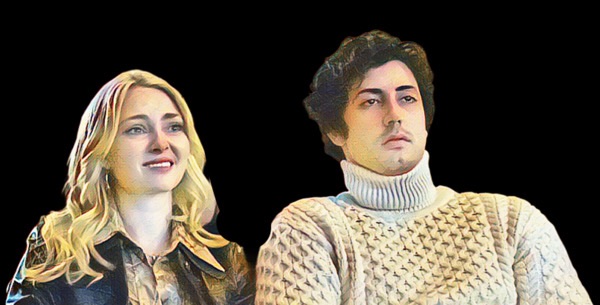
The film returns to the period when Stallone was collecting rejections, financial problems and small roles while trying to find a way into Hollywood. AnnaSophia Robb plays Sasha Czack, who would become his first wife and is presented as one of the people encouraging him to write his own material. If no one was willing to offer him a great role, perhaps he would have to create one himself.
That is how Rocky Balboa was born, but writing a strong screenplay solved only half the problem. Producers began to see the potential of the film and Hollywood became interested. The obstacle then changed: they wanted Rocky, but they did not necessarily want Stallone as Rocky.
He refused to accept that separation.
That is where the title comes from. I Play Rocky summarizes the position that turned the negotiation into one of Hollywood’s most repeated stories. Stallone may have desperately needed the money, he may have had almost no power inside the industry, and he may have been facing producers who saw established actors as a much safer choice, but there was one thing he would not give up. If the movie was made, he would play Rocky.
The production therefore reconstructs not only Stallone, but the entire small circle involved in the film’s creation. P.J. Byrne plays Irwin Winkler, Toby Kebbell is Robert Chartoff, and Jay Duplass takes on John G. Avildsen, the director who realized that what looked like a boxing story was, above all, about love, loneliness and dignity. Stephan James plays Carl Weathers, while Kiki Seto portrays Talia Shire and Robert Morgan plays Burgess Meredith.
Matt Dillon occupies a different place in that reconstruction as Frank Stallone Sr., Sylvester’s father. The difficult relationship between the two gives the film a more intimate explanation for Stallone’s almost obsessive need to prove himself. His refusal to hand Rocky over to another actor therefore becomes more than a professional struggle; it is also connected to a deeper need to prove that all the people who doubted him were wrong.
There is another particularly interesting layer because the real Stallone was not initially involved with I Play Rocky. When he learned that the project was being developed, he said that no one had contacted him and that he had discovered the film through the news. It was not, therefore, a biopic conceived from the beginning under his supervision or with his approval.

That relationship changed later. Ippolito was able to speak with Stallone during his preparation and found someone willing to help him understand that period of his life. When Stallone finally saw the trailer, his public tone changed as well. He wished the cast and crew well and said he was looking forward to seeing the beginning of his story brought to life.
It is a curious position for someone who has spent half a century so closely tied to the character he created. Stallone now has to watch another actor play the exact moment when he himself was trying to convince everyone that no one else should play Rocky.
Peter Farrelly also arrives at the project carrying his own recent connection to the Oscars. Green Book, his previous theatrical feature, came out of Toronto with enormous momentum and ended awards season by winning Best Picture. Now he returns with another story designed to provoke a strong emotional response from audiences, again based on real people and again arriving in the middle of awards season.
I Play Rocky premiered at the Toronto International Film Festival and made it clear that it has strong crowd-pleasing instincts. Ippolito’s performance emerged as one of the most talked-about elements, naturally pushing the film into awards conversation. That does not mean predicting how far it will go, but the symmetry is impossible to ignore: fifty years after Stallone was nominated for an Oscar for playing Rocky, another actor enters the season playing Stallone as he creates Rocky.
Perhaps the film’s greatest risk lies precisely in how familiar the story already is. Recreating the making of Rocky means constantly competing with our memories of the original and with a legend Stallone, the press and Hollywood have spent five decades reinforcing. The more recognizable the scene, the greater the temptation to turn the biopic into a succession of moments the audience is already waiting to see.
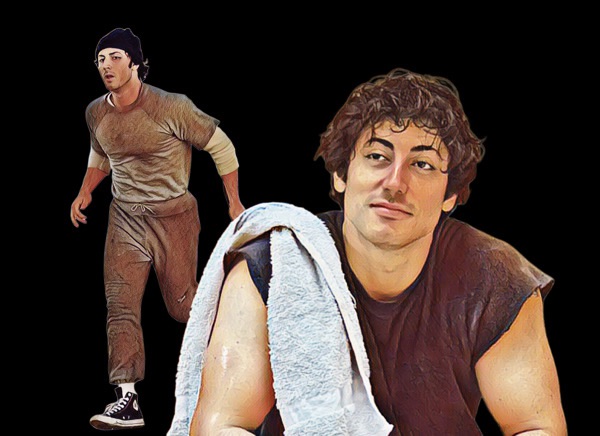
The trailer suggests that Farrelly has chosen not to fight that mythology. Instead, I Play Rocky seems to embrace it. The film accepts the story of the broke young man who hears “no” again and again, writes his own opportunity and, when Hollywood finally wants what he created, chooses to risk everything rather than hand the role to someone else. The biopic about Rocky’s creator turns Sylvester Stallone into the real Rocky Balboa.
Even “Gonna Fly Now” returns to complete the mirror. In 1976, the music followed Rocky as he began to believe he could make it to the end. Fifty years later, it follows the man who invented him through his own attempt to reach the top.
In Brazil, I Play Rocky opens on November 19, almost exactly as the original film reaches its 50th anniversary. The timing could hardly be more appropriate. In 1976, Hollywood watched a virtually unknown actor bet everything on the belief that he should play Rocky. Half a century later, Anthony Ippolito arrives on screen playing that very moment after creating his own first opportunity to win the role.
Perhaps that is the idea that connects the two films most clearly. Sometimes no one offers you the opportunity you are waiting for, and waiting longer changes nothing.
Stallone wrote his.
Fifty years later, Hollywood decided to make a movie about it.

Descubra mais sobre
Assine para receber nossas notícias mais recentes por e-mail.

