
American Hostage premiered quietly on MGM+, almost hidden among releases with larger campaigns, more popular platforms, and far noisier titles. That is unfortunate, because the series starring Jon Hamm and Giovanni Ribisi is among the most interesting productions of the season. Not simply because of the quality of its cast or the unbelievable strangeness of the true story it dramatizes, but because it revisits a 1977 case capable of explaining phenomena we still discuss as though they were invented by social media.
The first reaction is to wonder how much had to be created to turn the case into a miniseries. The shotgun connected by wire to the hostage’s neck sounds like the invention of an excessively enthusiastic screenwriter. The walk through the streets of Indianapolis, surrounded by police officers, reporters, and onlookers, defies any security logic. A hostage-taker who demands to be interviewed live, chooses the journalist he trusts, and ultimately organizes his own press conference sounds like satire. Almost all of it happened.
The necessary caution lies elsewhere in the story. Tony Kiritsis deeply believed that he had been cheated by a mortgage company. That does not mean that he had been. The distinction is essential if his paranoid conviction is not to become proof of a conspiracy—and a man pointing a gun at another man’s head is not to be turned merely into a representative of those mistreated by the system.
It is precisely within this ambiguity that American Hostage finds both its quality and its extraordinary relevance.
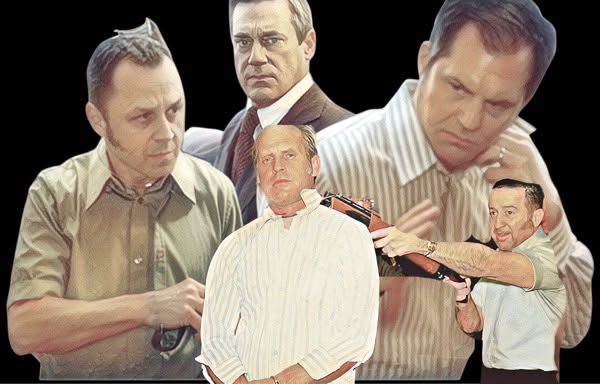
The Small Businessman Against the System
Tony Kiritsis, played by Giovanni Ribisi, was a car salesman and aspiring real estate developer. The son of Greek immigrants, he cultivated the image of a hardworking, honest man who could not tolerate humiliation. He had purchased 17 acres on the west side of Indianapolis with financing from Meridian Mortgage and intended to build a shopping center there.
The project did not move forward. Kiritsis failed to attract investors or secure the necessary contracts; the debt was approaching its due date, and the property was at risk of foreclosure. He then constructed an explanation capable of turning a commercial failure into a personal conspiracy.
Kiritsis came to believe that M.L. Hall, head of Meridian, and his sons had deliberately sabotaged his development. According to his theory, the family was driving potential tenants away so that it could seize the already appreciated land and resell it for a substantial profit.
The historical record does not support the fraud allegation. Indianapolis archives maintain that the Halls followed the terms of the contract. But to Kiritsis, the absence of proof did not weaken the conspiracy. It merely confirmed that his opponents were powerful enough to conceal it.
On the morning of February 8, 1977, he entered Meridian’s offices looking for M.L. Hall. His intended target was in Florida. Instead, Kiritsis found Richard “Dick” Hall, the businessman’s son and the company’s president, played in the series by Kristoffer Polaha.
Kiritsis was carrying a handgun, a sawed-off 12-gauge shotgun, and a carefully prepared mechanism. He pressed the weapon against Hall’s head and connected the trigger to a wire around his own neck. It was the so-called dead man’s wire: if police shot the hostage-taker, if Hall attempted to escape, or if any sudden movement tightened the wire, the shotgun would fire.
Killing Kiritsis would probably mean killing Hall.
Sixty-Three Hours with a Gun Against His Head
Kiritsis forced his hostage to call the police and explain the mechanism. He then left the building with Hall in front of him and walked through the streets in bitterly cold weather, accompanied by police officers, journalists, photographers, and a crowd of spectators. The images exist and are even more disturbing than the reenactment.
With no safe way to intervene, the police allowed the two men to enter a patrol car. Hall was forced to drive to Kiritsis’s apartment, which the hostage-taker claimed he had rigged with explosives. There, Hall remained captive for almost 63 hours, spending part of the ordeal chained inside the bathroom and always attached to the shotgun.
Kiritsis demanded $5 million from Meridian, the cancellation of his financial obligations, a public apology from the Hall family, and guarantees that he would not face criminal, civil, or federal prosecution.
But money and immunity were not enough. He wanted the city to accept his version of events. He needed to stop being seen as a criminal and be recognized as the victim of a powerful corporation. And he understood that controlling Dick Hall would not be sufficient. He also needed to control journalism.
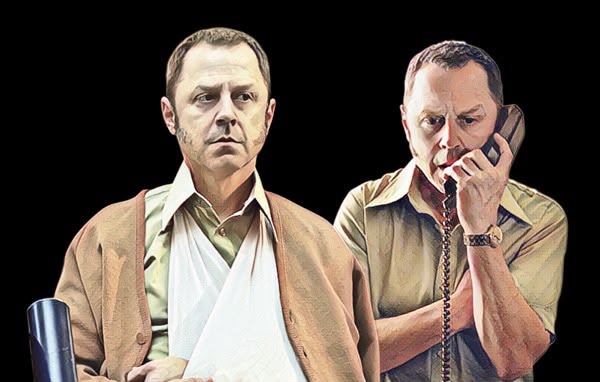
Fred Heckman Stopped Covering the Story
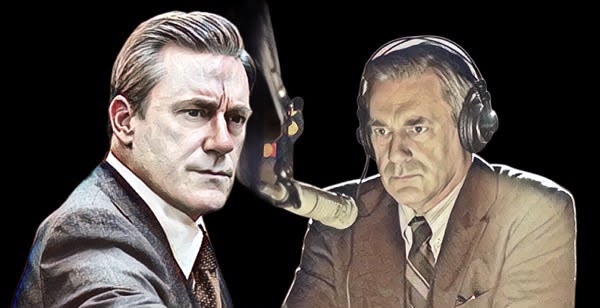
Fred Heckman, played by Jon Hamm, was the news director of WIBC-AM and one of the most respected voices in Indianapolis. He was not a sensationalist broadcaster looking for ratings. He had a reputation for rigor, led one of the city’s most important newsrooms, and had presented his radio commentaries, My Town Indy, for years.
Kiritsis followed his work and believed that Heckman was the only journalist who would not distort his story. Angry about the way the press was portraying him, he called the station and demanded to speak to him.
At that moment, Heckman stopped being merely the man covering the news. He became one of the hostage-taker’s conditions for keeping Dick Hall alive.
He spoke to Kiritsis repeatedly, listening to his accusations, emotional swings, and moments of despair. To earn his trust, he broadcast a recorded conversation in which the hostage-taker explained his demands. At the same time, Heckman began cooperating with the police and the FBI.
The crisis created a situation for which no journalism ethics manual could offer a satisfactory answer. If Heckman refused to broadcast Kiritsis, he would uphold the principle of not giving a criminal a platform, but might cause Hall’s death. If he put him on the air, he would preserve the contact capable of saving the hostage, but allow unproven accusations to be presented to a vast audience.
And there was a further complication. Heckman was not simply a decent man trying to save a life. He also understood that he was facing the greatest story of his career. Public interest, moral responsibility, journalistic adrenaline, and professional ambition could all coexist within him.
American Hostage does not try to prove that his heroism was false. It does something better: it rejects the fantasy that ethical choices are made by people without egos, desires, or contradictions.
When Journalism Also Becomes a Hostage
The series is not exactly about Fred Heckman’s ethics or lack of them. It is about what happens when an ethical journalist is placed in a situation in which every available decision violates some principle.
By working with the authorities, Heckman stops observing the event and begins influencing it. When he has to convince Kiritsis that his demands will be honored, he no longer merely reports the lie prepared by the police. He participates in it. Journalism becomes a negotiating instrument.
Ben Hairston, played by William Jackson Harper, matters precisely because he voices what Heckman can no longer see. A younger reporter and Fred’s protégé, he questions his boss’s emotional involvement, the platform being offered to the hostage-taker, and the transformation of the coverage into spectacle. Ben is fictional, but he functions as the newsroom’s critical conscience.
The problem is that he does not possess a solution either. Maintaining journalistic distance might have been more ethically pure. It would not necessarily have kept Dick Hall alive.
The title of the series therefore acquires a broader meaning. Hall is the literal hostage, attached to a loaded gun. Heckman also becomes hostage to the trust placed in him, the police who need to use him, the station that must decide what to broadcast, and the public that can no longer look away.
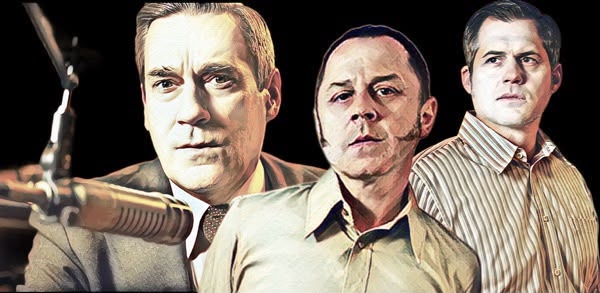
A Criminal Organizes His Own Press Conference
On February 10, Kiritsis was persuaded that his conditions had been accepted. The authorities prepared a promise of immunity because they needed to get Hall out of the apartment alive. The agreement, however, would not produce the lasting freedom Kiritsis imagined.
Still holding the shotgun against the hostage’s head, Kiritsis went down to the building’s lobby and organized a press conference. For approximately 23 minutes, in front of the cameras, he alternated between anger, tears, accusations, and profanity. He declared that he was not a kidnapper but a “national hero” who had finally forced the powerful to answer for their actions.
Indianapolis television stations carried the monologue live during prime time. The city watched without knowing whether it was about to see Hall released or murdered on camera.
At the end, Kiritsis removed the mechanism from the hostage’s neck. Before surrendering the weapon, he fired into the ceiling to prove that it had been loaded throughout the entire ordeal. Hall emerged physically unharmed. Kiritsis was immediately arrested.
One photograph of the spectacle, taken by John H. Blair, showed Kiritsis holding the shotgun and pulling the wire around Hall’s neck. The image received the 1978 Pulitzer Prize for spot-news photography.
Acquittal Did Not Mean Freedom
Kiritsis was charged with kidnapping, armed robbery, and extortion. During his trial in October 1977, the defense argued that he had been trapped in a paranoid delusion and was incapable of rationally understanding his actions.
The paradox is that the plan required preparation, practical intelligence, and enormous technical control. But planning does not necessarily exclude delusion. Kiritsis could be capable of constructing the mechanism while genuinely believing in a conspiracy that did not exist.
Under Indiana law at the time, prosecutors had to prove that the defendant was mentally responsible. The jury found him not guilty by reason of insanity.
That did not mean he simply went home. Kiritsis spent 11 years in state custody, moving through psychiatric hospitals, a period in a prison infirmary, and legal battles caused by his refusal to undergo medical evaluations. He was released only in January 1988, when the state could not prove that he remained mentally ill or dangerous.
The case became part of the debate that led Indiana to revise its rules concerning the insanity defense. In 1990, Kiritsis returned to the news when he filed 101 lawsuits against virtually everyone involved in his arrest and confinement. He died of natural causes in 2005, at the age of 72.
Dick Hall remained relatively silent for decades. In 2017, he published Kiritsis and Me: Enduring 63 Hours at Gunpoint, reclaiming the story from the perspective the spectacle had almost erased: that of the man who spent nearly three days not knowing whether any movement would cause his head to explode. Hall died in 2022.
How the Podcast Became a Series
American Hostage began as a scripted podcast. Released in 2022, it already featured Jon Hamm as Fred Heckman and used the case to construct a thriller sustained by voices, telephone calls, and recordings.
Hamm recognized its visual potential and approached Shawn Ryan, creator of The Shield and one of the producers behind The Night Agent. Ryan developed the adaptation alongside Eileen Myers, his collaborator on Mad Dogs and The Night Agent. The two serve as creators, writers, executive producers, and showrunners.
Produced by Sony Pictures Television, the series consists of eight episodes and is available on MGM+. It premiered on September 20 with two episodes, followed by weekly releases. Adam Arkin and Nina Lopez-Corrado share directing duties; Arkin also appears onscreen as John Ruckelshaus, one of the lawyers summoned by Kiritsis. Production took place in Winnipeg, Canada.
Shawn Ryan cites Sidney Lumet’s Network as a more important influence than Dog Day Afternoon, although comparisons with the Al Pacino film are inevitable. His interest lies less in the eccentric criminal surrounded by police than in the point at which information, entertainment, and the public appetite for blood become impossible to separate.
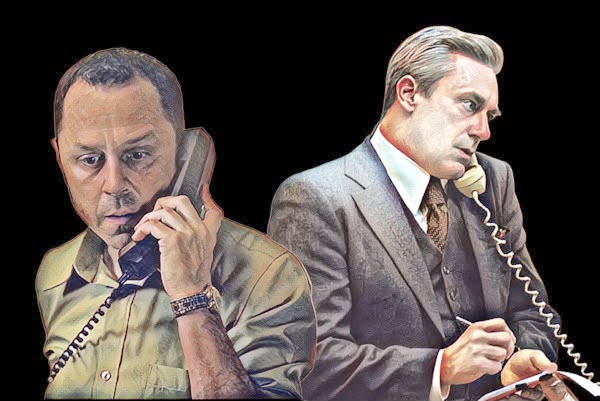
A Cast Working at Exactly the Right Pitch
Jon Hamm uses precisely what his screen presence offers best: authority, restraint, and a voice that seems to have been created for radio. His Fred Heckman believes in journalism as a public service, but he also feels alive in the presence of the greatest story ever to cross his desk. Hamm preserves the character’s dignity without turning him into a statue.
Giovanni Ribisi works at the opposite extreme. His Tony talks too much, moves too much, and always seems seconds away from losing control. The performance deliberately risks excess because the character needs to be threatening, ridiculous, exhausting, and occasionally persuasive. When he describes the financial system as a machine designed to crush the small businessman, we understand why some people transformed him into a folk hero. Then the camera returns to the gun pressed against Hall’s head.
Kristoffer Polaha faces the least showy and perhaps most thankless role. Dick does not control the narrative, does not possess the microphone, and must survive by pretending to feel a complicity that does not exist. Mireille Enos plays Barbara Heckman, while Kat Cunning portrays Ibby Hall. The friendship created between the two women was invented for the series to expand the story of the families waiting outside.
William Jackson Harper gives Ben the intelligence and uneasiness needed to keep him from feeling like a mere screenwriting device. June Laporte plays Ginny Hughes, another fictional journalist created to represent the newsroom’s investigative work. Jonathan Tucker appears as FBI agent Cormac McNally, Mark McKinney plays Police Chief Gallagher, and Adam Arkin portrays Ruckelshaus.
Real people therefore coexist with composite or invented figures. The kidnapping happened. The family relationships, internal disputes, and much of the private dialogue belong to the dramatization.
The Series Cannot Believe Tony Too Much
There is an obvious danger in devoting eight episodes to Kiritsis. Learning about his childhood, frustrations, and perception of injustice inevitably creates intimacy. And intimacy often creates sympathy.
Understanding someone’s pain, however, does not make his account true. Explaining someone’s anger does not absolve the violence committed in its name.
Indianapolis historical archives criticized the 2022 podcast for suggesting that the Hall family may actually have cheated Kiritsis. That conclusion is not supported by the available documentation. The podcast also implied that he walked free immediately after the trial, when he remained institutionalized for more than a decade.
The series appears more attentive to these contradictions. The journalists investigate the allegations and discover holes in Tony’s biography. Even so, viewers must resist the narrative structure that naturally favors the loudest character. Kiritsis controls the telephone calls, the threats, and the action. Hall spends most of the story trying not to die.
The initial critical reception has been strongly positive. American Hostage reached a 93% approval rating on Rotten Tomatoes, although its average score was a more moderate 6.8. Jon Hamm and Giovanni Ribisi emerged as the clear consensus strengths. The most frequent criticism concerns stretching a 63-hour crisis across eight episodes, particularly because the same case recently received another adaptation.
The Other Version of the Story
Dead Man’s Wire, directed by Gus Van Sant, stars Bill Skarsgård as Kiritsis, Dacre Montgomery as Hall, Colman Domingo as a fictionalized version of Heckman, and Al Pacino as the Hall family patriarch.
The film concentrates on the hostage-taker, the hostage, and the media circus surrounding them. The series shifts the center toward Fred Heckman and asks what happens when reporting the truth might kill, while manipulating it might save a life.
The two productions arriving almost simultaneously is no coincidence. Tony Kiritsis belongs to 1977, but the reaction he provoked feels frighteningly contemporary.
The Seed of Luigi Mangione
It is impossible to watch American Hostage today without thinking about Luigi Mangione. Not because the cases are legally equivalent, but because they reveal the same mechanism through which an accused man becomes a political symbol.
Kiritsis discovered that anger toward an unpopular institution could diminish the importance of the victim. He held an innocent man with a shotgun against his head, yet by presenting himself as a small businessman crushed by the financial system, he attracted supporters and declared himself a national hero.
Decades later, the response to the killing of executive Brian Thompson, in connection with which Mangione is accused, repeated that pattern on a much larger scale. Anger toward the American healthcare system led part of the public to treat a death as a political gesture and the accused as a romantic, rebellious, sexualized, and even collectible figure.
The difference is technological. Kiritsis needed Fred Heckman to reach an audience and impose his narrative. Mangione did not need a trusted intermediary. Social media instantly produced manifestos, memes, T-shirts, fans, and a folk-hero identity before the judicial process had reached any conclusion.
The creators of American Hostage have acknowledged the parallel. The Mangione case emerged while the series was still being prepared and confirmed the relevance of a story that, under other circumstances, might have seemed like nothing more than a forgotten 1970s curiosity.
The Series That Deserves to Emerge from the Silence
American Hostage arrived quietly because it is on MGM+, a service with a smaller reach, and because its premise lacks the immediate familiarity of a franchise, a famous literary adaptation, or another true-crime case already explored to exhaustion.
But it is a quality production, featuring excellent actors and a thesis that extends far beyond a police reconstruction. The series revisits a moment when live journalism was still discovering its power—and the danger of interfering with what it broadcast. It shows a criminal realizing that controlling the narrative could be as important as controlling the hostage. And it anticipates a society in which choosing a sufficiently hated enemy can transform violence into spectacle and an aggressor into a celebrity.
Tony Kiritsis needed 63 hours, a radio station, and the most respected journalist in Indianapolis to dispute the meaning of his own crime. Today, all it would take is a few minutes, an attractive photograph, and an unpopular institution.
Social media did not invent this mechanism. It merely eliminated the need for Fred Heckman.
Descubra mais sobre
Assine para receber nossas notícias mais recentes por e-mail.

