
Twenty years ago, sending someone a link was not enough. You still had to explain what would happen after they clicked it. When Juliano Prado and Marcos Luporini finished the first Galinha Pintadinha video in 2006, they wanted to present it to television producers. Juliano could not attend the meeting in São Paulo, and the alternative was to send the material from Campinas by courier. Instead, he decided to try something new called YouTube. “You’ll click there, and a video will play directly in your browser,” he remembers, laughing now at an explanation that seemed necessary at the time.
The video was shown and the channel was not interested. Juliano asked whether he could delete it and was told yes. He did not. What happened next turned that small act of digital disobedience into one of the most unlikely stories in Brazilian audiovisual entertainment. The public found the Chicken before the industry realized there was something happening there. New clips followed, then an initial run of one thousand DVDs — an amount the two of them already considered a victory if they managed to sell them — followed by national distribution, licensed products, new platforms, new countries and entire generations of children.
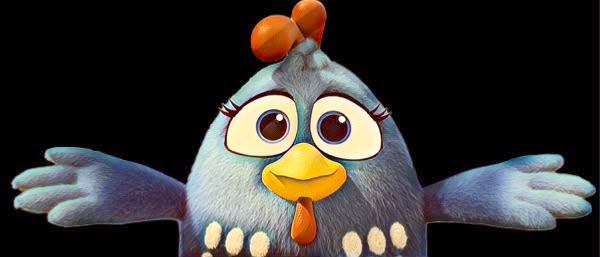
Two decades later, the character is reaching a place that, in some ways, seemed much farther away in 2006 than YouTube itself: the movie screen. Lottie Dottie Chicken: The Movie arrives in theaters on October 1, celebrating the 20th anniversary of a character that was born digital before the term had even become part of our everyday vocabulary. She reaches the cinema after surviving not only the passage of time, but a complete transformation in the way children watch, choose, and endlessly replay what they love.
Juliano likes to remember that the first video appeared almost at the end of the VHS era, when DVDs were still not in every home and the iPhone did not exist. At the time, producing content for the internet did not look like a strategy for the future. “It was a kind of marginal market. It wasn’t television, it wasn’t cinema, it wasn’t cable TV, it wasn’t anything. But something was happening there,” he recalls. And it certainly was.
Lottie Dottie Chicken grew into one of the Brazilian children’s properties with the widest reach, crossing platforms, languages and countries while remaining under the control of its creators. Juliano Prado and Marcos Luporini are still at the helm of the brand through Bromelia Produções, in an unusual trajectory for a market in which successful properties are often absorbed by major conglomerates. More interesting still is the fact that the Chicken did not have to remain exactly the same in order to remain instantly recognizable.
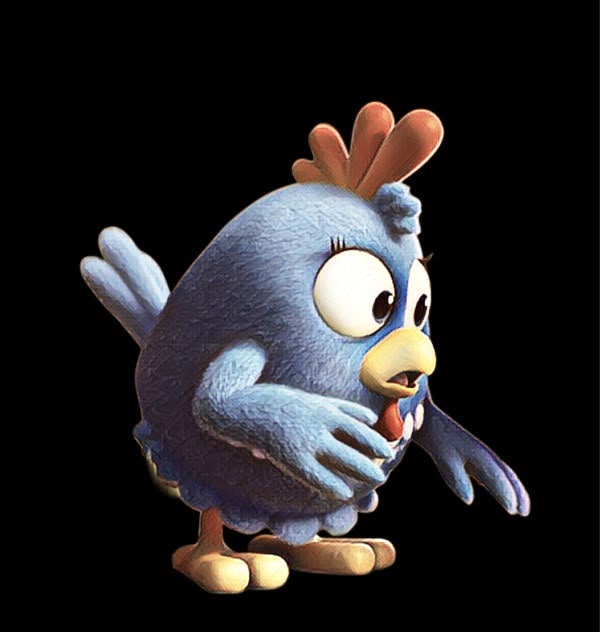
Marcos explains that even the visual identity now immediately associated with the character did not arrive fully formed. She was shaped by several hands, as often happens in animation. The first person to paint her blue was artist Ana Paula Indalêncio. The spots, the shape, and the other visual elements were refined over the years. “We are not the Mauricio de Sousa of Lottie Dottie Chicken,” Marcos says, precisely to emphasize that collective construction. Even so, he recognizes Sousa as an unavoidable reference for anyone working in animation in Brazil. The simplicity of the drawing, the flat colors, and the ease of recognition all belong to that tradition. Today, a blue chicken, white spots, and a red comb are enough for a child to know exactly who is on the screen.
But perhaps the character’s real strength does not lie only in the drawing. It lies in the music. From the beginning, the project relied on the Brazilian traditional songbook, a repertoire Marcos sees as one of the country’s great cultural treasures. These are songs that reached us after crossing decades — in some cases, centuries — before they ever depended on audiovisual records. “Imagine what it takes for a song not to be forgotten without even having to be written down,” he says.
Lottie Dottie Chicken ended up becoming a new bridge for that repertoire. Parents and grandparents recognized songs from their own childhoods while children discovered them through YouTube, DVDs, streaming, and now the cinema. That may be one of the reasons the brand has acquired what its creators now describe as a transgenerational quality.
“The grandfather sings, the uncle sings, the music already has that quality. And now the Chicken is 20 years old,” Juliano says. He already notices teenagers and adults saying they want to see the film, even when they joke that they may need to “borrow a child” to justify going to the movies. The generation that watched the first videos has grown up, and some are now bringing their own children. This creates an unusual situation for Lottie Dottie Chicken: her core audience continues to renew itself rapidly because young children grow out of that phase, while the character is also beginning to accumulate the emotional memory of those who have already passed through it. “For 20 years, we got past that barrier of: the novelty is over, so the Chicken is over,” Juliano says.
The movie may be the clearest proof of that. The idea of making a feature did not appear overnight. The project took around five years, and the creators say they waited until they felt both the brand and they themselves had reached the level of maturity needed to take it on. There was also a risk they were determined to avoid. “We didn’t want to make an opportunistic movie, just grab what we already had and throw it onto a screen,” Juliano says.
Turning short musical clips into a story capable of sustaining more than an hour meant relearning how to work with characters who had functioned perfectly for years in just a few minutes. The closest experience they had had was theater, but even that language was completely different. The movie needed to truly be a movie, and it also needed to hold the attention of a generation born surrounded by multiple screens, short-form videos, and instant choices.
Perhaps that is why it is especially symbolic to take the Chicken into a dark theater, where the experience becomes collective again. Juliano sees precisely that as part of the appeal of cinema for children: they are in front of a single story, in a space designed for immersion and surrounded by other people experiencing it at the same time.
Visually, the change is significant as well. The character leaves her essentially 2D universe and arrives in the feature in 3D animation. Marcos admits that the process brings an entirely different set of limitations. In 2D, if you need a castle, you draw a castle. In 3D, you have to build it: modeling, textures, details, lighting. Even so, he considers that transition one of the film’s greatest achievements. “You look at it and you see the 2D character there in 3D, with texture and everything. I think that’s one of the project’s strengths.”
The team avoided, however, an aesthetic that would make the film feel too much like a video game. Juliano explains that they looked for a visual language that also converses with stop motion, including in the way the characters move and are framed. The choice is part of a larger decision: to find an identity of their own instead of trying to compete visually with what the major international studios are doing. Marcos is direct about that. For him, entering a competition to make something that simply looks like a major Pixar production would make little sense. “It’s a very unequal fight. It’s not smart. So we chose our own path.”
That path also appears in the story itself. In the film, Lottie Dottie Chicken and Rooster Carijó are expecting their first child. A mix-up involving the eggs sends the Yellow Chick to the Hawk’s nest, while another baby ends up with the Chicken’s family.
Before arriving at that idea, the creators considered many possibilities. One involved a child crossing through a portal into the Chicken’s world. The problem, according to Marcos, was that cinema at that moment seemed to be going through “an outbreak of portals.” They dropped it.
The inspiration for the switched eggs came from a surprisingly adult place. Marcos remembered news reports about babies accidentally switched at maternity wards and the question that always came to mind when he watched those stories: how do two families go back to living normally after having cared, even for a period of time, for each other’s child? “You are connected to that child forever. There is no way around it. And there is another family that took care of your child.”
Within a children’s adventure, that premise allowed them to explore difference, acceptance, care and belonging without turning the film into a lesson. “You can talk about difference, you can talk about acceptance, you can talk about many things,” Marcos explains. Juliano highlights another concern: keeping the Chicken herself at the center of the action. That may sound obvious in a film that carries her name, but it is not so simple in a universe filled with other characters. For the creators, it was important that she not simply be surrounded by characters who solve the problems for her. Motherhood puts her in motion and, throughout the adventure, transforms her as well.
There is humor, music and familiar characters, but there is also an emotional layer that speaks differently to the adults accompanying the children. For those who have recently experienced the birth of a child, Juliano notes, some of those emotions may feel especially close.
The feature also arrives at an almost perfectly choreographed moment. As Lottie Dottie Chicken turns 20 and reaches theaters, a themed area devoted to the character has just opened at Beto Carrero World. They are independent projects, developed over four or five years, that ended up reaching the public almost at the same time. “If we had hired NASA, maybe it wouldn’t have worked out this perfectly,” Marcos jokes.
For now, he prefers to think of the film as a celebration. There is already market interest in new possibilities for this visual universe, including a potential series, but the creators seem less interested in announcing the next 20 years than in enjoying the first ones. “Right now we’re thinking more about vacation. Celebrating and taking some time off.”
They may have earned it. After all, there was a time when the dream was simply to sell one thousand DVDs. Now Juliano and Marcos walk into a movie theater and find children, teenagers and adults watching a blue chicken that could very easily have disappeared when someone said that the original video could already be deleted.
At the end of the interview, I ask Marcos whether, after hearing the same songs for two decades, he can still actually listen to them as music or whether the “cluck, cluck, cluck” has simply installed itself permanently somewhere in his brain. He remembers a recent screening, when the songs were playing as the audience entered the theater. “It gives me immense pleasure to hear the songs,” he says. “I just don’t get tired of them.”
Twenty years later, perhaps that is one of the simplest explanations for everything: they still love the Chicken. And so does the audience.
Descubra mais sobre
Assine para receber nossas notícias mais recentes por e-mail.

