
HBO has found a particularly elegant way to tease the conflicts of The Gilded Age Season 4: by turning its characters into works of art. The new promotional campaign features four portraits displayed in ornate golden frames, resembling paintings destined to decorate the walls of Fifth Avenue mansions. But each composition is accompanied by a word defining the challenges facing its protagonists: ambition, tradition, defiance, and audacity. It is a beautiful visual choice, but also a revealing one, offering clues about the directions Julian Fellowes and Sonja Warfield may explore in the upcoming episodes.
After all, Season 3 ended with a significant shift in the show’s balance of power. Bertha Russell achieved practically everything she had ever wanted socially, but may have lost her husband in the process. Agnes van Rhijn was forced to accept that she was no longer the absolute authority in her own home, while Ada discovered an independence she had never experienced before. Peggy Scott gained professional recognition and the possibility of a happy marriage, but continues to face the prejudices of a society determined to impose limits even on its most privileged members. And the younger generation, seemingly destined to reproduce their parents’ values, is beginning to demand a freedom that could radically transform their lives.
The four posters, therefore, are much more interesting than ordinary promotional photographs. They represent different ways of dealing with a society in transition, where wealth, family names, and social standing still determine people’s destinies, but no longer guarantee the unquestioned authority they once did.
The Art of Ambition: Bertha and George Russell
The first portrait, The Art of Ambition, brings together Bertha (Carrie Coon) and George Russell (Morgan Spector), the couple who have always represented the irresistible force of new money challenging the traditions of New York’s old aristocracy. Bertha stands confidently, one hand resting on her waist, wearing a spectacular blue gown, while George remains seated beside her, serious and distant. The composition preserves the image of a powerful couple, but also suggests the emotional separation that marked the end of Season 3.
Throughout much of the series, George and Bertha have been one of television’s most fascinating partnerships. He built fortunes, confronted competitors, and manipulated financial markets, while she transformed money into influence, prestige, and social recognition. They were ambitious, ruthless when necessary, and deeply in love. The trouble began when Bertha started treating their own children as instruments of her social ascent, particularly Gladys, whose marriage to a duke was practically negotiated as a strategic acquisition.
George, who had always known how to be merciless in business, discovered that there was a moral limit within his own family. After surviving an assassination attempt, he decided to reconsider his priorities and left Bertha, unable to continue participating in a life where social success seemed more important than the happiness of the people he loved. The irony is that Bertha, precisely when she achieved the recognition she had so desperately sought, realized that her greatest victory might represent a devastating personal defeat.
The poster keeps them within the same frame, but does not portray them as united. And perhaps that is the most important question of the upcoming season: can Bertha win George back without abandoning the ambition that defines her identity? Or will the couple who once seemed invincible discover that their achievements were built upon desires they no longer share?
The Art of Tradition: Agnes and Ada
In the second portrait, The Art of Tradition, we find Agnes van Rhijn (Christine Baranski) and Ada Brook (Cynthia Nixon), two sisters who represent the heart of old New York. Elegantly dressed and surrounded by symbols of a society that values the past, they stand side by side, although the contrast between their personalities remains unmistakable. Agnes maintains her aristocratic, uncompromising posture, while Ada, with a more alert expression and one hand resting against the frame, finally appears ready to claim her own place.
The irony of this choice is that tradition has already undergone a revolution within that household. Agnes spent decades supporting the family, deciding who could enter her drawing rooms, and establishing the rules everyone was expected to follow. Ada was the sweet, discreet, submissive sister, almost a permanent guest in a home where she had very little decision-making power. But the death of her husband, Luke Forte, changed that balance when she inherited a fortune and became responsible for maintaining the household.
Season 3 followed Agnes’s struggle to accept this reversal of positions, while Ada discovered that financial independence also means the freedom to disagree. The process culminated in an important symbolic gesture: Agnes acknowledged Ada’s place as the head of the family, surrendering a position she had considered hers exclusively for so many years.
What makes the poster particularly interesting is that neither sister actually wants to destroy the traditions they represent. Agnes seeks to preserve them because she believes they give meaning to her existence, while Ada is beginning to understand that it is possible to respect the past without remaining its prisoner. And that difference will be fundamental not only to the sisters’ relationship, but also to Marian, whose happiness depends, in part, on her aunts’ ability to accept that times are changing.
The Art of Defiance: The Scott Family
The third portrait, The Art of Defiance, may be the most significant of the four from a historical and social perspective. It features Peggy Scott (Denée Benton) and her mother, Dorothy (Audra McDonald), alongside Peggy’s fiancé, Dr. William Kirkland (Jordan Donica), and his mother, Elizabeth (Phylicia Rashad). Together, they represent a wealthy, educated, and influential Black elite that, despite its accomplishments, continues to face obstacles that do not exist for the show’s white families.
Since the first season, Peggy has been one of The Gilded Age‘s most interesting characters, precisely because her story allows the series to explore a reality frequently overlooked in productions set during the nineteenth century: the existence of a Black American upper-middle class, with its own social circles, traditions, conflicts, and aspirations. Peggy wants to build a career as a writer and journalist, achieve independence, and choose her own destiny, but repeatedly discovers that talent, education, and money are not enough to protect her from racism or moral judgment.
In Season 3, her relationship with Dr. William also exposed the prejudices that exist within that same elite. His mother, Elizabeth, considered Peggy’s past an unacceptable obstacle to marriage, demonstrating how social prestige can become an instrument of exclusion even among people who understand all too well what it means to experience discrimination.
The confrontation between Dorothy Scott and Elizabeth Kirkland was one of the season’s most satisfying moments, because it made clear that Peggy’s family was not prepared to accept humiliation in exchange for a socially advantageous marriage. Unlike Bertha, who frequently believes that any sacrifice can be justified by climbing the social ladder, Dorothy demonstrated that preserving her daughter’s dignity mattered more than winning another family’s approval.
The word defiance is particularly appropriate. We are not simply talking about characters who wish to participate in an existing society, but about people who refuse to accept the limitations imposed upon them. And the family portrait, with Peggy surrounded by those who know and share her struggle, reinforces the idea that her story is also that of a community determined to build its own future.
The Art of Audacity: A Generation Challenging the Rules
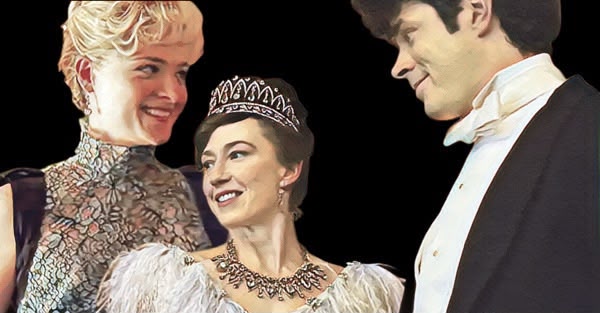
Finally, The Art of Audacity brings together younger characters, including Marian Brook (Louisa Jacobson), Larry Russell (Harry Richardson), and Oscar van Rhijn (Blake Ritson), alongside other figures involved in the show’s social and romantic transformations. Here, instead of the solemnity of the family portraits, we have a more relaxed composition, with champagne coupes in hand, provocative glances, and an atmosphere of celebration. It is almost as though this group might step outside the frame at any moment.
The word audacity is particularly well chosen, because these characters’ freedom does not simply consist of disobeying their elders. They are discovering that the rules designed to preserve fortunes, reputations, and family alliances can also prevent any possibility of individual happiness. Marian has already endured several romantic disappointments and learned that trusting the wrong man can come at a very high price, yet she remains determined to choose her own husband. Larry, meanwhile, is beginning to discover that working in the family business and loving someone do not necessarily mean accepting his parents’ methods.
The Season 3 finale left a more promising outlook for the two of them, although their relationship must still overcome the insecurities and misunderstandings that almost separated them for good. What makes this story interesting is that Marian and Larry love each other, but they are not younger, idealized versions of Agnes and Bertha. Both have personalities, ambitions, and expectations of their own, and the next stage of their relationship will require much more than a romantic reconciliation.
Oscar represents another kind of audacity, one that is considerably riskier. A gay man living in a society that does not allow him to openly embrace his identity, he has already lost money, love, and prestige while trying to find a safe place in the world. The possibility of a marriage of convenience with the now-widowed Enid Winterton is particularly intriguing, because it suggests a socially acceptable solution for two people who need to maintain appearances for different reasons. It could be a practical alliance, perhaps even an affectionate one, but built upon the recognition that society still does not offer Oscar the freedom to be who he truly is.
There is also a broader generational shift taking place. Money is creating opportunities, new professions are emerging, and some of the old divisions between social classes are beginning to weaken. Characters like Jack Trotter, who transformed his watchmaking skills into a genuine opportunity for upward mobility, demonstrate that the future no longer belongs exclusively to those born into the elegant drawing rooms of Fifth Avenue.
And that explains why audacity may be the most optimistic word of the four portraits. While the parents fight to gain or preserve their positions, the next generation is beginning to question whether those positions are really worth all the sacrifices required to achieve them.
Four Portraits, One Society in Transition
The campaign’s visual concept is especially successful because there is a fascinating contradiction between the characters and the frames surrounding them. During America’s Gilded Age, portraits were symbols of wealth, permanence, and respectability. Having one’s image immortalized in a painting meant declaring that someone had earned a place in society and, above all, deserved to remain there. But the characters of The Gilded Age are living through a moment when those positions are becoming increasingly unstable.
Bertha conquered the social world she desired, but risks losing the marriage that supported her entire journey. Agnes preserved tradition for decades, but had to learn that authority can also change hands. Peggy belongs to a respected family, but remains forced to defend rights that should be self-evident. And the younger generation is discovering that no family name, fortune, or marriage can guarantee happiness when one’s life must be lived according to the expectations of others.
Julian Fellowes has always demonstrated a particular fascination with the social transformations brought about by money, technology, and the weakening of traditional hierarchies. That was true of Downton Abbey, and it remains true of The Gilded Age, although the American version of this story is even more explicitly shaped by competition, ostentation, and the possibility of social advancement.
The four posters do not reveal exactly what will happen in Season 4, but they offer clues about the conflicts likely to dominate it. And perhaps the central question is precisely this: after making such tremendous efforts to secure a place within society’s gilded frame, how many of these characters will be willing to break it in order to obtain what they truly desire?
Descubra mais sobre
Assine para receber nossas notícias mais recentes por e-mail.

