
I did not like Below. I wanted to, which may make the disappointment even greater. After all, the series brings together Josh Hartnett, Mackenzie Davis, an isolated fishing community in Newfoundland, a mysterious iceberg, a sea creature, family trauma, and a very timely environmental debate. Those are many promising elements within a single production. The problem is that almost none of them receives the depth it deserves.
That did not stop viewers from becoming interested. In just four days, Below amassed 17 million views, reached No. 1 among Netflix series both in Brazil and globally, and achieved the platform’s biggest debut ever for a Canadian production. The numbers make the series impossible to ignore, but not necessarily any better. In fact, they help reveal something increasingly common in streaming: success does not depend exclusively on quality, but also on a production’s ability to present an immediately recognizable premise and keep viewers curious about the next episode.
In that sense, Below knows exactly what it is doing. There is something in the waters of Snooks Arm. A strange-looking iceberg appears near the small community, fishermen disappear, and a contaminated substance begins to affect the residents. Calvin Penney, played by Josh Hartnett, has carried the trauma of watching his father disappear into the sea since childhood. Forty years later, he remains in conflict with his son, Wade, while resisting attempts to empty the village where his family built its history.
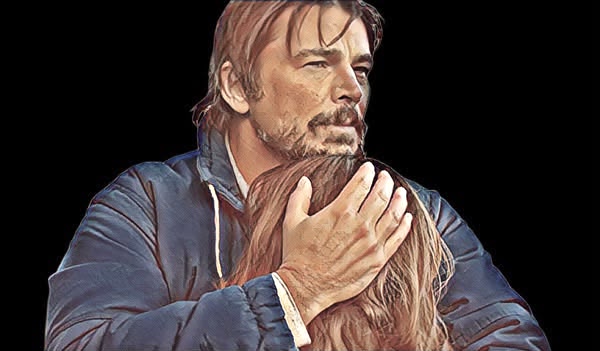
It is an effective opening. The setting is both beautiful and threatening; the sense of isolation works, and Hartnett has precisely the presence Calvin requires: rugged, melancholic, stubborn, and permanently exhausted. His casting also reflects the recent rediscovery of an actor who spent several years away from major productions and returned more interesting, mature, and willing to play broken men. He anchors the series even when the writing does not seem to know exactly what to do with him.
Mackenzie Davis, as marine researcher Fonda Howander, also gives the story some much-needed rationality. While Calvin reacts to the unknown through experience and trauma, Fonda tries to understand it scientifically. The opposition between them could sustain a much richer discussion about fear, nature, and knowledge. Yet Below frequently introduces ideas that it abandons before developing them.
The inevitable comparison is to Jaws, although the series also seeks references in The Thing, The Fog, and the kind of nostalgic horror revived by Stranger Things. The problem is that quoting or reproducing the atmosphere of better works is not enough. Suspense depends on what we cannot see, but also on what we fear losing. In Below, the threat takes too long to acquire real weight because many of its characters are presented as eccentric types before they become people.
The series wants to celebrate Newfoundland’s distinct identity, its accent, traditions, humor, and the resistance of communities that refuse to disappear. This may be its most genuine quality. Snooks Arm is not merely a setting; it is a population threatened by the monster, economic abandonment, and corporate greed. There is a good story hidden in this struggle between staying and leaving, preserving and exploiting. There is also an interesting question: Who represents the real danger—the creature trying to survive or the men who see nature merely as something to be dominated?
The problem is that Below does not entirely trust that story. Instead of deepening its conflicts, it adds humor, the grotesque, family drama, economic conspiracy, climate commentary, and body horror, as if the accumulation of different tones could replace a coherent narrative identity. At times, the strangeness works. At others, the series cannot seem to decide whether it wants to provoke fear, emotion, or laughter. It ends up achieving very little of each.
The excessive explanations do not help, either. The mystery is more interesting while we still do not know exactly what exists beneath the water. Once the series reveals the creature and rationally organizes what happened, it reduces an almost ancient threat to a relatively conventional solution. The monster, we discover, is not exactly the villain. It is an intelligent creature trying to protect its offspring in an environment altered by warming waters. The ecological intention is obvious and relevant, but it is diluted by a plot more interested in leading viewers toward the next revelation than in allowing the idea to acquire any real impact.
There is also a predictable reversal: The creature acts on instinct, while the humans are motivated by greed. The Crocker family and its interest in exploiting the region assume the role of antagonist that the monster gradually abandons. It is not an incorrect conclusion, merely an overly familiar one. Below gestures toward a discussion about the climate crisis, population displacement, and cultural survival, but retreats whenever it could become more uncomfortable.
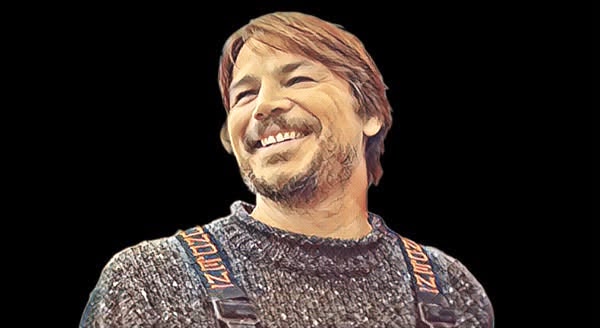
Still, it is easy to understand why so many people watched until the end. There are only six episodes, the threat is clear, each chapter delivers new information, and the landscape gives the production a visual identity that its writing does not always possess. The series was built for binge-watching. Before viewers have time to question its inconsistencies, they are already close enough to the conclusion to continue.
This is precisely where its 17 million views begin to make sense. Below did not become a phenomenon because it is extraordinary. It became one because it offers a highly efficient combination of a familiar star, a mystery, accessible horror, an unusual setting, and a short running time. It demands little, moves quickly, and keeps a simple question at the center of the narrative: What exists beneath that iceberg?
Unfortunately, the answer is less interesting than the promise.
In the end, Calvin manages to protect his family, and the community regains some degree of autonomy. The creature dies after giving birth, but its offspring cannot survive the changes in the environment. The image should be devastating. However, the series has not built enough emotional depth for the tragedy to reach its full potential. Even the new iceberg spotted in the closing scene feels less like a genuine provocation than a door left open in case the numbers convince Netflix to turn the miniseries into something bigger.
Perhaps they will. Below was marketed as a limited series, and those involved have stated that, for now, there are no plans for a continuation. But 17 million views tend to speak a language every streaming platform understands.
If it returns, there is material for a better series. There is an interesting cultural universe, an urgent environmental conflict, and a protagonist whom Josh Hartnett makes more complex than he is on the page. During this first visit to Snooks Arm, however, Below proves only that an excellent premise can carry us to the end without ever delivering what it promised at the beginning. Netflix has found its latest phenomenon. I am still looking for the great series that might have existed inside it.
Descubra mais sobre
Assine para receber nossas notícias mais recentes por e-mail.

