
Contains spoilers for the first two episodes.
I may still change my mind, but the first two episodes of VisionQuest left me underwhelmed. There are intelligent ideas, a character who deserves this space, and an interesting discussion about what makes us who we are. The writing, however, is weak precisely where it needs to bring all of this to life. The need to explain a complicated history is understandable, but the exposition becomes repetition; the repetition slows the pace, and the series ends up talking too much about feelings without managing to evoke them in equal measure. Without James Spader, it would lack soul.
The shadow of WandaVision’s narrative brilliance hangs over this continuation, as does the success of Agatha All Along. These comparisons are inevitable for a production presented as the conclusion to this trilogy, particularly because its predecessors found such distinctive ways of telling their stories. In WandaVision, the language of sitcoms was part of Wanda’s defense mechanism: the form allowed us to understand her suffering before we had all the explanations. VisionQuest also seeks a visual representation of its protagonist’s inner life, but so far, it seems to trust what it shows less than the explanations it provides afterward.
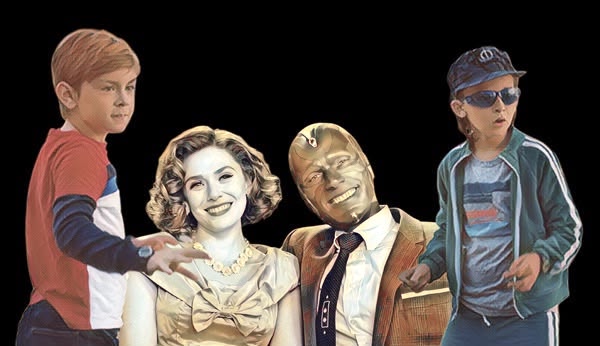
The problem is not revisiting information. Between deaths, reconstructions, children created through magic, and consciousnesses that survive in other bodies, there is plenty to sort out. The problem is that the series keeps clarifying its premise after we have already understood it, as though every conversation needs to ensure that no one has missed a step. This difficulty also appears in the initial reviews: The Rolling Tape’s assessment of the first two episodes highlights the excessive exposition, while Variety, which reviewed the complete season, points to the distance between the series’ ideas and its ability to create an emotional connection. My impression, for now, is limited to the premiere.
Remembering Is Not Feeling
The Vision we are following makes a point of reminding us, repeatedly, that he is a different Vision. He possesses his predecessor’s memories, but not the feelings associated with them. He knows that he loved Wanda, recognizes events from their shared life, and can access those experiences, although he cannot experience them as the man who lived through them. It is a particularly intelligent premise because it separates two things we tend to treat as inseparable: knowing our history and being able to give it emotional meaning.
From this perspective, we can offer a psychoanalytic reading of the series without assuming that it literally reproduces a process of analysis. Being able to recount what happened does not mean we have worked through that experience. We can describe a loss, identify its circumstances, and even rationally understand its effects while remaining detached from the emotions involved. Information alone cannot accomplish that work. Vision knows the facts, but remains trapped in the attempt to understand why they should matter to him.
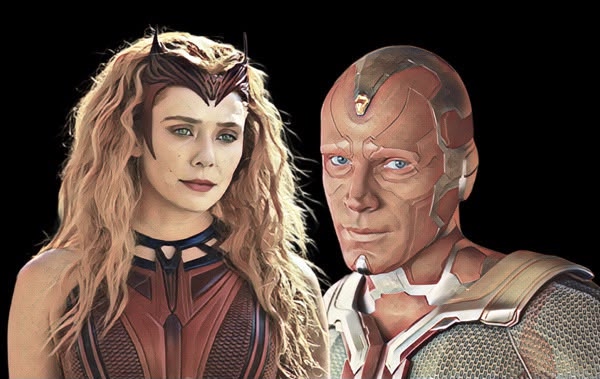
The house built inside his mind offers an interesting image of this organization. Other artificial intelligences live there, with different functions and personalities, helping him interpret the world. We can read that space as a dramatization of his psychic life, with memories he returns to, subjects he avoids, and a household that is far from entirely harmonious. The unconscious does not work like a perfectly organized archive, but the distance between what Vision can access and what he can connect with emotionally offers a productive parallel.
It is also intriguing to follow an artificial hero at a time when artificial intelligence so frequently appears as a threat. Marvel has a more ambivalent history with this, and the series revisits that tradition by bringing together J.A.R.V.I.S., F.R.I.D.A.Y., E.D.I.T.H., and other programs associated with Tony Stark’s world. Ultron is part of that equation, of course, but he does not single-handedly represent what these intelligences can be.
That is precisely why I miss Tony as a stronger emotional presence. His legacy is everywhere, but recalling where those programs came from is not the same as exploring what their creator meant to them. In a story so interested in origins, identity, and fatherhood, Stark could carry more weight than he does in these opening episodes. Not out of nostalgia or a need for another special appearance, but because his relationship with these creations would help give the discussion greater depth.
The Children Set the Story in Motion
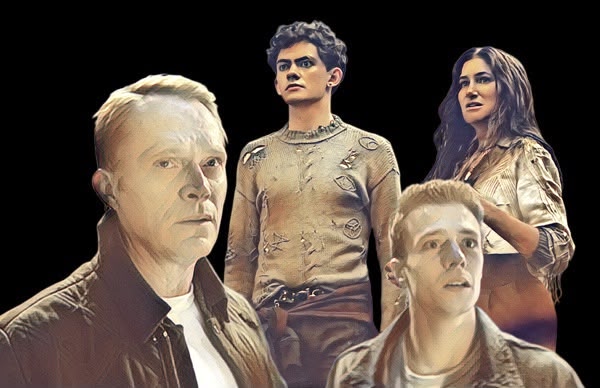
Vision’s attempt at isolation ends when Ultron exposes his hiding place and Paladin, a bounty hunter working for an unidentified employer, enters the picture. The attack on the pub claims Fiona and forces the protagonist to flee. Later, the capture of Thomas Shepherd gives his pursuer a way to lure him out: the young man may be Tommy, the son Vision believed had disappeared along with the reality of Westview.
It is through the children that this story moves forward again. Agatha All Along had already shown Billy surviving in William Kaplan’s body and taking part in the search for a body for his brother’s soul. Now we meet Thomas, who describes a near-drowning experience after which he began to feel that there was someone else inside his head. He carries memories of Wanda, Vision, and a life he cannot reconcile with his own. Lisa, his partner in street scams, entered his story when the two escaped from a transport to Saint Mabyn’s, the institution to which Paladin now takes him again.
Father and son therefore face similar questions, although not identical ones. Both must deal with experiences they recognize without being able to integrate them fully into their identities. The possibility of a relationship between them could turn this discussion into something deeply moving, because neither arrives at their encounter entirely certain of who he is.
Ultron helps Vision stop treating this merely as a philosophical problem. By revisiting the Ship of Theseus, he shifts the focus to the hero himself, who confronted the Minotaur to save the young people. The provocation works: a son is in danger, and the decision to help him cannot wait for a definitive answer about which version of Vision is making that decision.
The rescue, however, leads to a trap. Imprisoned in an electromagnetic cage and struck by Paladin’s adamantium ammunition, Vision is severely weakened. The crisis allows Ultron to leave his confinement in the attic, expanding his freedom within that mental space. With the systems collapsing, J.A.R.V.I.S. sacrifices his code to preserve the others, while Tommy returns with a car and saves his father.
There are important consequences to this development, but I still feel the effort to construct emotion more than the emotion itself. The loss of J.A.R.V.I.S. should carry the full weight of his history, and perhaps this is precisely where a more developed connection to Stark’s legacy is missing.
The Weight of a Line We Already Know
The repetition of the line about grief also contributes to this feeling. “What is grief, if not love persevering?” was one of WandaVision’s most beautiful formulations because it emerged from an encounter, at a moment when Vision was trying to understand Wanda’s pain. There was tenderness in that discovery, and its power came as much from the words as from the relationship that made them possible.
I understand why VisionQuest returns to it. The line connects memory, love, and loss, while also offering a trace of the Vision who learned to feel through his relationship with Wanda. But repeating it ad nauseam does not necessarily deepen its meaning. To me, it begins to suggest a difficulty in finding new words to continue the conversation. Such a powerful line loses weight when it becomes a recurring reminder of an emotion that another series already managed to create.
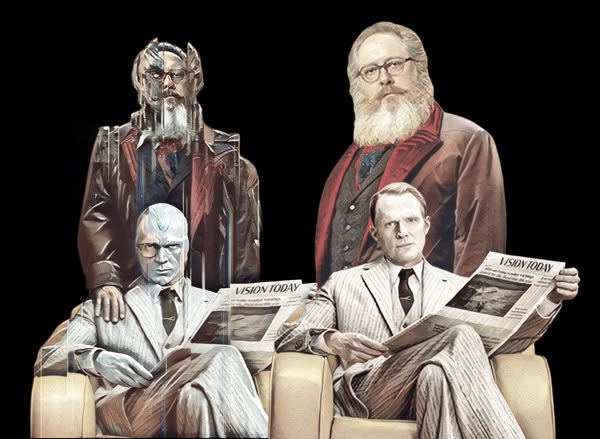
The music and sets add another layer of excess. There are moments when everything seems intent on emphasizing a scene’s strangeness, importance, or emotional weight, leaving little room for it to find its own balance. Spader manages to cut through all of this because he brings rhythm, irony, and an unpredictability that the rest of the writing does not yet sustain. His Ultron generates interest even when he is merely commenting on what is happening, because we never know exactly how much insight, manipulation, or pleasure in provoking others lies behind each intervention.
I will keep watching, because the premise has possibilities and the relationship with Tommy may give the series the emotional center I am still missing. So far, however, VisionQuest describes the difficulty of remembering without feeling very well, but ends up sharing a little too much of that difficulty with its protagonist. I understand what it is trying to do. I am still waiting for it to make me feel.
Descubra mais sobre
Assine para receber nossas notícias mais recentes por e-mail.

