
I belong to the generation that grew up traumatized by Jason Voorhees. For those of us who experienced the Friday the 13th phenomenon in the 1980s, all it took was that strange breathing, a movement among the trees, or the sight of a hockey mask to know that something terrible was about to happen. Jason didn’t run, didn’t talk, didn’t negotiate. He simply appeared. And no matter how fast his victims ran, he always got there first. Almost half a century later, Crystal Lake, an eight-episode series available on Peacock in the United States, takes us back to where it all began. But this time, we are not running away from the killer. We are trying to understand how he came to be.
The story of Friday the 13th began in 1980, when producer and director Sean S. Cunningham recognized the success of John Carpenter’s Halloween, released in 1978, and decided to embrace a similar formula: isolated teenagers, a mysterious killer, and increasingly violent deaths. Written by Victor Miller, produced on an estimated budget of just $650,000, and featuring special effects by Tom Savini, the film opened in American theaters on May 9, 1980. It became a commercial phenomenon, grossing nearly $60 million worldwide. One of horror cinema’s most profitable and recognizable franchises was born.
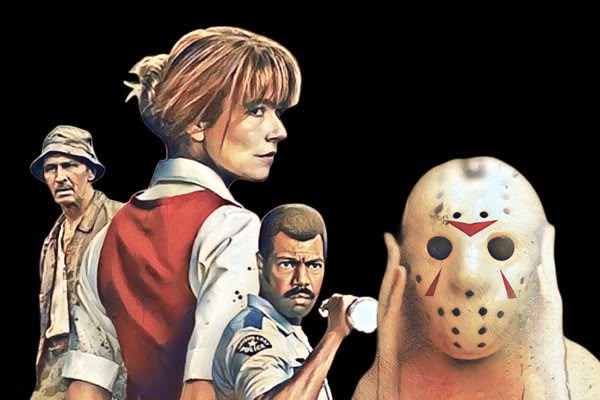
The premise was as simple as it was effective. A group of young people decides to reopen Camp Crystal Lake, which had been closed following a series of tragedies, including the drowning of a boy in 1957. The counselors begin to be murdered one by one, until the sole survivor, Alice, discovers the killer’s identity: Pamela Voorhees, Jason’s mother, convinced that her son died because the counselors were more interested in fooling around than watching the children. Played by Betsy Palmer, Pamela was a woman consumed by grief and revenge. Contrary to what many people remember, Jason was not the killer in the first film.
Success demanded a sequel as early as 1981, and Jason took center stage, gradually becoming an almost indestructible figure. The hockey mask, now inseparable from his identity, did not appear until the third film, in 1982. Before that, he concealed his face beneath a burlap sack. The rest is history: an endless succession of inventive deaths, sequels, resurrections, a confrontation with Freddy Krueger, and even an adventure in space. Critics never needed to love Friday the 13th for audiences to turn it into a classic. The film helped establish the essential elements of the slasher genre: vulnerable teenagers, isolation, sexuality associated with danger, elaborate murders, and the feeling that nobody would be safe until the closing credits.
But what made Jason so terrifying was not simply the violence. It was his presence. The camera frequently adopted the killer’s point of view, Harry Manfredini’s score built tension through that unforgettable vocal effect that sounded like a threatening whisper, and the forest seemed to conceal something around every corner. There was also an almost childish cruelty in the way the film built anticipation around death. We knew it was coming. We just didn’t know from where.
This is precisely the universe that Crystal Lake brings back. Produced by A24 for Peacock, with Brad Caleb Kane serving as showrunner, the series stars Linda Cardellini as a younger Pamela Voorhees. And this is its strongest decision. Known for Freaks and Geeks, Dead to Me, and numerous other projects, Cardellini creates a character who moves between vulnerability, maternal love, guilt, and increasingly disturbing violence. She does not simply attempt to reproduce Betsy Palmer’s performance. Her Pamela is a woman who still believes she can save her son, even when she can no longer distinguish protection from destruction.
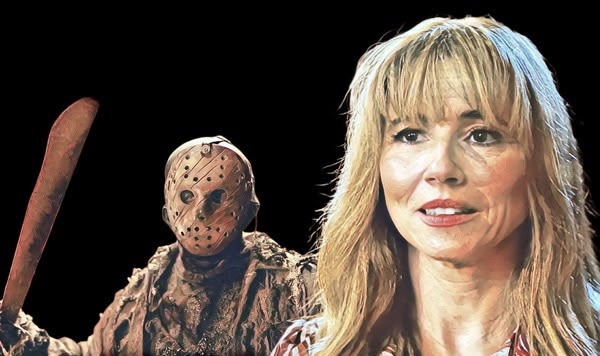
The series initially takes place in 1972, moving the original tragedy to a different decade. We meet Jason as a child, played by Callum Vinson, and witness his profoundly dependent relationship with his mother. He experiences rejection, is treated as different, and finds in Pamela his main, perhaps his only, source of safety. This perspective gives the story a human dimension, but it also changes its nature. Pamela’s violence is no longer simply the response of a mother driven mad by loss. It becomes part of a larger universe of manipulation, family secrets, and interests that extend far beyond her personal tragedy.
Visually, however, the production demonstrates genuine respect for the original material. The cinematography explores the darkness of the forests, the deceptively peaceful waters of the lake, and the vulnerability of characters in isolated settings. The recreation of the 1970s is more than a nostalgic backdrop. It is present in the costumes, hairstyles, young people’s behavior, and the way the camera follows approaching danger. There are direct references to classic death scenes, unapologetic graphic violence, and a deliberate combination of macabre humor and physical horror. The practical effects and makeup reinforce this connection to the cinema that made the franchise famous. It is a visual language we immediately recognize, even when the narrative decides to take a very different direction.
And that direction is considerably different.
SPOILERS FOR THE FIRST SEASON AHEAD
The major revelation comes when we discover that Jason’s physical deformities and extraordinary resilience are connected to Project Argonaut, a scientific experimentation program conducted by Bellflower Chemicals. His own father, Elias Wittering, played by Hamish Linklater, was involved in the procedures performed on the boy, including interventions that began before his birth. The objective was to develop human beings capable of surviving extreme conditions, including the consequences of a nuclear catastrophe. As a result, the child who once seemed condemned to physical vulnerability becomes a creature capable of surviving fatal injuries, regenerating, and growing at an extraordinary rate.
This represents a significant alteration to the Friday the 13th mythology. The franchise always contained contradictions regarding Jason’s survival, but it never required such an elaborate scientific explanation. The series attempts to fill that gap with a corporate conspiracy, medical experiments, and characters who seem to belong to an entirely different genre. It is not necessarily a bad idea. The problem is that by explaining too much, Crystal Lake weakens precisely what made Jason so effective: the unknown. Perhaps we never needed to understand why he could survive everything. It was enough to be terrified whenever he reappeared.
There is also a significant change in the way Pamela is presented. Her suffering remains the emotional center of the story, but responsibility for the earliest murders is redistributed, including Grace’s involvement in the killings of Barry and Claudette. The screenplay combines hallucinations, guilt, fanaticism, and violence, sometimes with interesting results, sometimes at the expense of clarity. The series seems determined to be a traditional slasher, a psychological drama about motherhood, and a conspiracy thriller all at once. These ambitions do not always coexist harmoniously.
Even so, there is a fascinating interpretation of the relationship between Pamela and Jason. She is a mother who loves her son profoundly but also imprisons him within her need to protect him. Jason, in turn, transforms that love into a dependency that survives even his apparent death. It is a symbiotic relationship, defined by guilt and the impossibility of separation. The rejected child finds his only refuge in his mother; she finds in him the justification for everything she does. When protection becomes violence, they begin to inhabit a world in which everyone else represents a threat.
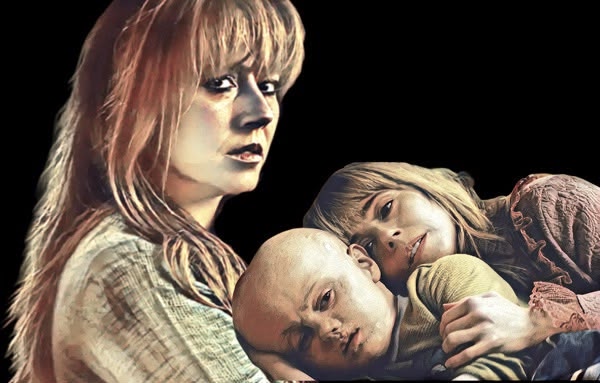
The season finale, titled The Final Chapter, a direct reference to the franchise’s fourth film, brings Pamela, Jason, and Elias together in a violent confrontation. Jason, now physically an adult and concealing his face beneath the familiar burlap sack, kills the father responsible for the experiments. He then turns against Pamela. For a moment, he seems ready to kill her as well, but the memory of their bond prevents the final rupture. Jason disappears into the forest once again, while Pamela adopts an even more disturbing position: Crystal Lake has become their territory, and nobody should come near it.
It is an ending that opens up new possibilities while also creating continuity problems. After all, how can this Pamela, who now knows Jason is alive, become the woman we met in 1980, convinced that her son drowned? The series does not resolve this contradiction. It also leaves unanswered questions about the consequences of Project Argonaut, the possibility of other experimental subjects, the fate of characters involved in the investigation, and the future of the relationship between mother and son. The appearance of Steve Christy, associated with the camp’s reopening in the original film, serves as a bridge to the events we already know, but it does not guarantee that the story will follow exactly the same path.
The production itself went through a complicated journey before reaching television. Initially developed by Bryan Fuller, of Hannibal fame, it underwent creative changes and eventually landed in Brad Caleb Kane’s hands. Perhaps that helps explain some of its tonal inconsistencies. International critics have also been divided, although they have generally shown more enthusiasm for Cardellini’s performance than for the narrative choices. Some consider the expansion of the mythology unnecessary, especially because simplicity was always one of Friday the 13th’s greatest strengths.
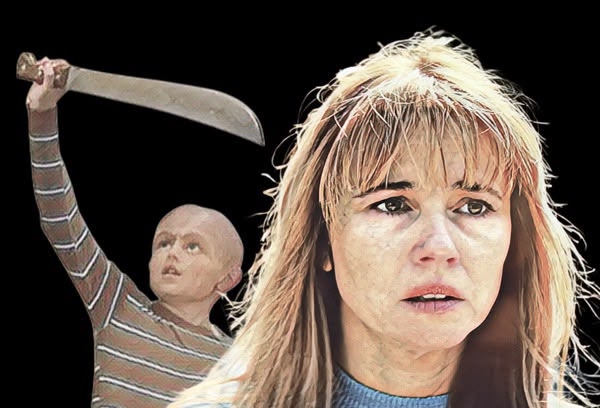
For me, Crystal Lake works best when it forgets its obligation to justify its own existence and simply embraces the horror that made it possible. When the camera moves through the forest, when a teenager wanders away from the group, when silence announces a presence we cannot see, we rediscover the fear that was part of our youth. Linda Cardellini gives emotional consistency to a story that sometimes becomes unnecessarily complicated. And Jason remains Jason, even without the mask that would eventually turn him into an icon.
Perhaps that is the series’ greatest contradiction. Crystal Lake was created to explain the origins of one of cinema’s most famous killers, but its finest moments happen when it explains absolutely nothing. For those of us who grew up traumatized by Jason Voorhees, discovering what lies behind the mask might satisfy a decades-old curiosity. But I still believe it is far more terrifying not to know what is waiting among those trees.
Descubra mais sobre
Assine para receber nossas notícias mais recentes por e-mail.

