
Netflix spent more than a decade teaching Hollywood how to do things differently. It changed the way we watch television, challenged traditional studios, confronted movie theaters, created a global market for productions that previously would have struggled to travel beyond their home countries, and turned binge-watching into a cultural habit. Now, the company seems to have reached the conclusion that it needs to change once again. And this time, it may have to reconsider some of the very ideas that made it so powerful.
The dismissal of Bela Bajaria, Netflix’s global chief content officer, announced on October 15, is not simply another executive reshuffle. The arrival of Peter Rice, a veteran of Fox and Disney, represents a potential change of direction that could affect the entire entertainment industry. The decision came alongside approximately 1,000 layoffs, representing 6% of the company’s workforce, at a particularly delicate moment for streaming. Not because Netflix has stopped making money, but because its ability to keep growing and, more importantly, holding audiences’ attention is increasingly being questioned.
For years, Netflix was the company that forced Hollywood to reinvent itself. Today, it is Netflix that needs to find an answer to the changing market.

The Revolution That Began With a Binge
To understand what is happening, we need to remember that Netflix did much more than offer movies and television series online. It transformed television’s economic model. While traditional broadcasters depended on programming schedules, commercial breaks, and weekly ratings, Netflix began selling access to a catalog available at any time for a monthly subscription fee. Viewers no longer had to organize their lives around television schedules.
The premiere of House of Cards in 2013 was one of the defining moments of that revolution. All episodes became available simultaneously, consolidating the concept of binge-watching. There was no need to wait another week to discover what happened next. All you had to do was keep watching.

The model worked extraordinarily well. Netflix attracted subscribers, invested billions in original productions, and expanded its international presence. Its globalization strategy, strengthened under Bela Bajaria, helped turn productions such as Squid Game and Adolescence into international phenomena.
But there is a fundamental difference between consuming a series quickly and keeping that series culturally relevant for months. And that difference is becoming increasingly important.
Releasing an entire season at once can generate enormous immediate impact, send a production to the top of the charts, and dominate social media for a few days. Then, quite often, comes oblivion. By contrast, series released weekly sustain discussions, theories, anticipation, and conversations for months.
This is not merely an impression. A Reelgood survey covering the first six months of 2026 found that Netflix placed 27 series among the ten most in-demand titles in its U.S. rankings, but none remained there for more than five weeks. The Pitt, released weekly on HBO Max, remained on the list for 17 weeks. These figures come from a specific platform rather than a comprehensive measurement of total viewership, but they help illustrate an important shift.
Binge-watching is not dead, and it remains an attraction for millions of subscribers. But it has lost some of its power as a tool for creating lasting cultural phenomena. Netflix itself has already experimented with split-season releases and alternative distribution formats.
The problem is that, in a subscription-based business, it is not enough for someone to watch an entire series over one weekend. You have to convince that person to keep paying the following month.

Netflix Challenged Hollywood, but It Never Defeated Movie Theaters
Netflix’s relationship with movie theaters has always been marked by contradiction. While investing in films by major directors and seeking recognition from the industry, the platform resisted the traditional theatrical distribution model, in which a movie plays exclusively in theaters before becoming available for home viewing.
The debate intensified with productions such as Roma, The Irishman, and Marriage Story. Netflix demonstrated that it could attract important filmmakers, finance ambitious projects, and compete for Oscars without relying on the conventional studio system. But winning awards did not necessarily mean achieving the same cultural prestige as a major theatrical release.
There is something that a theatrical premiere still provides: a collective event, an experience that goes beyond individual consumption. Just look at the phenomena surrounding Barbie, Oppenheimer, or Top Gun: Maverick. These were films that generated conversations and attracted audiences far beyond the screen.
Movie theaters, so often declared endangered by streaming, continue to offer an experience that platforms have never fully replaced. And Hollywood has noticed.
Major filmmakers have increasingly returned to prioritizing theatrical releases, even when that means turning down more generous financial offers. Netflix, which spent years trying to rewrite the rules, now faces an industry that continues to value box office performance, premiere events, and major franchises.
The irony is that Netflix helped weaken the traditional model without managing to create an equally powerful alternative for every kind of production.
Awards Are No Longer Enough
It is important not to confuse a decline in prominence at certain awards ceremonies with a lack of recognition. Netflix continues to win significant trophies. At the 2026 Emmy Awards, for example, the platform received acting awards for Allison Janney in The Diplomat, Matthew Rhys in The Beast in Me, and Sally Field in Remarkably Bright Creatures.
But the discussion goes beyond the number of statuettes. Netflix can no longer automatically translate its enormous volume of releases into cultural dominance or prestige. Competitors such as HBO and Apple TV continue to demonstrate that a smaller catalog, when carefully developed and promoted, can establish a strong identity.


Having more television series does not necessarily mean having the best television series. And winning awards, although important for reputation, does not guarantee that a production will retain subscribers or generate additional revenue.
That appears to be one of the central questions behind the reorganization.
The New Rival Is Not HBO. It Is YouTube.
Perhaps the most significant change in the entertainment market is happening outside the traditional competition between streaming services.
For years, Netflix, Disney+, Prime Video, HBO Max, and Apple TV competed for subscriptions and exclusive productions. Now, they all face a rival operating under an entirely different model: YouTube, TikTok, and other platforms offering a virtually infinite amount of content, much of it free.
Netflix invests millions of dollars in producing a television series. A content creator can publish a video at a fraction of the cost and compete for exactly the same amount of the viewer’s attention. And this competition is not limited to people who enjoy movies and television series. It involves every entertainment option available on a screen.
For Netflix, this transformation is particularly troubling. Its economic model depends on substantial investments in content, technology, infrastructure, and marketing, financed primarily by subscriptions and, increasingly, advertising.
In the second quarter of 2026, the company reported approximately $12.56 billion in revenue, up 13% from the same period a year earlier, with net income of around $3.4 billion. In other words, we are not talking about a company facing an immediate financial crisis. The problem lies in expectations for future growth.

Investors want to know whether Netflix can attract new subscribers, retain existing ones, increase advertising revenue, and justify the money spent on productions. When audience engagement grows slowly and shares lose value, the pressure increases.
That is why the recently announced cuts should not be interpreted simply as a cost-saving measure. They indicate an attempt to reorganize priorities and generate greater returns on investment.
Netflix’s expansion into live sports, live events, gaming, and video podcasts is part of this search for new revenue streams and new ways to keep viewers on the platform.
Netflix no longer wants to compete only for the time we devote to movies and television series. It wants to compete for all our free time.
Warner Bros. and the Deal That Never Happened
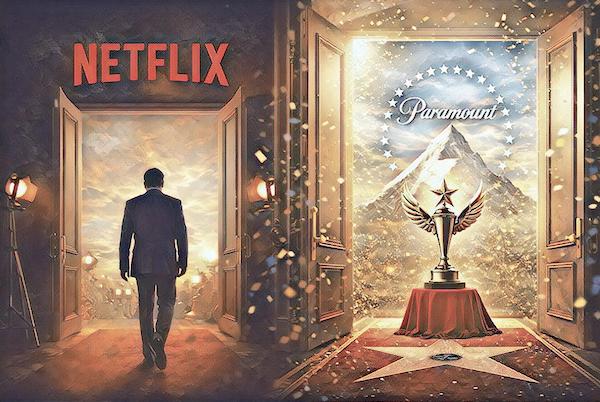
There is another fundamental element to this story: Netflix’s unsuccessful attempt to acquire Warner Bros. Discovery’s studios and streaming operations, competing against Paramount Skydance for control of Warner’s assets.
The acquisition would have given Netflix control of one of Hollywood’s most historic studio operations, including HBO and an extraordinary catalog of films, series, and characters. It would have been a way to immediately acquire something Netflix has spent years trying to build: established brands and franchises capable of generating revenue for decades.
In February 2026, Netflix decided not to increase its offer to beat the competing bid. Paramount won the battle and completed its acquisition of Warner Bros. Discovery on October 6, creating the new Skydance conglomerate. The significance of this development should not be underestimated.
Netflix built its success by constantly creating new stories. Traditional studios, on the other hand, own characters and fictional universes that can be commercially exploited for generations. Harry Potter, Batman, Game of Thrones, and countless other intellectual properties demonstrate the economic value of a franchise.
A film or television series is only the beginning. There are sequels, spin-offs, licensed merchandise, video games, live experiences, and countless other commercial possibilities.
It is no coincidence that, just days before the leadership shake-up, Netflix announced plans to begin negotiating merchandise licensing directly in Brazil in 2027, moving even closer to the model traditionally adopted by major studios.
The failed Warner acquisition does not, on its own, explain Bajaria’s dismissal. But it helps us understand the change in mindset.
Netflix appears to want to become less dependent on having to invent a new hit every season.
What Does Peter Rice Represent?
Peter Rice officially takes over global content operations on October 26. His experience at Fox and Disney reflects a background much closer to Hollywood’s traditional structure, with an emphasis on developing major brands, managing relationships with talent, and producing entertainment capable of reaching large audiences.
He is the first major outsider to arrive directly at the top of this division with an explicit mandate to bring about significant change. His appointment signals that Netflix may once again concentrate more resources on major American productions with international appeal, without necessarily abandoning its global operations.
That distinction matters. The company has not announced the end of its international strategy, but Ted Sarandos explicitly emphasized the potential of productions developed in the United States and Canada to generate major hits and worldwide conversations.
The shift could mean fewer scattered bets, greater concentration of resources on selected projects, and increased attention to each title’s potential to become a lasting brand.
It could also mean greater selectivity when approving films and series. And that inevitably raises questions about the future of smaller productions, experimental storytelling, and projects designed for specific audiences.
We do not yet know how far Rice intends to take this reorganization. But his appointment suggests that Netflix is looking for someone capable of combining the technological efficiency of streaming with Hollywood’s experience in creating major cultural phenomena.
And What About Brazil? Should We Be Concerned?
Brazil occupies an important position in this equation. In 2026, Netflix marked 15 years of operations in the country and opened a new office in São Paulo. According to figures released by the company, it worked with more than 40 Brazilian production companies over the previous three years, while its productions released in 2025 generated more than 12,000 jobs. Additionally, global viewership of Brazilian productions increased by 60% during the second half of 2025 compared with the previous six months.
These numbers show that Brazil is not a secondary market. It matters both as a consumer market and as a content producer. But there is a question: if the priority becomes creating major international hits, what happens to Brazilian productions that perform well locally but do not necessarily attract millions of viewers in other countries?

On one hand, the shift could benefit Brazilian projects with franchise potential, popular storytelling, and genres capable of reaching broad audiences. On the other, it could reduce opportunities for smaller productions, regional narratives, and creative proposals that do not immediately fit the search for the next global phenomenon.
Nor can we assume there will be specific cuts to Netflix’s Brazilian operations. So far, no such announcement has been made. It would be premature to interpret a global reorganization as an automatic decision to reduce investments in the country.
Even so, the impact could eventually become visible in the way projects are selected, the budgets approved, and the importance assigned to each production’s international potential.
The challenge will be finding a balance between telling Brazilian stories and trying to turn them into global products. Because the success of Squid Game demonstrated precisely that a story does not need to look American to conquer the world.
The End of an Era?
Bela Bajaria’s departure may represent more than the replacement of an executive. It could mark the end of a particular chapter in the entertainment industry, one in which expanding the catalog, attracting subscribers, and constantly offering new releases seemed to be enough.
Netflix grew by dismantling old assumptions. It showed that audiences no longer needed to wait a week for another episode, that foreign-language productions could conquer global audiences, and that a film did not necessarily need a theatrical release to reach millions of viewers.
But some of those achievements also created problems. The abundance of content made productions disposable. Binge-watching shortened the time many series remained part of the cultural conversation. Competition for subscribers drove up costs, while market fragmentation multiplied viewing options without necessarily improving the audience experience.
Now, Netflix is searching for a formula that combines global reach, profitability, prestige, and cultural staying power. It is a difficult equation, especially when competing against platforms that barely need to invest in producing the content they distribute.
My biggest question is whether this new strategy will represent a creative evolution or simply an even greater concentration on familiar formulas, sequels, and franchises. Hollywood has demonstrated countless times that enormous investments do not guarantee good stories. And a company that grew precisely by challenging conventions risks becoming too similar to the studios it once tried to disrupt.
Perhaps that is the greatest irony of this transformation. After changing Hollywood, Netflix may be discovering that it still has a few things to learn from it.
And for us, the viewers, what truly matters is not how many productions are available, but how many of them stay with us long after the credits roll.
Descubra mais sobre
Assine para receber nossas notícias mais recentes por e-mail.

