
Netflix won the streaming wars. That much is undeniable. It transformed the way the world consumes entertainment, challenged Hollywood’s traditional structures, changed audience habits, and forced major studios to chase a business model many of them initially dismissed. Today, however, the question is no longer whether Netflix managed to win. It is what happens when the company that revolutionized an industry begins to reproduce the very system it promised to fight.
The changes announced in October 2026 to the platform’s creative leadership are far more significant than a simple executive reshuffle. Bela Bajaria’s departure, her replacement by Peter Rice, Dan Lin’s dismissal, and the elimination of approximately 1,000 jobs reveal a company that remains powerful but needs to reconsider its strategy. Not because it has stopped making money or producing hits, but because its ability to turn viewership into cultural relevance seems increasingly uncertain.
That distinction is fundamental. Netflix remains a financial and commercial powerhouse. Its international presence, enormous catalog, and ability to turn a production into an immediate phenomenon are impressive. But being the platform everyone subscribes to does not necessarily mean producing the most important, memorable, or widely discussed works.
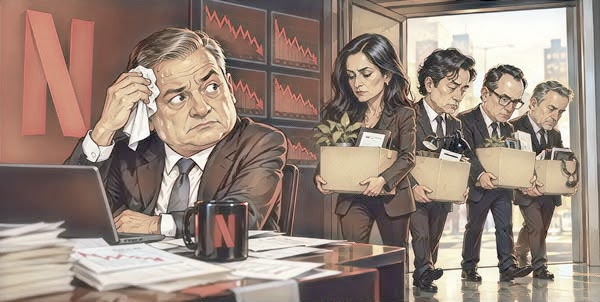
A report published by The Wall Street Journal on October 20 makes that contradiction even clearer. According to the newspaper, Ted Sarandos had been expressing concerns for months about Americans spending less time watching Netflix and the company’s difficulty replicating cultural phenomena capable of engaging audiences over extended periods. The internal reorganization, known as Project Meridian, resulted in approximately 1,000 layoffs, representing about 6% of the workforce, and placed Peter Rice in charge of a global content operation estimated at $20 billion.
The problem does not appear to be a lack of money. It is the difficulty of turning that investment into stories that truly endure.
The Weight of the Numbers and Wall Street’s Pressure
Netflix shares have lost more than 40% of their value over 12 months, even as projections continue to indicate revenue growth in 2026. Its monthly cancellation rate in the United States remains around 2.1%, one of the lowest in the industry. Yet estimates from Antenna cited by The Wall Street Journal suggest that the platform failed to record a single month of net subscriber growth in the United States through September. Netflix disputes how representative that methodology is, but concerns about engagement are real.
We need to distinguish three things that are often conflated in market analysis: subscriber numbers, financial performance, and the time audiences actually spend watching content. A platform can remain profitable, continue attracting advertisers, and maintain an enormous customer base without necessarily increasing interest in its films and television shows.
And this is precisely where Netflix seems to face its greatest challenge. The platform has never produced so much, but producing more does not mean producing something that remains in the collective memory.
The decision to cut costs and replace executives also reflects pressure from investors who are no longer willing to accept growth at any price. For years, Netflix was treated as a technology company operating in entertainment. Increasingly, it must now answer the traditional demands placed on a major media conglomerate: profitability, efficiency, audience retention, and return on investment.
The revolution has matured. And Wall Street wants results.
The Oscars, the Emmys, and the Difference Between Quantity and Prestige
This contradiction did not begin now. It was already evident in my analyses of the 2026 Oscars and Emmys.
For years, Netflix invested millions in awards campaigns to gain recognition from Hollywood’s Academy. It attracted celebrated directors, financed projects traditional studios were reluctant to support, and made the awards race an important part of its strategy for artistic legitimacy.
Its contribution to contemporary cinema is undeniable. Without Netflix, certain projects might never have secured financing or reached such a large international audience. But it is equally impossible to ignore that investment, visibility, and numerous nominations do not guarantee artistic dominance.
The 2026 Oscars once again highlighted the difference between participating in the race and dominating the cinematic conversation. Netflix remains an important contender, but its commercial strength does not automatically translate into a proportional level of artistic recognition.
Television’s Emmy Awards expose a similar challenge. The platform releases an extraordinary volume of series, works with first-rate talent, and reaches audiences on virtually every continent. Yet competitors with proportionally smaller catalogs can establish themselves as references for quality, earn prestige, and keep their productions at the center of cultural discussion.
HBO and Apple TV+ are particularly interesting examples. Neither needs to match Netflix’s catalog size to compete for the attention of critics, voters, and viewers. Often, all it takes is one series capable of generating anticipation, inspiring interpretation, and remaining culturally relevant for months.
This is not to suggest that awards are the only measure of quality. They never have been. But there is a difference between producing hits that dominate rankings for a week and creating an artistic legacy that survives seasons and years.
Netflix still has an extraordinary ability to accomplish the first. The second requires something that cannot always be purchased with an enormous budget.

What MiscelAna’s Audience Reveals
This perception is also reflected in the behavior of MiscelAna’s readers.
Netflix is unquestionably one of the platforms that generates the greatest interest. New releases drive searches, views, and immediate engagement. Popular series create curiosity about casts, characters, endings, and possible renewals. Its commercial power is also evident in how audiences seek information about its productions.
But there is a distinctive aspect to this behavior: the intensity often disappears almost as quickly as it emerges.
A major premiere dominates conversations for a few days, sometimes a week, and is quickly replaced by another. Audiences consume the series, search for answers, and move on to the next release. This does not mean they did not enjoy what they watched. It means their relationship with the work often ends when the season does.
By contrast, productions from other platforms can continue generating interest long after their premieres. Audience involvement follows the episodes, character relationships, writers’ decisions, and narrative possibilities.
There is a difference between watching and following. And following may be one of the most important ways of building lasting cultural loyalty.
Of course, Netflix itself has produced notable exceptions. Stranger Things, Squid Game, Bridgerton, and other phenomena demonstrated its capacity to create communities of viewers. The problem is that phenomena of this magnitude cannot be manufactured indefinitely, regardless of how much money is invested.
Has Binge-Watching Become a Trap?
Perhaps the most important discussion concerns the very model that helped turn Netflix into a global leader.
The strategy of releasing entire seasons at once was revolutionary. It freed viewers from weekly schedules, encouraged marathon viewing, and created a new relationship with television storytelling. For years, binge-watching was presented as a symbol of freedom, modernity, and respect for consumer autonomy.
But the same strategy that made consumption easier also helped shorten the lifespan of cultural conversations.
A series that costs millions, takes years to produce, and requires extraordinary creative effort can be consumed in a single weekend. On Monday, viewers discuss the ending. By the following week, another production has taken its place.
The contrast with weekly releases is significant. A series distributed over two or three months creates intervals that encourage reflection, discussion, theories, and identification with characters. Anticipation becomes part of the experience.
This does not mean that every viewer prefers waiting or that weekly releases are necessarily superior. It means that distribution models directly affect a work’s cultural longevity.
What The Wall Street Journal now reveals is that Netflix itself has begun discussing the effectiveness of this system internally. The report also points to questions about its dependence on recommendation algorithms and the possibility of increasing human editorial involvement in how content is presented to users.
This represents an important conceptual shift. The company that turned the algorithm into an invisible programmer is beginning to recognize that technology does not necessarily replace curation.
Perhaps audiences need something beyond an endless list of recommendations based on what they have already watched. Perhaps they need to be surprised.

Bela Bajaria, Dan Lin, and Hollywood’s Return
Bela Bajaria’s departure is particularly symbolic. During her time at Netflix, she helped consolidate an international strategy that transformed productions from different countries into global phenomena. Her leadership also expanded the company’s presence in unscripted programming, live events, and sports.
Netflix stopped being merely an American production company with international distribution. It became an organization capable of discovering, financing, and promoting stories for audiences from different cultures.
Replacing her with Peter Rice therefore represents more than exchanging one executive for another. Rice is a professional shaped within Hollywood’s traditional structures, with significant experience at Fox and Disney. His background is connected to precisely the industrial model Netflix spent years challenging.
Dan Lin’s dismissal reinforces the scale of this transformation. His leadership of the film division focused on greater financial discipline and an attempt to reorganize movie production. Yet the difficulty of balancing volume, commercial results, and artistic ambition remained.
Rice now faces the challenge of managing an enormous global operation while establishing a more consistent creative identity.
The irony is obvious: in an attempt to recover its ability to surprise, Netflix is turning to an executive who understands the very system against which it built its revolutionary image.
Cinema, Greta Gerwig, and Ben Affleck: What Does Netflix Want to Be?
Netflix’s relationship with cinema has always been one of its greatest contradictions.
The company invested in major filmmakers, produced ambitious films, competed for Oscars, and helped finance projects that might have struggled to find a place within the traditional system. At the same time, it resisted conventional theatrical windows and the idea that certain movies require a collective experience in theaters.
This tension becomes particularly interesting when considering projects such as Greta Gerwig’s Narnia. Its visual scale and cinematic ambition make it difficult to discuss the film merely as another title designed for home viewing.
The question is not simply how many days a film should remain in theaters. It is recognizing that the experience of watching a work also contributes to its cultural identity.
Another example of Netflix’s current contradictions lies in its investment in artificial intelligence technology, including the acquisition of Ben Affleck’s company. The move points to an organization interested in transforming audiovisual production processes as well, pursuing efficiency and new technical possibilities.
But it raises another question: to what extent can technology help create better stories, and at what point does it become a mechanism for reducing costs primarily?
Netflix continues to pursue innovation. The difference is that it is now doing so while reconsidering some of the very decisions that once defined its identity.
The Warner Battle and the Meaning of Power
Netflix’s unsuccessful attempt to pursue Warner’s assets must also be considered in this context.
The transaction represented more than an opportunity for expansion. It offered the possibility of incorporating one of Hollywood’s great historical legacies, including its catalog, franchises, and cinematic tradition.
For a company that built its identity by challenging traditional studios, acquiring that dimension of Hollywood’s heritage would have been particularly symbolic.
But the dispute also demonstrated the limitations of acquisition-driven expansion. Buying libraries, franchises, and production structures does not automatically solve the challenge of keeping audiences interested.
Size can expand distribution. It cannot guarantee relevance.
Netflix must also confront a transformation affecting the entire industry. Disney, Warner, Paramount, Amazon, and Apple are competing for audiences, talent, and intellectual property. At the same time, YouTube, TikTok, and other platforms are competing for the scarcest resource in contemporary entertainment: the audience’s time.
In this environment, Netflix is no longer competing merely for streaming subscriptions. It is competing for attention against virtually every form of audiovisual consumption.

And What About Brazil?
The impact of these changes must also be considered in the Brazilian market.
Brazil occupies an important place in Netflix’s international strategy, both because of its audience and because of its ability to produce local content capable of reaching global viewers. The platform helped increase the visibility of Brazilian artists, technicians, and stories on a scale that traditional distribution systems rarely achieved.
But changes in global priorities could affect which projects receive approval, the budgets available, and the creative freedom offered to filmmakers.
There is not yet enough evidence to suggest that the restructuring will lead to specific cuts in Brazilian productions. Nevertheless, a global content operation with such a substantial budget and new creative leadership will inevitably reconsider its investment criteria.
The question is whether the pursuit of greater efficiency will favor original storytelling or reinforce a preference for familiar formats, established franchises, and projects considered commercially safe.
For a market like Brazil, that distinction could be decisive.
Netflix Won. But What Does Winning Mean?
It would be misleading to interpret these changes as evidence that Netflix is on the verge of failure. The company remains enormously influential, financially powerful, and capable of reaching audiences most of its competitors could never hope to assemble.
The problem is more complicated.
For years, Netflix taught Hollywood that technology could transform distribution, that audiences did not need to obey television schedules, and that films and series could find viewers anywhere in the world.
It was right.
But it also helped create an industry dominated by abundance, speed, and the permanent need to replace one hit with another.
The same company that democratized access to entertainment now struggles to ensure that its entertainment is remembered. The company that turned consumption into freedom must understand that waiting can also create desire. The one that trusted algorithms is beginning to rediscover the value of curation. And the company that challenged Hollywood is now looking inside Hollywood for answers about its own future.
Perhaps this is the true meaning of Netflix’s leadership changes. We are not simply witnessing the replacement of executives or an attempt to satisfy Wall Street. We are watching a company that must decide whether it will remain primarily a distribution platform or recover an artistic identity capable of making a difference amid an overwhelming abundance of content.
Because Netflix won the streaming wars. But winning a war does not mean conquering culture forever.
And the irony is that, this time, Netflix must prove it knows how to play by the very rules it once made a point of dismissing.
Descubra mais sobre
Assine para receber nossas notícias mais recentes por e-mail.

