
As published on Caderno B+
There is an almost sacred rule in romantic comedies: the couple must overcome obstacles before finally getting together. Complicated families, cultural differences, misunderstandings, former partners, or simply the inability to express their feelings. What matters is keeping the audience rooting for a kiss, a reconciliation, or a passionate declaration of love. But what happens after the happy ending? That is precisely the challenge facing Nobody Wants This, which has just premiered its third season on Netflix.
When it arrived in 2024, Erin Foster’s series won over audiences with a formula that seemed simple but had become increasingly rare on television: a smart, funny, grown-up romantic comedy featuring two leads with irresistible chemistry. Kristen Bell plays Joanne, a sex and relationships podcaster with no religious affiliation and a complicated love life. Adam Brody is Noah, a newly single rabbi who is charming, understanding, and practically too perfect to exist outside fiction.
Their relationship seemed doomed from the beginning. After all, Noah needed to reconcile his religion, his family, and the expectations of his community with a woman who was not Jewish and had no interest in converting. Joanne, meanwhile, had to figure out whether she was willing to change part of her life to make a relationship work.

The first season was a delight. The humor worked, the situations felt familiar, and the dialogue had a quick-witted rhythm reminiscent of the great romantic comedies of the 1990s. More importantly, Bell and Brody made audiences believe in their relationship. And that, let’s face it, is no small achievement.
The second season faced a more complicated problem. Having established that the two were in love, the writers needed to invent new difficulties to prevent the story from simply ending. Joanne’s religious conversion became the main obstacle. Noah wanted to remain a rabbi and build a life with her, but he also did not want his girlfriend to change her beliefs merely to please him.
The solution presented in the season finale was interesting. Joanne realized she might find something meaningful in Judaism beyond her relationship. At the same time, Noah understood that his love could not depend entirely on her conversion. Finally, the two seemed ready to move forward together.
Now what?
The third season begins with Joanne and Noah sharing a home. Netflix has decided to abandon the question of whether they will stay together and explore what happens when a couple actually begins building a life after reconciliation. It may seem like a small change, but it represents a significant transformation for a series built around romantic tension.
Creator Erin Foster and the production team have said they wanted to recapture the lightness of the first season, allowing the couple to enjoy their relationship without facing a crisis in every episode. The idea was to create a season with the spirit of a glass of champagne: fun, light, and romantic. It is an appealing decision. But can stability make for a compelling story?
Early reviews suggest that it can, although critics disagree about why. The series remains charming, but that domestic routine has reduced the tension between its protagonists, while also allowing the relationship to mature. Interestingly, the supporting characters are beginning to steal the spotlight.
Morgan, played by Justine Lupe, and Sasha, portrayed by Timothy Simons, receive more attention as their relationship, which had already sparked curiosity in previous seasons, develops. She is Joanne’s sister; he is Noah’s brother. The two formed an unlikely friendship and an intimacy that seemed to cross the boundaries of a conventional relationship, particularly because Sasha was married.
Now, with Sasha and Esther, played by Jackie Tohn, separated, that connection opens up new possibilities. What once seemed like an inconvenient attraction could become something more serious. And naturally, this is exactly where romantic comedy rediscovers its favorite material: two people who do not quite know what to do with their feelings.
Esther also gets an opportunity to exist beyond her role as the controlling wife and difficult sister-in-law. As she navigates separation, she begins discovering who she is outside her marriage. A transformation that could prove just as interesting as any new romance.
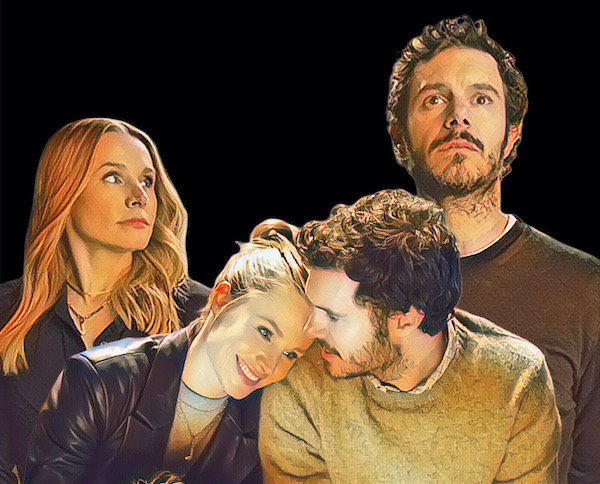
This expansion of the supporting cast may be the smartest way to extend the life of the series. After all, not every relationship needs to be on the verge of collapse to be interesting, but it is difficult to sustain a romantic comedy indefinitely on the happiness of its protagonists alone.
There is also a question here that goes beyond television. We are so accustomed to associating love with suffering, pursuit, and insecurity that the tranquility of a stable relationship can seem less exciting. In romantic stories, just as in life, we often confuse intensity with depth.
Perhaps Nobody Wants This is trying to challenge that logic. Rather than suggesting that true love must overcome extraordinary obstacles, the series embraces the idea that building a life together, respecting differences, and learning to coexist can also be interesting.
The problem is that, for screenwriters, a happy couple offers fewer opportunities for conflict than two people in love who have not yet figured out how to be together.
Kristen Bell and Adam Brody remain the production’s greatest attraction. Their chemistry does not disappear simply because their characters have finally decided to share a home. But the third season seems to recognize that the world of Nobody Wants This needs to expand if the series is going to continue working.
And perhaps that is the most interesting evolution of a show that began as a story about two people falling in love and now needs to find stories for everyone living around them.
Ultimately, romantic comedies have always taught us to long for a happy ending. What they rarely told us is that, after the happy ending, another story begins.
And that one, let’s face it, is usually much more complicated.
Descubra mais sobre
Assine para receber nossas notícias mais recentes por e-mail.

