
Witches have always been associated with women who challenge the rules, possess forbidden knowledge, and inspire fear in those who cannot control them. But cinema and television have developed a particularly fascinating tradition: witches who are sisters. Bound by blood, magic, or a family curse, these women discover that their powers can become extraordinary when they stand together. The problem is that living together is not always as enchanting as casting spells. There are rivalries, resentments, jealousy, secrets, and that familiar difficulty of escaping one’s own family.
Film and television have explored these relationships for decades, transforming sisterhood into a metaphor for female power. Some stories are funny, others romantic, and some deeply frightening. But almost all share the same idea: for these women, magic is not simply an individual gift. It is an inheritance that can either bring them together or condemn them.
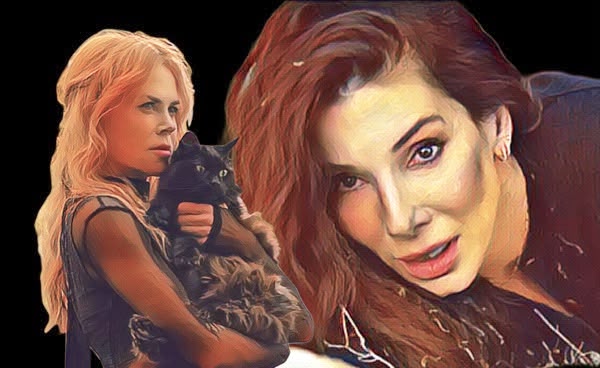
The Owens Sisters and the Curse of Love
Perhaps no story represents this contradiction better than Practical Magic (1998). Sandra Bullock and Nicole Kidman play Sally and Gillian Owens, two sisters raised by eccentric aunts in a family of witches haunted by an ancient curse. Any man who falls in love with an Owens woman is doomed to die prematurely.
Sally tries to build a normal life, away from magic. Gillian prefers to challenge conventions and live intensely, even when her choices become dangerous. They have opposite personalities, but their differences are precisely what makes their relationship so interesting. Sally seeks stability. Gillian seeks freedom. Neither can completely escape her family history.
Directed by Griffin Dunne and based on Alice Hoffman’s novel, the film does not use witchcraft merely as a fantasy element. Magic also represents a female inheritance passed down through generations, carrying traditions, trauma, and expectations. The sisters must confront not only a supernatural threat but also the weight of a story that began long before they were born.
And there is something particularly beautiful about the way the narrative transforms love between women into a possibility of breaking what once seemed inevitable. Romantic love may be cursed, but solidarity among the women in the family offers a path toward liberation.
The return of the Owens sisters in Practical Magic 2 in 2026 confirms the enduring appeal of this universe. More than the romances or the spells, the relationship between Sally and Gillian remains its heart.
Charmed: The Power of Three
If the Owens sisters represent magic as both inheritance and curse, the Halliwell sisters turned it into a matter of identity and responsibility.
Premiering in 1998, Charmed followed Prue, Piper, and Phoebe Halliwell, three sisters who discover their magical powers after their grandmother’s death. United by the Power of Three, they become responsible for fighting demons and other supernatural threats.
The series featured monsters, spells, romance, and battles, but its strength lay in the relationship between its protagonists. The sisters argued, disagreed, competed, and frequently made disastrous decisions. Their bond did not depend on idealized harmony but on a connection that survived their differences.
Prue’s death at the end of the third season profoundly changed the show’s dynamics. The arrival of Paige, a previously unknown half-sister, allowed the Power of Three to be restored, but it did not erase the loss. Magic required the sisters to stand together, even as the family had to learn how to exist in a different way.
Charmed found a formula that would be reproduced many times: powerful women who did not have to choose between everyday life and a supernatural identity. Their romantic, professional, and family problems were just as important as their battles against evil.
But there was also a deeper question. The Halliwells’ power worked best when shared. Individually, each sister possessed extraordinary abilities. Together, they could face far greater threats.
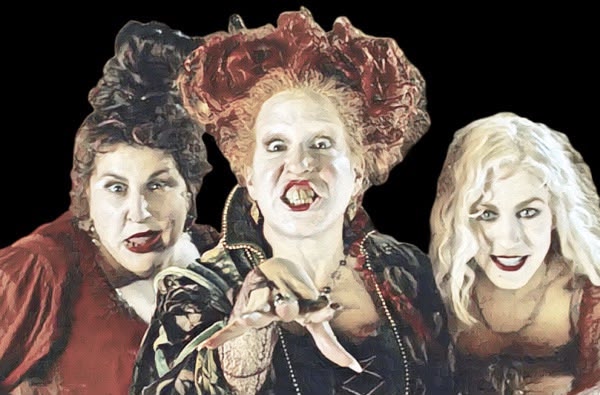
The Sanderson Sisters: United Even in Evil
Of course, not all witch sisters have to be heroines. Winifred, Mary, and Sarah Sanderson from Hocus Pocus (1993) are probably the funniest example of a family whose unity serves rather questionable purposes.
Played by Bette Midler, Kathy Najimy, and Sarah Jessica Parker, the three sisters live under the authoritarian leadership of Winifred, who seems to regard the other two as rather unintelligent assistants to her own plans.
Mary tries to please her, Sarah is easily distracted, and Winifred constantly loses patience with both. Their relationship is marked by such an unbalanced hierarchy that it might be more appropriate to describe them as a small family-run criminal organization.
But that dynamic is precisely what made the Sanderson sisters unforgettable. They fight, insult one another, and frequently sabotage their own spells, yet remain inseparable.
The film’s belated success and its transformation into a Halloween tradition deserve an analysis of their own. Here, what matters is how the Sanderson sisters offer a delightfully dysfunctional version of magical sisterhood. Not even centuries together have been enough for them to learn how to work in perfect harmony.
Twitches: Two Sisters, One Divided Power
In Twitches (2005), the family bond takes on an almost literal magical dimension. Played by real-life sisters Tia and Tamera Mowry, Alex and Camryn were separated at birth and raised by different families, unaware of their true origins.
When they finally meet at the age of 21, they discover that they are witches and that their powers grow stronger when they work together.
The premise is simple, but it touches on one of the most recurring themes in these stories: the idea that individual identity remains incomplete when part of one’s family history is unknown.
For the twins, their reunion is not simply about discovering magic. It is about understanding where they came from and why they were separated.
The film follows a lighter formula, aimed at younger audiences, but reinforces the idea that the connection between sisters can become a source of strength neither could achieve alone.
Esther and Dahlia: When Sisterhood Becomes a Threat
There is, however, a much darker side to this tradition. In The Originals, a spin-off of The Vampire Diaries, sisters Esther and Dahlia demonstrate what happens when family bonds become instruments of control.
Esther, responsible for creating the Original vampires, carries the consequences of decisions that forever changed the destiny of her descendants. Dahlia, her older sister, possesses extraordinary magical powers but also represents a threat built on resentment, old agreements, and family debts.
Their story shows that female solidarity is not an automatic consequence of sisterhood. Shared magic can be a source of power, but also of domination.
Unlike the Halliwells, whose strength depends on cooperation, Esther and Dahlia transform ancient family obligations into a struggle over freedom and the fate of future generations.
Family ceases to be a source of protection and becomes a prison.
The Real Magic Lies in Their Relationships
What makes these stories so interesting is not simply the presence of women capable of casting spells. It is the way witchcraft makes visible conflicts that exist in virtually every family.
There are sisters who want different things, who compete for recognition, who seek independence, or who remain trapped by the expectations of previous generations. Some need to stand together to survive. Others must learn to separate to achieve a measure of freedom.
Perhaps that is why stories about witch sisters remain so popular. Magic offers a fantastic language for exploring very familiar human relationships. Who has never felt that their own family could provide their greatest protection while simultaneously creating some of the most difficult conflicts to overcome?
In film and television, these women can fight demons, resurrect the dead, break curses, and challenge centuries of tradition. But no amount of magic can completely eliminate the resentments, rivalries, and contradictions of family life.
And perhaps that is precisely the charm. The power of witches may come from the supernatural, but their stories remain profoundly human.
Descubra mais sobre
Assine para receber nossas notícias mais recentes por e-mail.

