
As published in CLAUDIA
There is an irresistible irony in casting Isabelle Huppert, arguably the most internationally recognized and respected French actress of her generation, as a woman who has never managed to gain recognition as an actress. That is precisely the contradiction at the heart of The Illustrious Unknown (Ni vue, ni connue), Marc Fitoussi’s delightful comedy, which premiered in French cinemas on October 7, 2026, and arrives in Brazil on October 29 as part of the French Film Festival. The director, who visited Rio de Janeiro to present the film, knows his leading lady exceptionally well. This is their third feature film together, following Copacabana (2010) and Folies Bergère (2014), not counting an episode of Call My Agent!. Yet he managed to find a role she had never played before: that of an actress nobody knows.
The idea, however, did not emerge solely from this playful reversal of Huppert’s public image. Fitoussi had already become fascinated by the world of film extras when he made the documentary Des figurants in the late 2000s. While following people who spent their days on film sets, he discovered the stories of aspiring performers who dreamed of acting careers but never managed to move beyond the anonymity of the background. One woman in particular helped inspire the character Huppert would portray years later. The director held on to the idea until he found the opportunity to turn it into fiction, choosing one of the world’s most celebrated actresses to embody someone who remains invisible.
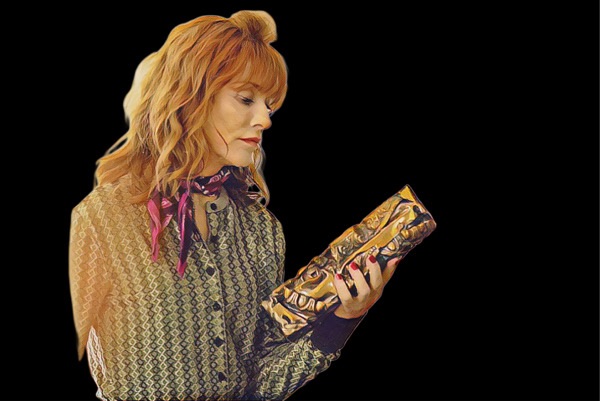
Huppert plays Corinne Maclou, a professional extra who has spent decades working on film sets, handing out résumés, and trying to convince directors and producers that she deserves a real opportunity. She knows the film industry, understands acting, has theatrical experience, and genuinely believes in her own talent. Yet she has never managed to rise above the status of an extra. And, to make matters even more painful, she seems unwilling to acknowledge that the success she has been waiting for may never come.
The premise is simple, following a cinematic tradition of using the backstage world of filmmaking to explore cinema itself, its illusions, and its contradictions. There is something of François Truffaut’s Day for Night in its self-referential approach, along with the pleasure of watching performers play fictionalized versions of themselves, a device that found renewed popularity with the series Call My Agent!. Here, famous and respected actresses move through the sets playing their own public personas, while the one entirely fictional character is precisely the woman who desperately wants to belong to their world.
The result is an intelligent comedy about the paradoxes of fame, art, womanhood, and identity. But it would be little more than an entertaining film, filled with clever inside jokes and celebrity appearances, without Isabelle Huppert’s extraordinary talent.
Corinne is not a particularly likable character. She can be intrusive, inappropriate, relentless, and incapable of recognizing other people’s boundaries. At times, it is almost impossible not to feel embarrassed by her behavior. At other times, she seems like a woman who has spent her entire life pursuing a dream without ever allowing herself to contemplate failure. Huppert, however, makes no effort to turn her into someone adorable or to ask for our sympathy. Her performance allows Corinne to be ridiculous, irritating, vulnerable, and admirable all at once, without any of these qualities canceling out the others.
There is an especially delightful joke for Huppert’s admirers when Corinne appears as an extra in a production of Madame Bovary. It is impossible not to remember that Huppert herself played Emma Bovary in Claude Chabrol’s 1991 adaptation. The woman who once was Madame Bovary is now standing in the background of a scene that belongs to somebody else. The joke works because we know her history, but also because it perfectly illustrates one of the film’s central questions: how much does the position we occupy determine the way other people see us?
The film’s real strength, however, emerges when Corinne crosses paths with Sandrine Kiberlain, who plays a version of herself. The famous, admired, and successful actress develops an unlikely relationship with a woman who seems to represent everything she has never been. Or perhaps everything she might have become had her career taken a different turn.
It is in this partnership that the film discovers its richest layers, particularly because it refuses to be condescending. This is not the story of a generous celebrity deciding to make an unknown woman’s dream come true, nor is it a conventional tale about two women discovering the power of friendship. Their relationship is far more complicated, shaped by admiration, conflicting interests, opportunities, frustrations, and expectations that do not always correspond to reality.
And this is precisely where the film moves beyond the world of cinema.
How often are we encouraged never to give up on our dreams? To believe that persistence will eventually be rewarded, that talent will find its place, and that all we need to do is keep trying until someone finally recognizes our worth? These are positive messages, particularly for women who grew up learning to minimize their ambitions, but they can also become a trap.
After all, where is the line between perseverance and an inability to accept reality? When does determination stop being a virtue and start creating impossible situations? And to what extent can we hold others responsible for failing to give us the recognition we believe we deserve?

Corinne embodies these contradictions. There is something admirable about her refusal to abandon her dream, especially in an industry that tends to be even more unforgiving toward women as they grow older. At the same time, her desperate need for recognition begins to interfere with the way she relates to people and interprets opportunities. She cannot simply be present: she needs her presence to mean something.
Sandrine, meanwhile, appears to have achieved everything Corinne desires. But recognition does not mean absolute freedom, just as fame guarantees neither security nor fulfillment. Even after reaching center stage, an actress remains subject to audience expectations, casting decisions, and the pressure to live up to the image others have created of her. One woman is desperately trying to enter that world; the other must continually justify the place she has earned within it.
Perhaps the central question of The Illustrious Unknown lies in the distance between who we are, who we want to be, and who others recognize us as. Our identity is not constructed entirely from within. It also depends on the roles we play, the expectations we encounter, and how others perceive us. But there is a danger in handing over to other people the entire responsibility of confirming our worth.
And there is an additional difficulty for women: we are often encouraged to be resilient, discreet, generous, and understanding, even when pursuing our own interests. An ambitious woman may be admired as long as she remains pleasant. When she insists too much, demands too much, or refuses to respect certain conventions, she suddenly becomes a nuisance. Corinne is uncomfortable to watch precisely because she does not know how — or refuses — to play the social role expected of her.
That does not mean she is always right. And perhaps this is the greatest achievement of Fitoussi’s screenplay and Huppert’s performance: they never attempt to convince us that Corinne necessarily deserves what she wants. We can understand her frustration without excusing her behavior, recognize her courage without ignoring her excesses, and admire her persistence without treating the decision to give up as a moral defeat.
Ultimately, there is an enormous difference between refusing to abandon a dream and allowing that dream to determine our entire existence. We do not always get what we want, talent does not invariably receive the recognition it deserves, and not every missed opportunity represents an injustice. Accepting these possibilities can be just as difficult as continuing to fight.

With its humor and understated cruelty, The Illustrious Unknown invites us to consider these contradictions without offering easy answers. And it has one of the world’s greatest actresses bringing depth and humanity to a character who could easily have been reduced to a caricature.
The film is part of the 17th French Film Festival in Brazil, running from October 29 through November 11, 2026, with screenings in more than 50 cities across the country. Featuring 21 films in approximately 100 cinemas, the festival offers Brazilian audiences a chance to discover some of the latest French productions, including Fitoussi’s recently released comedy.
Isabelle Huppert, who has spent her entire career occupying center stage, manages to make the woman nobody notices the most impossible to ignore. And perhaps that is the film’s most beautiful irony: reminding us that recognition may depend on countless circumstances, but the complexity of a human life should never be measured by the size of the role it has been given.
Descubra mais sobre
Assine para receber nossas notícias mais recentes por e-mail.

