
I have always been fascinated by photography and photographers. And few people have influenced the way we see the culture and history of the 20th century as profoundly as Richard Avedon. His images are part of our collective memory, even when we don’t realize he was the one who created them. So, ever since Netflix announced the documentary directed by Ron Howard, Avedon had been high on my watchlist. It premiered on November 11, and I devoured it.
I wasn’t disappointed. Quite the opposite. Howard delivers a fascinating film, not only for its historical context and extraordinary archival material, but especially for the honesty with which he portrays his subject. This is not simply a celebration of a photographic genius, but an exploration of how Avedon worked, how he thought, and how he transformed people, movements, and moments into images that would become iconic.
Avedon didn’t simply photograph the 20th century. He helped define how we remember it.
Beauty Was Never Enough
We know Avedon through his fashion photographs and his portraits of Marilyn Monroe, Audrey Hepburn, Twiggy, and countless other personalities. His contribution to fashion photography was revolutionary. Before him, models were often static figures, carefully posed to display clothes. Avedon gave them movement, personality, and a freedom rarely seen on the pages of fashion magazines.
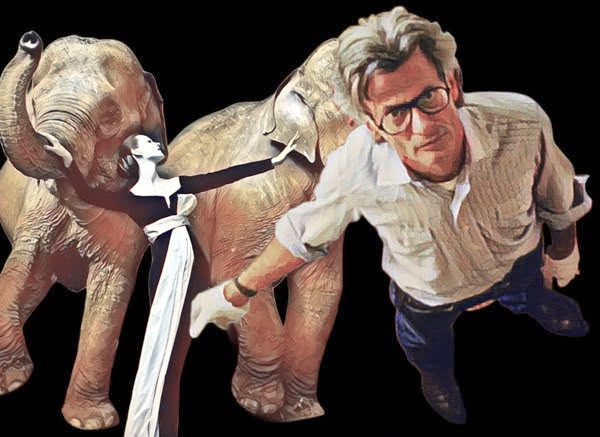
His famous photograph of Dovima with elephants, taken in 1955, is an almost perfect example of his talent. The model’s elegance, the delicacy of the Dior gown, and the monumental presence of the animals create an image of improbable, theatrical, and unforgettable beauty.
But Howard demonstrates that reducing Avedon to fashion would be a tremendous mistake. The same man who helped construct American glamour photographed the civil rights movement, the Vietnam War, patients in psychiatric institutions, and anonymous workers in the American West. His camera moved between seemingly incompatible worlds, yet there was a consistent thread: his interest in people, their expressions, and what they might reveal in front of his lens.
His series In the American West, created between 1979 and 1984, is particularly impressive. By photographing miners, laborers, unemployed people, and individuals who would hardly ever appear in fashion magazines, Avedon granted them the same visual importance traditionally reserved for celebrities.
The white background, one of his trademarks, eliminated every distraction. There was no setting, profession, or environment to explain who stood before the camera. All that remained was the person, bearing the marks of their existence.
This did not necessarily mean the resulting image was spontaneous or innocent. Avedon directed his subjects, provoked reactions, and waited for precisely the right moment. Photography was a construction, and he never pretended otherwise.
The Man and His Contradictions
One of Howard’s best decisions is not to turn Avedon into a consistently likable character.
The photographer was demanding, obsessive about his work, controlling during his sessions, and often difficult in his personal relationships. His devotion to art came at a cost to those closest to him. The documentary neither ignores this aspect nor attempts to justify it in the name of genius.
Interviews with models, collaborators, friends, and family members help build a complex portrait. Isabella Rossellini, Twiggy, Lauren Hutton, and other personalities recall their experiences with a photographer capable of earning the trust of those in front of his camera while simultaneously demanding considerable emotional vulnerability.
The recollections of his son, John Avedon, add an intimate dimension that professional interviews alone could never provide.
We also discover the importance of his family history, particularly his relationship with Louise, his younger sister, whose beauty and psychological suffering profoundly affected his life. Avedon described her as the ghost behind so many of his subjects, acknowledging that she remained a constant reference for the women he photographed.
Howard does not turn these experiences into simplistic explanations for Avedon’s work. Instead, he allows the contradictions to remain.
The result is a portrait of someone capable of recognizing extraordinary humanity in his subjects, yet not always able to offer the same emotional availability to the people closest to him.
Why Ron Howard?
Ron Howard has already demonstrated his interest in extraordinary artists through documentaries about the Beatles, Luciano Pavarotti, and Jim Henson. What seems to attract him is not merely talent, but a curiosity about how certain individuals manage to produce exceptional work over decades.
The project’s origins are particularly interesting. In 2023, Howard was invited to select a photograph for Avedon 100, an exhibition organized by Gagosian in New York to celebrate the photographer’s centenary. He chose a portrait of Red Owens, an oil-field worker photographed for the In the American West series.
Initially interested in producing the documentary, Howard became so involved in researching Avedon’s life and creative process that he decided to direct it himself. He discovered someone he had associated with the glamour and sophistication of commercial photography, only to find a far more restless artist, politically engaged and willing to take risks.
The project was made in collaboration with the Richard Avedon Foundation and benefited from exceptional access to the photographer’s personal archive. Previously unseen photographs, behind-the-scenes footage, interviews, and recordings made by Avedon himself allow Howard to reconstruct not only his career but also parts of the creative process behind so many familiar images.
The archive contains approximately 480 audio recordings, many dating back to the 1960s, in which Avedon discusses assignments, interviews, and professional experiences. This material adds a particularly interesting dimension to the documentary: we are not merely listening to other people talk about the photographer, but hearing the artist himself reflect on his work.
That access is one of the film’s greatest strengths. Howard also understands that he doesn’t need to compete with the photographs. The documentary moves at a confident pace, uses its visual material intelligently, and gives the images room to breathe. The editing transforms still photographs into elements of a living narrative without diminishing their original power.
There is little in the way of cinematic experimentation, and that works remarkably well. The structure is relatively traditional, but the material is so extraordinary that it needs no gimmicks to hold our attention.
There is, naturally, an unmistakable admiration for the subject. Given that the production was made in association with the foundation responsible for preserving his legacy, it is fair to question how far the film is willing to challenge him. Even so, Howard does not erase Avedon’s flaws or conceal the personal cost of his devotion to work.
The documentary is more interested in understanding Avedon than judging him. To me, that is the right choice.
“All Photographs Are Accurate. None of Them Is the Truth.”
This statement by Richard Avedon may be the best way to understand his work.
The photographer also used to say that all his portraits were self-portraits. No matter who stood in front of his camera, it was always his interpretation that determined the result. The image showed what he had chosen to see.
Writer Andrew Solomon, who knew Avedon personally, described this characteristic with remarkable precision. His portraits were carefully constructed, regardless of how spontaneous they appeared. The photographer provoked, directed, and manipulated situations to produce something he considered revealing.
One of the best-known stories involves the Duke and Duchess of Windsor. Knowing how much they loved animals, Avedon told them a sad story about his dog and captured their crestfallen expressions. The photograph became a memorable portrait, but the sadness had been deliberately provoked.
It is a fascinating demonstration of how Avedon understood portraiture. He wasn’t interested in merely recording someone’s appearance. He wanted to provoke a reaction, a crack in the public image that might reveal something unexpected.
Marilyn Monroe, for example, was photographed thousands of times. Yet there is something deeply unsettling about Avedon’s famous 1957 portrait, in which the actress seems to momentarily abandon the public persona that had transformed her into a sex symbol.
It is impossible to know exactly what she was feeling at that moment. And perhaps that is precisely the point. Avedon was not necessarily interested in making someone look more beautiful. He wanted to create an image that would be impossible to ignore.
The question remains fascinating: if every photograph reflects a choice made by the person behind the camera, to what extent are we getting to know the subject, and to what extent are we discovering the photographer’s own perspective?
The documentary itself explores this paradox. Richard Avedon built his career trying to reveal something about others, but his photographs also revealed his obsessions, interests, convictions, and anxieties.
The Photographer Who Changed the Way We See
There is something extraordinarily contemporary about Avedon’s work. We live in a world where we constantly produce, edit, and share images of ourselves. Appearance has become a permanent language, and the construction of personal identity increasingly depends on how we choose to be seen.
Avedon understood the power of this construction better than almost anyone. And perhaps that is precisely why he was so determined to find something beyond it.
His photography accompanied the great cultural transformations of the 20th century. From the golden age of haute couture to the political upheavals of the 1960s, from the rise of new models and new standards of beauty to the visibility he gave people society preferred to ignore, he was constantly searching for new ways of seeing.
He died in 2004, at the age of 81, after suffering a cerebral hemorrhage while working on a series about American democracy for The New Yorker. He continued photographing until the very end. I finished the documentary with that wonderful feeling of having rediscovered images that have been part of my life for years, while also discovering the man behind them.
Ron Howard does not attempt to reinvent Avedon. He accomplishes something perhaps more difficult: he restores context, movement, history, and humanity to photographs that had become so iconic they risked being reduced to mere images. And he reminds us why certain photographs outlive time, fashion, and even the people who appear in them.
Descubra mais sobre
Assine para receber nossas notícias mais recentes por e-mail.

