
The Wizard of the Kremlin is an important, intelligent, and didactic film. None of that guarantees it has any charm.
Olivier Assayas tells the story of how Vladimir Putin was transformed from an unlikely bureaucrat into an inevitable figure, but he approaches the manufacture of power with a solemnity that often turns characters into arguments and scenes into illustrated chapters from a lecture on contemporary Russia.
I do not belong to the group that necessarily uses “didactic” as a criticism. The collapse of the Soviet Union, the rise of the oligarchs, widespread corruption, the Chechen War, the control of television, the annexation of Crimea, and Putin’s transformation into a new tsar all require some historical organization. Especially for those who followed these events from outside and, over the decades, received only fragments of a much more complex reality.
The problem is not that the film explains too much. It is that it almost always explains better than it dramatizes.
Inspired by Giuliano da Empoli’s novel, The Wizard of the Kremlin follows Vadim Baranov, a fictional character based on Vladislav Surkov, the political strategist who helped create not only Putin’s image but also a new way of managing reality.
Played by Paul Dano, Baranov begins in avant-garde theater, moves into television and reality shows, and eventually reaches the Kremlin with a fundamental discovery: contemporary politics does not need to convince anyone of a truth. It only needs to produce enough narratives for truth to stop mattering.
From Television to the Kremlin
Baranov’s trajectory is fascinating because it brings together worlds that, for a long time, we pretended were separate. Art, television, advertising, politics, and war begin to obey the same logic. Everything depends on the right image, the appropriate enemy, and the story the public is willing to consume.
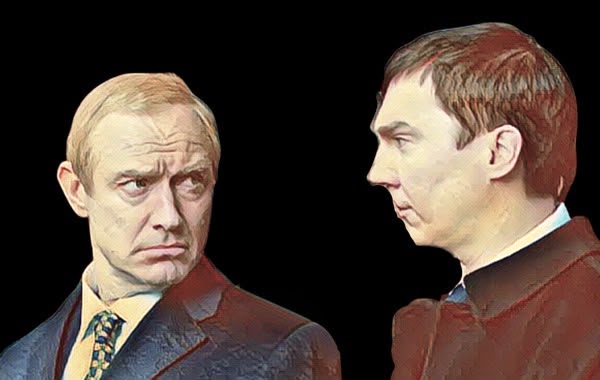
In a Russia devastated by the end of the Soviet Union, capitalism does not arrive as a promise of freedom, but as an opportunity for a select few to accumulate fortunes while most of the population loses security, reference points, and dignity. The oligarchs believe they control the country because they control the money and television. When they choose Putin to succeed Boris Yeltsin, they imagine they have found a disciplined and manageable civil servant.
They fail to realize that they are inviting a wolf into their home.
Jude Law plays Putin without resorting to an ostentatious impersonation. His characterization lies in restraint, in his gaze, and in the economy of his gestures. The character does not need to raise his voice to establish who holds the power. He listens, observes, and allows others to mistake silence for submission.
Baranov understands before everyone else that this seemingly charmless man possesses precisely the quality needed to occupy the void left by the Soviet collapse. Putin can be manufactured as stability, discipline, and strength. After a decade of humiliation, chaos, and the obscene enrichment of the oligarchs, Russia was ready for someone who promised to restore its importance.
It did not matter that this restoration would require enemies, wars, and the gradual elimination of all opposition.
There is a great deal of historical truth in this construction, but this is not a disguised biography. Surkov really did study theater direction and work in advertising, banking, and television before reaching the Kremlin. He also helped create the so-called “sovereign democracy,” a system in which elections, parties, and opposition continue to exist, as long as they remain incapable of threatening the desired outcome.
Baranov, however, is a fictional synthesis. The film concentrates in him strategies, decisions, and events produced by a much larger machine. The public facts are recognizable; the private conversations, relationships, and his constant presence at decisive moments belong to the novel.
Politics as a Reality Show
The most interesting part of the film lies in television’s transformation into a political laboratory. Baranov learns from reality shows that audiences do not need to believe everything they see. They only need to keep watching.
Contradiction ceases to be a problem and becomes part of the strategy. The government can encourage opposing groups, finance incompatible narratives, and simultaneously occupy every side of a debate. When no one can tell what is spontaneous, manipulated, true, or false, exhaustion replaces resistance.
Traditional propaganda sought to impose one official version of events. Contemporary propaganda understands that it can be even more effective to destroy the very possibility of a shared fact.
This is the most relevant idea in The Wizard of the Kremlin. The film is about Putin’s Russia, but it is impossible not to recognize a mechanism that has spread far beyond its borders. The internet promised to decentralize information; it also became the ideal environment for distributing resentment, conspiracy theories, and personalized versions of reality.
Baranov does not merely create a leader’s image. He creates an atmosphere in which anything can be true for as long as it takes to produce a particular effect.
The historical events running through the film are real. Boris Berezovsky participated in the effort to find a successor to Yeltsin and supported Putin under the assumption that he could control him. After coming to power, Putin reduced the influence of the oligarchs, took control of the major television networks, and drove Berezovsky into exile.
The sinking of the Kursk submarine, the Chechen Wars, Ukraine’s Orange Revolution, the Sochi Olympic Games, the Night Wolves, and the annexation of Crimea are also real. What we do not know is whether the decisions were made during the conversations shown in the film or whether Surkov occupied the central position Baranov assumes in each of them.
Even Putin’s rise is given a more elegant dramatic structure than reality provided. The film shows Baranov and Berezovsky practically selecting the future president and persuading him to accept the role. In real life, Putin was one of several possible successors considered by Yeltsin’s inner circle. His ascent involved competing interests, improvisation, rival factions, and the oligarchs’ miscalculations.
By turning him into a silent strategist who understood everything from the beginning, the film risks reproducing the very mythology it intends to examine: the image of a cold, patient, infallible leader who always sees further than everyone else.
Where Is the Charm?
All of this is fascinating. And yet the film rarely manages to transform its ideas into a cinematic experience.
Paul Dano plays Baranov with an almost monotonous coldness. There is intelligence in that restraint because the character sees himself as someone capable of moving through power without being contaminated by it. He observes others as pieces in a game that only he understands. The problem is that this distance also prevents the film from acquiring energy.
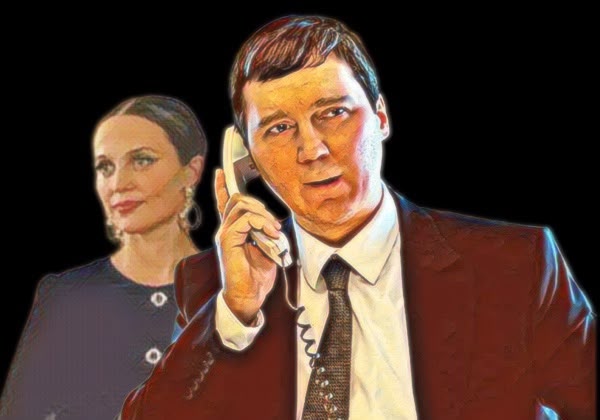
Baranov narrates, explains, interprets, and anticipates. He almost always knows more than everyone else and rarely seems genuinely threatened. Gradually, he stops being a character and becomes a tour guide through the corridors of authoritarianism.
The same happens with Ksenia, played by Alicia Vikander. She is meant to represent everything Baranov cannot control: desire, freedom, and the possibility of a life beyond the political machine. But her function is so obvious that the character never fully escapes the symbol assigned to her.
Ksenia, like the romance with Baranov, is a fictional creation. Assayas expanded the character to turn her into a representation of a Russian generation that briefly experienced freedom and then watched that possibility being taken away by the regime. The intention is clear. Perhaps too clear.
There is an irony that is difficult to ignore: Baranov understands that politics requires drama. The film telling his story does not understand this with the same clarity.
Assayas assembles extraordinary characters, brutal events, and urgent ideas, but delivers a narrative that often seems satisfied with explaining them. We travel through decades of political transformation without fully feeling the speed, danger, or seduction of the process.
And seduction matters. No authoritarian system survives through fear alone. It must offer belonging, pride, entertainment, and the fantasy that someone has finally restored order to the world. Putin did not emerge simply because everyone had been deceived. He responded to the genuine desires of a wounded society — and converted them into instruments of power.
The film understands this intellectually. It fails to make it pulse.
Zamyatin and the Realized Dystopia
The story begins with the American journalist played by Jeffrey Wright arriving in Russia to research Yevgeny Zamyatin, the author of We. Published in the 1920s, the novel anticipated many of the ideas we would later recognize in Brave New World and 1984: surveillance, control, uniformity, and the destruction of individuality in the name of happiness administered by the state.
The journalist searches for a writer and finds Baranov. He searches for a literary dystopia and finds a country that has learned to update its mechanisms.
The Russia of The Wizard of the Kremlin does not need to force everyone to think in the same way. Its sophistication lies in allowing each person to receive a different narrative, as long as none of them threatens the center of power. Rather than prohibit entertainment, the regime uses it. Rather than eliminate the appearance of freedom, it learns to incorporate it into the performance.
It is a prison that does not need to hide every door. It only needs to convince its inhabitants that the world outside is even more dangerous.
Perhaps that is why the excessive didacticism does not make the film any less important. There is something genuinely illuminating about following Putin’s construction and realizing that it did not happen through the force of one man alone. The regime was born from the collaboration of politicians, oligarchs, producers, intellectuals, artists, and opportunists who believed they could move close to power without becoming responsible for it.
Baranov may imagine himself as merely the man who understood the rules before everyone else. He may claim that he did not fully share the ideology he helped establish. But recognizing the manipulation does not absolve him. On the contrary, it makes his responsibility even greater.
The Punishment Reality Never Delivered
After telling his story to the journalist, Baranov says goodbye, leaves the house, and is murdered with a gunshot to the head. The image is powerful: the man who helped build the machine is finally devoured by it.
But that death never happened.
Vladislav Surkov is alive. He officially left the Kremlin in 2020 and, although he has reduced his public presence, continues to write and occasionally give interviews. In Giuliano da Empoli’s novel, Baranov also survives. He remains removed from power, living comfortably in his dacha with his daughter.
The murder was created for the film. And it changes the meaning of the story.
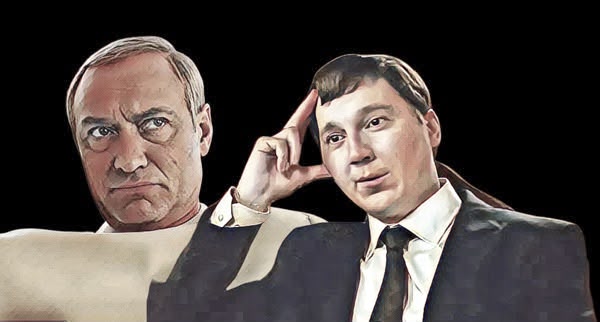
Assayas turns the accomplice into a victim of the regime and offers viewers a moral punishment that reality never guaranteed. Baranov ceases to be merely the man who helped manufacture Putin and assumes the tragic role of someone who knew too much to be allowed to live.
It is a cinematic conclusion, but an excessively tidy one. After two and a half hours spent discussing the manufacture of narratives, the film creates its own more convenient version: Baranov built the monster, revealed its secrets, and paid with his life.
The scene also provides the character with a form of redemption. His murder allows him to end the story as someone who is finally persecuted by the system, rather than simply as a man who collaborated with authoritarianism and managed to walk away without suffering the expected punishment.
Reality is less satisfying. People who help build violent regimes are not always destroyed by them. Some survive, become wealthy, write books, give interviews, and continue to defend the ideas they helped put into practice.
Even the final shot confirms the film’s didacticism. Assayas does not entirely trust the ambiguity he spent so long constructing. He needs to turn Baranov’s responsibility into a sentence, and that sentence into an image.
The Wizard of the Kremlin is not the seductive film it could have been. It is long, talkative, solemn, and at times excessively impressed with its own intelligence. It lacks charm, especially for a story about men who understood the power of spectacle so well.
Even so, it is impossible to dismiss. Because, despite never fully transforming its ideas into cinema, Assayas identifies one of the fundamental mechanisms of our time: contemporary dictatorships do not need to conceal the lie. They only need to turn it into entertainment.
And when reality fails to provide a sufficiently clear ending, the film chooses to manufacture one as well.
Descubra mais sobre
Assine para receber nossas notícias mais recentes por e-mail.

