
Ryan Murphy has never been a creator particularly interested in pleasing everyone. Quite the opposite. Sex, violence, nudity, perversion, religion, guilt, desire, and death are recurring elements in a universe where excess is rarely an accident, but a deliberate choice. And just when he seems to have crossed every possible boundary, Murphy finds another one to push.
That is why the news that Grotesquerie and The Beauty will not return for second seasons, according to reports in the American press, strikes me as particularly disappointing. They are two very different productions, both complex, brilliantly acted, and, despite their imperfections, courageous enough to explore highly contemporary issues through decidedly unconventional narratives.
I can’t help wondering whether Ryan Murphy’s creativity made people uncomfortable.
I am not suggesting that the shows were canceled because they provoked discomfort. Industry decisions involve ratings, budgets, contracts, and strategies we rarely fully understand. But I find it curious that two of Murphy’s most interesting experiments should end so prematurely, while more conventional productions, and even those demolished by critics, are given room to continue.
Grotesquerie: The Unconscious Doesn’t Have to Make Sense
When Grotesquerie premiered in 2024, the first impression was that Ryan Murphy had decided to compete with himself in creating repulsive imagery. Religious crimes, mutilated bodies, extreme violence, seemingly perverse characters, and a relentlessly apocalyptic atmosphere.
But there was much more going on.
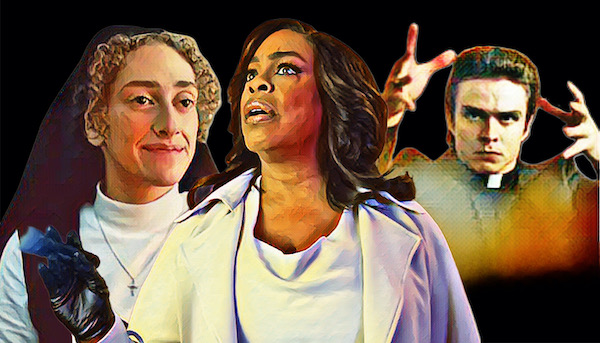
Niecy Nash-Betts delivers an extraordinary performance as Lois Tryon, a detective tormented by her addictions, her family relationships, and a reality that seems to be progressively collapsing. Around her, characters played by Lesley Manville, Courtney B. Vance, Nicholas Alexander Chavez, and Micaela Diamond inhabit a disturbing universe filled with contradictions.
The season’s major revelation completely transforms our perception of everything we have been watching. Lois is in a coma, and much of what we have witnessed belongs to a reality constructed by her own mind.
For me, that was precisely when Grotesquerie became fascinating. Instead of a conventional police investigation, we were taken on a journey through someone’s unconscious. Memories, guilt, desires, resentments, fantasies, and fears are rearranged into a narrative that refuses to follow the rules of everyday logic. And why should it?
Freud had already described, in The Interpretation of Dreams, the mechanisms through which the unconscious transforms and reorganizes psychic material. Condensation, displacement, and the construction of images allow people, events, and emotions to merge, acquiring meanings quite different from those they possess in conscious life.
It is important not to confuse a coma with the dreams studied by Freud, or to imagine that the series scientifically represents the experience of an unconscious patient. What matters here is artistic expression: Murphy uses the logic of dreams as a narrative language.
Characters change roles, relationships are reversed, and emotions take monstrous forms. Chronology loses its importance. The absurd ceases to be a narrative flaw and becomes part of the experience itself.
This does not mean every inconsistency is brilliant. Nor does it place the series beyond criticism. It simply means that demanding a rational explanation for every image may be a terribly limited way of understanding what Murphy is trying to accomplish.
The human mind is neither organized, coherent, nor morally comfortable. Why should its fictional representation be?
The Beauty: What Is the Price of the Image We Desire?
In The Beauty, released in 2026, Murphy exchanges the torments of an individual mind for society’s collective obsession with physical appearance.
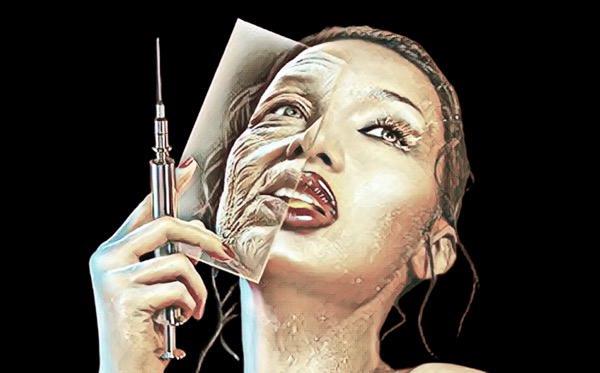
The premise is as absurd as it is disturbingly close to reality: a substance associated with a sexually transmitted infectious agent allows people to achieve extraordinary physical beauty. Bodies are transformed, faces perfected, imperfections erased. But there is a terrible price to pay.
What might initially seem like nothing more than a satire of cosmetic procedures becomes a discussion about identity, desire, narcissism, power, and self-destruction.
We live in a society that has turned physical appearance into a form of capital. Youth must be preserved, bodies corrected, faces perfected. Social media offers seemingly endless models of beauty, while an entire industry promises to bring everyone closer to an idealized version of themselves. But who determines that ideal?
This is where I find the psychoanalytic reading particularly interesting. The Ego Ideal, a concept developed by Freud, concerns the standards of perfection against which individuals measure themselves. In The Beauty, we can consider how that ideal becomes increasingly externalized and subjected to the demands of a world that dictates which bodies deserve to be desired.
The promise is not simply to become beautiful. It is to finally become someone worthy of admiration, recognition, and love. And, naturally, it is never enough.
There is something particularly perverse about this promise of transformation: to achieve the desired body, one must abandon the body one already possesses. Under certain circumstances, even abandon one’s own identity.
Murphy pushes this fantasy to its extreme, transforming it into body horror. The organism reacts violently to what was supposed to perfect it. Beauty no longer represents health, pleasure, or fulfillment, but becomes a threat to survival itself.
It is impossible not to recognize the relevance of this discussion at a time of weight-loss medications, digital filters, increasingly early cosmetic interventions, and relentless pressure to conform to standards that never stop changing.
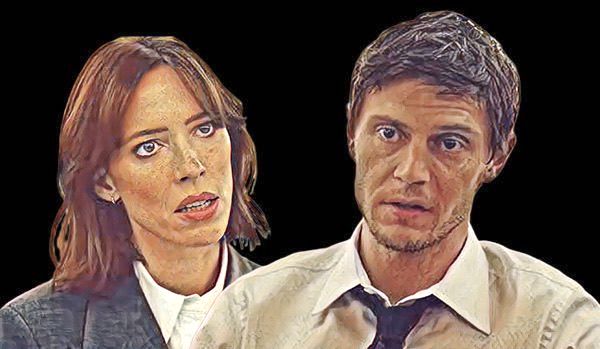
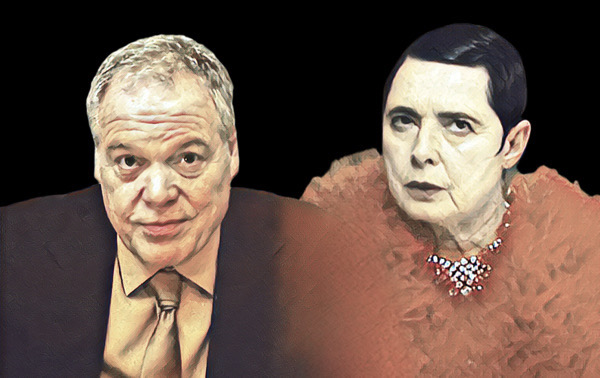
The show’s visual excess is not merely decorative. With calculated cruelty, it reproduces the excesses of the very culture it seeks to examine. And then there is the remarkable cast. Evan Peters, Rebecca Hall, Anthony Ramos, Jeremy Pope, and Isabella Rossellini help sustain a narrative that moves between satire, science fiction, thriller, and horror. Rossellini’s presence, in particular, adds a sophisticated layer of irony to the discussion of aging and beauty.
Sex, Violence, and the Discomfort of Looking
The two series share one fundamental characteristic: neither seems interested in making its subject matter pleasant. In Grotesquerie, violence externalizes emotions that cannot find rational expression. In The Beauty, the body becomes the battleground between desire and identity. Sex appears in both productions not simply as eroticism, but as an expression of power, vulnerability, compulsion, and, at times, destruction.
Nudity is not necessarily liberating. Desire is not necessarily romantic. Beauty is not necessarily good. And the grotesque, however repulsive, can reveal something profoundly human. Murphy works precisely along these boundaries.
What interests me is how we react when a narrative forces us to confront what we would rather keep hidden. It is easier to dismiss a scene as excessive or gratuitous than to investigate why it makes us so uncomfortable.
That does not mean every provocation possesses depth. Murphy frequently overindulges, loses track of his ideas, and sometimes appears more interested in creating a memorable image than maintaining narrative continuity. These are legitimate criticisms, and both series have been subjected to them.
But there is a difference between acknowledging a work’s shortcomings and dismissing what it is attempting to achieve.

The Ryan Murphy Paradox
The reception of both series was divided. Grotesquerie earned considerable critical appreciation but faced resistance from viewers who rejected its narrative twist. The Beauty was praised for its topical relevance and visual imagination, while other critics found its examination of beauty standards superficial.
It is a revealing contrast. Especially when we remember that All’s Fair, another Murphy production, was practically demolished by critics and still earned a second season. And I have absolutely nothing against that. Quite the contrary. I follow All’s Fair with the pleasure of someone who recognizes an exaggerated, luxurious, unapologetically absurd, and thoroughly entertaining soap opera.
But I do not confuse that pleasure with the experience of watching Grotesquerie or The Beauty. One thing is to create entertainment that delivers exactly what we expect. Another is to create something that challenges us to understand what we have just witnessed. Ryan Murphy knows how to do both. And perhaps that is one of the reasons he remains one of the most interesting figures in American television.
We do not know whether these cancellations resulted from commercial performance, production costs, cast availability, or creative decisions. It would be premature to attribute them to the boldness of the stories themselves. But the coincidence raises an uncomfortable question.
In an industry increasingly concerned with capturing audiences’ attention as quickly as possible, how much room is left for productions that demand interpretation, tolerance for ambiguity, and a willingness to experience discomfort?
Grotesquerie invited us into a mind that did not have to obey our logic. The Beauty presented a society willing to destroy its own body in pursuit of an impossible fantasy of perfection. Two stories about what we cannot entirely control: our desires, our fantasies, our fears, and the image we construct of ourselves. Perhaps that is why I regret their endings so much. Not because they were perfect. But because they had something to say.
And, above all, because they were not concerned with saying it comfortably.
Descubra mais sobre
Assine para receber nossas notícias mais recentes por e-mail.

