
After more than three decades of anticipation, Heat 2 finally has a scheduled filming date, a star-studded cast, and Michael Mann once again at the helm of the story that turned Heat into one of cinema’s great crime classics. But just as the project appeared to be moving forward, a legal dispute between the filmmaker and New Regency has added an unexpected chapter to the production’s behind-the-scenes drama. At stake are the copyrights to the original 1995 screenplay, raising an inevitable question: could the long-awaited return to this universe face yet another obstacle?
On Friday, November 13, New Regency filed a lawsuit in federal court in California to prevent Mann from reclaiming the rights to the screenplay he wrote decades ago. The production company is seeking to invalidate three termination notices the director issued throughout 2026 and obtain a judicial declaration that it continues to own the rights to the work. Mann, meanwhile, argues that he is simply exercising a right granted under U.S. copyright law to reclaim an original creation he developed during the 1980s.
The director’s team insists that the lawsuit will not interfere with filming, currently scheduled to begin on January 19, 2027. However, New Regency itself acknowledges in its complaint that certain contractual provisions related to Heat 2 depend on the outcome of the dispute. This does not mean the sequel has been suspended, but it is enough to cast a shadow over a project that has already endured years of negotiations, studio changes, and uncertainty.

The Legacy of a Classic That Only Grew With Time
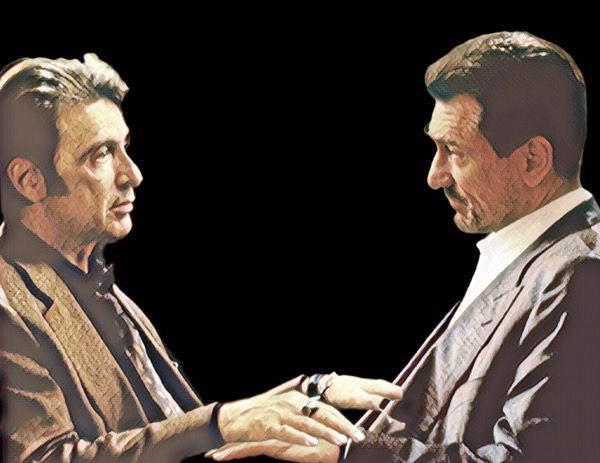
Released in December 1995, Heat brought Al Pacino and Robert De Niro together in a confrontation that would become one of the most iconic in contemporary cinema. Although both actors had previously appeared in The Godfather Part II, their characters existed in different timelines, and they never shared a scene. Michael Mann finally brought them face to face, turning their encounter into one of the film’s defining attractions.
But Heat was much more than the reunion of two movie stars. Inspired by the real-life criminal Neil McCauley and Chicago detective Chuck Adamson, the film followed two seemingly opposite men governed by the same professional obsession. Vincent Hanna, Pacino’s detective, and McCauley, De Niro’s master thief, recognized in each other a discipline and dedication that prevented them from building meaningful lives outside their respective professions.
Their famous conversation in a diner captured that conflict without relying on violence or spectacle. Meanwhile, the bank robbery and subsequent shootout on the streets of Los Angeles demonstrated Mann’s technical precision, with the actors undergoing extensive training and an unusual commitment to the realism of weapons handling and police tactics.
The film enjoyed respectable commercial success, but it did not immediately become the cinematic monument it is considered today. Its reputation grew over time as audiences rediscovered it as a meditation on identity, loneliness, and masculine obsession. Los Angeles, portrayed as a luminous yet emotionally desolate metropolis, became almost as important as its protagonists.
That reputation explains why the mere possibility of a sequel generated such intense curiosity. Heat is not simply an admired movie. For many viewers and filmmakers, it has become something close to the definitive adult crime thriller.
Heat 2: A Story That Begins Before and Ends After
The sequel originated with a novel published in 2022 by Michael Mann and Meg Gardiner. Rather than simply imagining what happened after the first movie, the authors created a narrative that functions simultaneously as a prequel and a sequel, exploring events that take place both before and after the story told in 1995.
Part of the plot returns to the 1980s to explore Neil McCauley’s operations and his crew before the robbery audiences already know. Another storyline begins immediately after the original film’s conclusion and follows Chris Shiherlis, the character played by Val Kilmer, one of the few members of the crew to survive.
Shiherlis attempts to escape the police pursuit and rebuild his life away from Los Angeles, but eventually becomes involved in new international criminal networks. The story expands the geography of the original film, moving through Chicago, Mexico, and countries in South America and Asia while developing events that help explain the characters’ pasts.
It is an ambitious undertaking because it requires recreating iconic figures without simply imitating the original performances. At the same time, Mann intends to preserve what made Heat exceptional: the relationship between identity, profession, and obsession in a world where criminals and police officers seem equally incapable of abandoning their personal codes.

Leonardo DiCaprio, Christian Bale, and Stephen Graham Take On the Legacy
The casting reflects the scale Mann intends to give the project. Leonardo DiCaprio will portray Chris Shiherlis, taking over the character played by Val Kilmer, whose death in 2025 made the prospect of revisiting the story even more emotional.
Christian Bale has been linked to the role of Vincent Hanna, originally played by Al Pacino, while Stephen Graham is set to portray Neil McCauley, the character Robert De Niro turned into one of the most memorable figures of his career.
The actors’ selection suggests a strategy similar to the one that helped define the original film: bringing together performers of extraordinary prestige and allowing their presence to sustain a large-scale dramatic confrontation. DiCaprio and Bale are among the most recognizable names of their generation, while Graham has built a formidable reputation for intensity and versatility, often portraying characters marked by moral contradictions.
Adam Driver and Jason Clarke have also been associated with the production, further strengthening the ensemble. However, the precise distribution of every role and the adaptation of the different timelines still await complete confirmation from the filmmakers.
The challenge will be considerable. Recreating Hanna and McCauley means confronting the memory of performances many regard as definitive, while Shiherlis’s story must now move forward without Kilmer.
There is also an intriguing narrative complication: because Heat 2 combines the past and the future, the new actors will need to portray familiar characters at different stages of their lives. The project aims to be both an expansion of the original universe and an opportunity to understand it from another perspective.
A Production That Has Already Changed Hands
Bringing Heat 2 to the screen has not been straightforward. The project went through prolonged negotiations and changes in its financing structure. Initially associated with Warner Bros., it eventually moved to Amazon MGM Studios, which took over the production.
The transition was significant because it demonstrated both the commercial appeal of an apparently unlikely franchise and the difficulty of financing a large-budget sequel to a film released more than thirty years earlier.
With Mann once again responsible for both the screenplay and direction, expectations center on a large-scale international production capable of preserving his distinctive artistic vision without relying exclusively on nostalgia.
Filming is scheduled to begin on January 19, 2027. There is still no definitive release date, although the production calendar has encouraged speculation about late 2027 or, more likely, 2028, depending on the length of filming and post-production.
It is precisely at this moment, when the film’s realization seems more concrete than ever, that the dispute over the original screenplay’s rights has reached the courts.
Who Really Owns Heat?
At the center of the lawsuit lies a relatively common issue in the film industry, but one that becomes particularly sensitive when it involves an artist so closely identified with his work.
New Regency argues that Mann developed the Heat screenplay under a contractual arrangement known in the United States as work made for hire. Under this framework, when the legal requirements are satisfied, copyright ownership belongs to the commissioning company rather than necessarily to the individual who wrote the material.
The director offers a different interpretation. According to his team, the story originated in personal screenplays developed during the 1980s, before taking its definitive form in the 1995 feature film. Mann maintains that he has the right to reclaim copyrights transferred decades earlier through a mechanism established under U.S. law.
The distinction is fundamental. Copyright law allows authors, under certain conditions, to reclaim rights previously assigned to others, but it establishes important exceptions for works legally classified as made for hire.
The dispute also involves an alleged oral agreement from 1988 and subsequent contracts related to companies controlled by Mann himself. New Regency contends that the documents establish ownership under a contractual structure incompatible with the director’s attempt to reclaim the rights. His team disagrees and has promised to vigorously defend his position.
The issue is not determining who wrote Heat, something no one disputes, but rather who legally owns the right to commercially exploit that creation and any works derived from it.
According to the complaint, Mann’s termination notices could take effect beginning in 2028, potentially affecting rights New Regency claims to have held for more than three decades.
Could the Legal Battle Actually Stop Heat 2?
For now, there is no indication that filming has been suspended or that the planned production start is under immediate threat.
Michael Mann’s representative explicitly stated that the lawsuit is unrelated to the production of Heat 2 and reiterated the January filming schedule. There is also an important detail: both Mann and New Regency have entered into agreements with Amazon MGM that take the dispute over the original film’s rights into account.
According to reports about the case, Mann has also assigned to Amazon any rights he may ultimately recover. This suggests that the sequel’s contractual structure has been designed to accommodate different judicial outcomes, reducing the likelihood that the conflict will immediately interrupt production.
The concern, therefore, should not be mistaken for an actual cancellation threat. The lawsuit may have consequences for ownership, licensing, and future projects derived from the original film, but the announced schedule remains in place for now.
What makes the situation particularly intriguing is its symbolic dimension. Heat has always been a story about two extraordinarily competent men who are nevertheless incapable of giving up what they consider essential. Hanna and McCauley respect each other because they recognize the same obsession in their adversary, even though they know that mutual understanding will not prevent their confrontation.
Now Mann and New Regency are defending incompatible positions over a work that both consider legitimately connected to their respective histories. The filmmaker claims the creation he developed and transformed into a classic; the production company maintains that it holds rights acquired and exploited over several decades.
Hollywood has always operated through this separation between artistic authorship and intellectual property, but rarely does the contradiction seem so striking as in the case of a film whose identity is virtually inseparable from its director.
More than thirty years later, Heat continues to generate confrontations. This time, however, there will be no shootout on the streets of Los Angeles, nor a meeting between adversaries in a diner. The battle will be fought through lawyers, contracts, and interpretations of copyright law.
And as Michael Mann prepares to revisit the universe he created, one can only hope that the battle over ownership of the past will not compromise the future of one of cinema’s most eagerly anticipated projects.
Descubra mais sobre
Assine para receber nossas notícias mais recentes por e-mail.

