
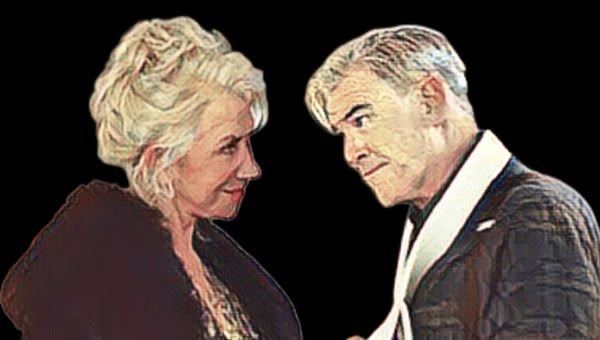
MobLand is undeniably a hit, even though its plot is little more than a thin thread of recycled clichés about organized crime. Comparisons to Shakespeare are plentiful, a reference frequently invoked whenever a story involves powerful families, excessive ambition, betrayal, and murder. But there is a considerable distance between assembling these elements and achieving the dramatic complexity that would justify such praise. And in Paramount+’s series, one of its most intriguing characteristics is the contrast between restrained performances, particularly those of Tom Hardy and Paddy Considine, and others that are deliberately extravagant, such as Johnny Flynn’s and those of the Harrigan family’s more eccentric members. At the far end of that spectrum are Pierce Brosnan and Helen Mirren, who turn Conrad and Maeve into characters so theatrical that, at times, they seem to belong to an entirely different production.
It is difficult to understand how the chaotic Harrigans managed to establish themselves as one of Britain’s most powerful criminal families. Even more difficult is figuring out exactly what they do to sustain their fortune and influence because, over two seasons, almost everything we have witnessed amounts to ego clashes, internal conspiracies, murder plots, betrayals, and an astonishing inability to make even remotely rational decisions. Harry Da Souza, played by Hardy, spends most of his time cleaning up problems his employers create for no apparent reason. It is as though the criminal empire exists solely to finance the private war of the very people who are supposed to run it.
The explanation for this behavior, or at least a key to understanding it, came from the stars themselves. In an interview with Deadline, Helen Mirren and Pierce Brosnan revealed that they approach MobLand through a specific theatrical tradition: Jacobean tragedy. For them, the excess, violence, humor, and theatricality are not necessarily flaws but fundamental elements of the universe created by Jez Butterworth.
So what exactly does that mean?
Jacobean Tragedy: When Power Becomes a Spectacle
Jacobean theater flourished in England during the reign of James I, between 1603 and 1625. It was an especially fertile period for English drama, characterized by an often bleak view of human nature, an obsession with power, moral corruption, and violence. Shakespeare was still writing, but other playwrights, including John Webster, Thomas Middleton, and John Marston, pushed certain characteristics of tragedy to even more disturbing extremes.
Contrary to what a superficial association with Shakespeare might suggest, Jacobean tragedy is not defined merely by death, revenge, or family conflicts. Its universe is profoundly suspicious of institutions and human relationships. The court, seemingly a place of refinement, frequently emerges as a morally decaying environment in which desire, sexuality, ambition, and cruelty become inseparable. The family, which should represent protection, becomes a place of danger, while the exercise of power exposes impulses that civilization attempts to conceal.
In The Duchess of Malfi, by John Webster, a woman is persecuted by her own brothers for challenging male authority over her romantic life. In The White Devil, also by Webster, private passions become entangled with political conspiracies and murder in a society where virtually no one seems able to escape corruption. Meanwhile, The Changeling, by Middleton and William Rowley, tells a story in which desire, manipulation, and violence feed on one another until the characters lose control of the consequences of their actions.
The horror of these plays lies not only in what happens but in how their characters behave in response to what they themselves have unleashed. There is a deliberate theatricality, a disconcerting coexistence of the grotesque and the tragic, of cruelty and humor, often so dark that audiences cannot decide whether to laugh or recoil in horror.
This is the world Mirren and Brosnan recognize in MobLand.
The Harrigan Family as a Decadent Court
Viewed from this perspective, the Harrigan family begins to make more sense. Conrad is less an organized crime businessman than a monarch surrounded by potential usurpers, incapable of distinguishing genuine threats from personal insults. Maeve occupies the position of a queen who manipulates alliances, fuels rivalries, and seeks to exercise an authority that is not formally hers. Children, grandchildren, relatives, and allies compete for positions within a structure where loyalty appears to last only until an opportunity for betrayal presents itself.
Wealth, business interests, and criminal operations become secondary because the real object of the struggle is power. Not necessarily the power to conquer new territories or expand the family business, but the power to determine who obeys, who deserves trust, and who is allowed to survive.
This interpretation helps explain one of the series’ most persistent contradictions: the Harrigans constantly talk about preserving their family, yet its own members are the ones most responsible for putting it in danger. Conrad and Maeve seem incapable of recognizing that the survival of their empire depends precisely on the people they insist on humiliating, controlling, or eliminating.
In Jacobean tragedy, however, this self-destruction can be the very engine of the drama. Power ceases to be a means of achieving something and becomes an absolute necessity, even when maintaining it requires destroying the very thing it supposedly exists to protect.
The problem is that MobLand also wants to function as a contemporary crime drama. And it is in this coexistence of genres that its contradictions become most apparent.
Why Does Tom Hardy Seem to Be in a Different Series?
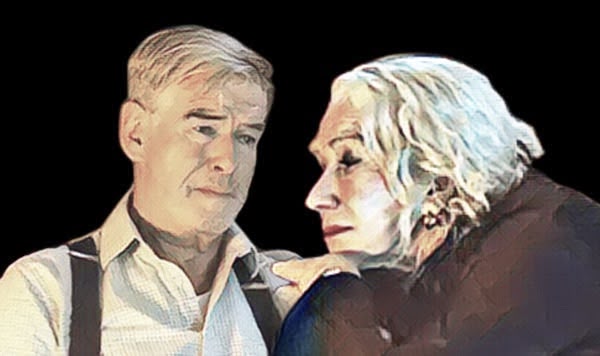
In the same Deadline interview, Mirren praises Tom Hardy’s stillness, emphasizing the power he can convey without resorting to the expansiveness of the other characters. The observation matters because it reveals that the contrast between the acting styles has not escaped the attention of the stars themselves.
Harry Da Souza is a man who watches, calculates, and reacts. In a world populated by people who shout, threaten, and constantly seem on the verge of losing control, his restraint becomes a form of authority. He does not need to announce that he is dangerous because his behavior has already established that possibility.
Paddy Considine also frequently works with an economy of gestures that contrasts with the patriarchs’ extravagance. Johnny Flynn, meanwhile, as Frankie, explores a more eccentric characterization, bringing his character closer to a grotesque figure who might easily inhabit a revenge tragedy.
What makes this interesting is that these choices do not always seem to belong to the same dramatic language. Hardy frequently plays Harry as the protagonist of a relatively realistic crime thriller, while Brosnan and Mirren appear to be performing the decline of a bloodthirsty monarchy. The result can be fascinating because it places rationality and delusion face to face, but it can also create the impression that characters from entirely different fictional universes have been brought together in the same story.
In a production less conscious of this contrast, we might simply attribute it to the direction or to inconsistent performances. But Mirren and Brosnan offer another explanation: they know they are exaggerating, and they find artistic freedom in that excess.
The Pleasure of Excess, According to Mirren and Brosnan
Mirren is particularly revealing when she explains that she does not regard MobLand as a contemporary psychological drama. For the actress, the series is closer to a Jacobean tragicomedy, an experience that does not require viewers to conduct a meticulous investigation into every character’s motivations.
Her comparison is intriguing: watching the series would be like boarding a roller coaster in the dark, accepting the ride and allowing oneself to be carried along by its surprises. Brosnan agrees, emphasizing the richness of Butterworth’s writing, the humor of the situations, and the freedom both actors find in expansive, almost theatrical scenes.
There is also an important element in the way they work. Both have theatrical backgrounds and describe a fast-paced filming process in which the intensity of a performance is allowed to flourish without necessarily undergoing endless adjustments in front of the camera. According to Brosnan, the experience of acting opposite each other approaches the sensation of being back on stage.
This helps explain why Conrad and Maeve so often seem larger than the series itself. They are not pursuing naturalism, nor do they appear particularly interested in making their characters likable or psychologically transparent. Their intention is to explore the grotesque dimensions of two people for whom the world exists to satisfy their desires.
But there is an important difference between understanding an aesthetic choice and believing that it always works.
Shakespeare Is Not Synonymous With Shouting and Murder
The comparison to Shakespeare deserves some caution. Although many of his tragedies were written during the Jacobean period, the power of characters such as Macbeth, Lady Macbeth, or King Lear does not lie simply in the violence they commit or provoke. It lies in the complexity of the contradictions driving them, in the way desire, guilt, fear, and conscience evolve throughout the narrative.
Lady Macbeth may encourage the murder of a king, but she cannot prevent guilt from destroying the illusion of control she had constructed. Lear turns his vanity into a family catastrophe, but undergoes a painful process of recognition. These are characters who make monumental mistakes, yet their journeys offer something beyond the repetition of their impulses.
Maeve Harrigan, on the other hand, often seems indifferent to the consequences of her own actions. Her hostility toward Seraphina, her manipulation of Eddie, and her determination to eliminate Harry follow a logic of domination that, while recognizable, risks becoming predictable. If everyone who threatens her authority must be destroyed, there is little room left for us to discover new dimensions of her character.
Even more disturbing is her relationship with Kevin. Not even being her son seems to guarantee loyalty that goes beyond her need for control. Maeve presents herself as a matriarch, yet frequently behaves as though the family deserves to exist only as long as it remains subject to her will.
There is a profoundly tragic dimension to this possibility, particularly if we think of characters such as Tamora, from Titus Andronicus, whose revenge transforms family bonds into instruments of violence. The difference is that, in Shakespeare’s play, we can identify the wound that fuels the destruction. In MobLand, we often recognize the cruelty without sufficiently understanding what sustains it.
Mirren herself seems to suggest that perhaps such an understanding is unnecessary. And that is precisely where the most interesting question arises.
Does Excess Explain Everything?
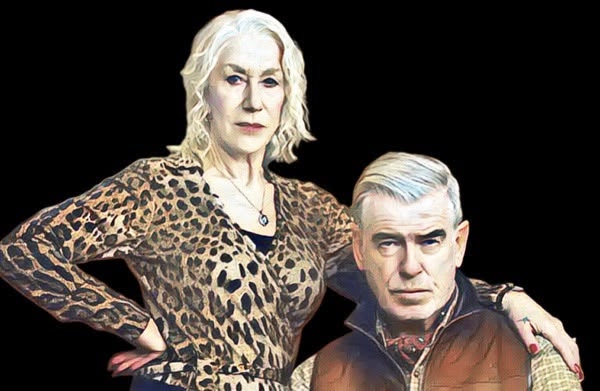
The Jacobean reference offers an enriching perspective on MobLand, but it can also become a convenient justification for its weaknesses.
Revenge tragedy does not require balanced characters, reasonable behavior, or morally acceptable decisions. Quite the opposite: it frequently emerges from the inability to control impulses and from an escalation of events that no one can stop. But that does not mean dramatic construction can dispense with internal logic.
Even absurdity must obey the rules of the universe in which it takes place.
When Conrad and Maeve behave like deranged monarchs while Harry remains responsible for managing the practical consequences of their decisions, the series finds an interesting dynamic. The contrast between a decadent court and the man who must keep it functioning produces humor, tension, and, occasionally, a remarkably cruel understanding of power relationships.
The problem arises when conflicts repeat themselves without the characters evolving or the consequences genuinely changing their positions. Viewers may accept a criminal family that continually conspires against itself, but after two seasons, they also have every right to ask how this empire continues to exist.
Perhaps the answer is that MobLand was never intended to be a convincing portrait of organized crime. Its real subject may be the decline of a family incapable of surviving its own desires, a kind of Jacobean court transplanted into the London underworld of the twenty-first century.
It is a generous interpretation, certainly, but also an interesting one, especially because it offers a key to understanding the actors’ choices and the deliberately excessive tone of so many scenes.
Mirren and Brosnan seem to take enormous pleasure in portraying characters who recognize no boundaries. And there is pleasure in watching them exercise that freedom, even when the story surrounding them threatens to collapse under the weight of so many conspiracies.
The reference to Jacobean theater does not automatically turn MobLand into a great tragedy, much less Shakespeare. But it helps explain why its protagonists seem so comfortable in a universe where nobody knows exactly who is in charge, everyone wants power, and almost nobody demonstrates the competence to exercise it.
Perhaps the secret is to follow Helen Mirren’s advice and board the roller coaster without demanding an explanation for every turn. We should simply remember that even in the theater of excess, there is a difference between the madness of the characters and a story that has lost its direction.
Descubra mais sobre
Assine para receber nossas notícias mais recentes por e-mail.

