
Contains spoilers for all six episodes of Treasure Island.
There’s an increasingly obvious trend among streaming platforms: borrow the title of a literary classic, keep its characters and built-in audience, and change practically everything else. What’s left of the original? The name, a few references, and the promise of a story audiences already know. Everything else is negotiable.
That’s what happened with The Buccaneers, the rather loose adaptation of Edith Wharton’s unfinished novel. To some extent, it’s also one of the biggest complaints George R. R. Martin’s readers have about House of the Dragon. And now we have Treasure Island, the latest adaptation of Robert Louis Stevenson’s 1883 adventure classic.
I’m not against loose adaptations. In fact, I’m generally something of a purist when I know and love the source material, but I don’t believe absolute fidelity is necessarily a virtue.
When I first started watching Game of Thrones, for example, I hadn’t read the books. I accepted the entire universe the series presented to me. I read Martin’s novels afterward and still considered the adaptation excellent, particularly while the producers had published material to work with.
There were changes, of course. David Benioff and D. B. Weiss considerably reduced the magical and fantastical elements of Martin’s universe. They also eliminated characters and subplots that might have enriched the story but perhaps complicated the pacing of a television series.
And it worked. At least for most of its run.
The problem begins when an adaptation stops interpreting an existing work and starts using it merely as the starting point for an entirely different story.
And that’s precisely how I felt watching all six episodes of Treasure Island, the MGM+ production starring David Oyelowo, Hayley Atwell, Tom Sweet, and Jack Huston.
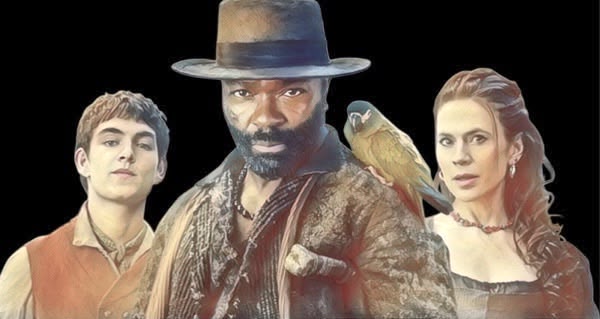
A beautiful adventure that never quite draws us in
Visually, the production is stunning. The ships, landscapes, sets, and locations create an adventurous world that looks as though it has stepped straight out of the illustrations of a book.
The series was filmed in Bristol, England, and Tenerife in the Canary Islands, along with other British locations. To recreate the maritime sequences, the production team built a ship along the Tenerife coastline, allowing the real sea to appear in the background. Camera techniques created the illusion of movement, while the volcanic landscapes surrounding Mount Teide provided the setting for the treasure island itself.
It’s impressive production work, and it helps explain the show’s cinematic scale. David Oyelowo is also one of its greatest strengths as Long John Silver, one of literature’s most famous pirates. His accent, posture, intelligence, and ability to shift between menace and apparent friendliness make him the most compelling presence in the story.
It’s no small challenge. Silver has been portrayed by numerous actors, including Orson Welles in 1972 and Robert Newton in Disney’s classic 1950 adaptation. Oyelowo manages to create his own interpretation without relying on imitating his predecessors. But there’s an important difference between his character and Stevenson’s original.
In the novel, Silver earns Jim Hawkins’ trust. Their relationship is built on admiration, affection, and manipulation, making the boy’s discovery of Silver’s true nature particularly painful. In the series, Silver is much more obviously dangerous from the beginning. He may be fascinating, but he hardly seems like someone Jim could genuinely trust as a friend. That change removes some of the emotional complexity from their relationship.
Then there’s Aaron Graham, played by Jack Huston, a character who doesn’t even exist in the original novel. He’s yet another ambiguous figure, with unclear interests and a complicated relationship with the Hawkins family.
Everyone is hiding something. Everyone has a secret agenda. At some point, so much ambiguity becomes more exhausting than surprising.
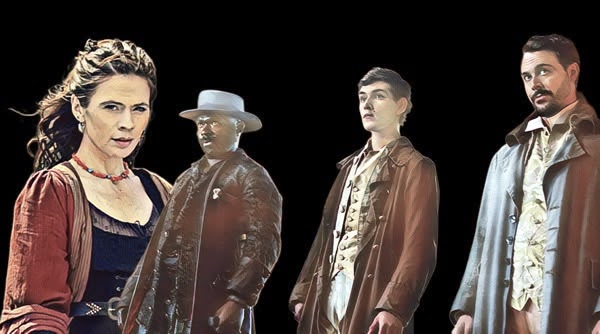
Jim’s mother and the mystery that never existed
One of the most significant changes involves Bess Hawkins, played by Hayley Atwell.
In the novel, Jim’s mother plays an important part at the beginning of the story but never boards the Hispaniola. In the series, her role is dramatically expanded, and she accompanies her son on the adventure.
She’s independent, seductive, and far more daring than we might expect from a woman in that historical setting. Her revealing dresses and necklines, incidentally, often seem to belong to an entirely different period. But that didn’t particularly bother me. I understand the desire to expand female characters in classic stories that offered them very little space. And Hayley Atwell is certainly a welcome presence. The problem is what the writers do with that decision.
After turning Bess into a central character, they decide to murder her and introduce an entirely new mystery surrounding the identity of her killer. Suddenly, the treasure hunt must share the narrative with a murder investigation and a revenge story. Jim is no longer simply a boy confronted with ambition, violence, and the contradictions of the adult world. Now he must discover who murdered his mother.
The revelation comes in the final episode, when Cameron, played by Neil Pendleton, admits to poisoning Bess with arsenic. It’s a mystery invented entirely for television, one that changes the characters’ motivations and directly affects how the adventure ends.
The ending Stevenson never wrote
By the series finale, after surviving the dangers of the island, Jim discovers his mother’s killer and ends up forming an unlikely alliance with Silver and Graham.
The adventure also includes a sequence involving captivity and the threat of sacrifice, another invention of the adaptation that helps transform the treasure hunt into an increasingly elaborate succession of dangers.
When they finally escape, the three find themselves drifting in a small boat. Silver gives up the treasure to ensure their survival. But when they spot a Portuguese ship, a new idea emerges: why not seize the vessel and embark on another adventure? It’s practically the formation of a new trio of pirates, con artists, and treasure hunters. And that’s not how the novel ends.
In Stevenson’s story, Jim returns to England with his share of the fortune. Long John Silver escapes with a small amount of treasure, and the boy is left deeply affected by his experiences, with absolutely no desire to return to the island.
It’s a conclusion that transforms the adventure into a coming-of-age story. The television series prefers to turn its ending into the promise of a franchise. And this brings me to what bothers me most.
What happens when you haven’t read the book?
I hadn’t read Treasure Island before watching the series. And I’m certainly not alone. We’re talking about a novel published almost a century and a half ago, a story particularly familiar to English-speaking audiences but not necessarily to newer generations around the world.
For anyone unfamiliar with Stevenson, everything on screen might appear to belong to the original: the mother who joins the voyage, her murder, the investigation, the new characters, the sacrifice on the island, and the formation of a trio of adventurers. I found myself wondering which parts actually came from the book.
This is one of the problems frequently raised by adaptation purists. A heavily altered version can eventually replace the original story in the imagination of audiences who have never encountered the source material.
Of course, adaptations don’t need to function as literature lessons. But there’s a difference between updating a work and transforming it into something so distant that practically only the names remain.
Apple TV’s The Buccaneers is another example. The series takes inspiration from Edith Wharton’s novel about wealthy young American women entering British aristocratic society but eventually follows a path very much its own, particularly in its language and the behavior of its characters.
Television has rediscovered its fascination with this world. HBO’s The Gilded Age began rather quietly and evolved into a full-blown period melodrama, with characters and conflicts growing in importance over successive seasons. Its success helps explain the renewed commercial interest in stories about aristocracy, wealth, and social conventions.
Much as Game of Thrones sparked a race to produce ambitious fantasy series, historical dramas are once again occupying an important place in streaming. But identifying a trend isn’t enough to make a good production.
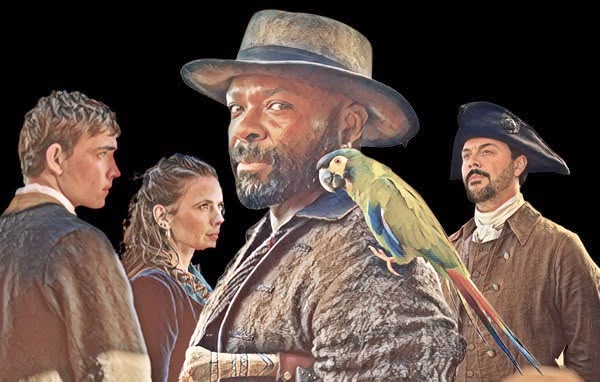
Will Treasure Island return for Season 2?
The ending clearly leaves the door open for another adventure. Stevenson’s story may be finished, but the lives of the characters reinvented for television could easily continue.
In an interview with TV Insider published on November 15, David Oyelowo acknowledged that the possibility of a second season depends on the audience’s response. The actor suggested that the story’s universe offers endless narrative possibilities and expressed enthusiasm for continuing to explore these characters.
So far, MGM+ has not announced a renewal. And I’m not sure it will happen. Treasure Island is an ambitious production, with an impressive cast, elaborate sets, and location filming that must represent a considerable investment. The work carried out in Tenerife alone, including the construction of the ship used for the maritime sequences, gives some idea of its scale. Perhaps the decision will depend on whether the audience response is strong enough to justify another voyage.
Does the series work as entertainment? Yes. It’s beautiful, features strong performances, and delivers some effective action sequences. I even consider it a better adventure than Robin Hood, another MGM+ production. But it never managed to engage me as much as it should have.
Perhaps that’s because I’ve never been particularly passionate about pirates and treasure hunts. Perhaps there’s something about classic adventures, a combination of discovery, danger, and wonder, that twenty-first-century television doesn’t always manage to recreate. Or perhaps, in their determination to modernize everything, the writers lost the very qualities that made the original story work.
Ultimately, Treasure Island is a perfectly reasonable choice for anyone looking for an entertaining period adventure without worrying too much about fidelity to the novel. Just don’t confuse what you’re watching with the story Robert Louis Stevenson actually wrote. Because if the intention was to change practically everything, perhaps it would have been more interesting to invent an entirely new adventure.
Descubra mais sobre
Assine para receber nossas notícias mais recentes por e-mail.

