
I still maintain that The Last of Us will be a great series, but it will not necessarily reach the level of “phenomenon. It has nothing to do with Pedro Pascal‘s departure, although it is felt. It does not even have to do with the lack of unanimity around Bella Ramsey. It has everything to do with the dystopia of a society destroyed by the incurable Cordyceps fungus, being a story of revenge. Even with all the depth of the proposal, it is not innovative. At the same time, episode 4 of the second season is so perfect that it gives us back the desire to continue following the story.
Ellie (Ramsey) is after the person who brutally murdered Joel (Pascal), the now missing Abby (Kaitlyn Dever). This reunion will take a while to happen, and along the way, we will come across other terrifying stories, such as that of Isaac (Jeffrey Wright), the leader of the W.L.F. – Washington Liberation Front – or the Wolves.
Having a great actor like Wright in the spotlight is a great addition to the series. His powerful entrance at the beginning of the episode, in a flashback from 11 years ago, is scary and impactful, but it is still not 100% clear.

If you forgot, Joel explained to Ellie in season 1 that, worse than the infected, the outside world is suffering because there is a brutal war between the survivors, divided into factions and radicals, resulting in very strong and devastating scenes. Isaac is one of the worst antagonists in this scenario, and we have to prepare ourselves for this.
We left Ellie and Dina (Isabella Merced) unaware that the Wolves are not in small numbers and are marching through Seattle for some kind of confrontation. But instead of going back to that problem, we open the episode in the city’s quarantine zone in 2018, 11 years before the series’ current timeline. We come across FEDRA soldiers exchanging “funny” stories of attacks on citizens, called voters. They are preparing for another mission, and when one asks how the name “voters” came about, we hear Isaac break the mood by explaining that the irony of the name is precisely because FEDRA took away society’s fundamental right to choose. No one votes anymore.
We then see that Isaac was a FEDRA sergeant but that, dissatisfied, he turned against the organization: he kills all the soldiers and creates the W.L.F. From then on, the Wolves will have many “enemies”, the current ones being the Seraphites, those bald men with scars that we saw being decimated in the third episode. In other words, in 11 years, the Wolves have become even more oppressive than FEDRA, and Isaac is the ruthless leader of this movement. He tortures a prisoner, and we see that the Seraphites are “religious” radicals and not even physical pain scares them.
We soon return to Ellie and Dina, but be warned: until they find Abby, this existential struggle between radicals will bring problems, pain, and drama.
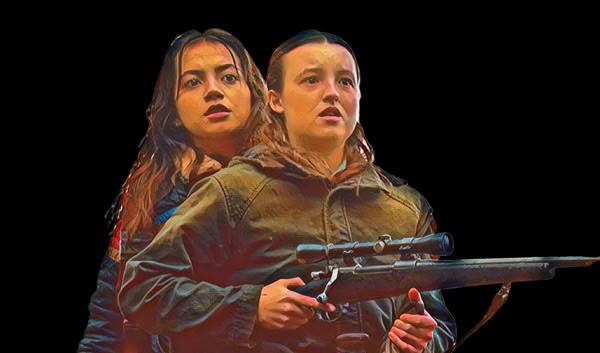
The sequences that leverage the relationship between the two young women and the romance that will bring docility to Ellie are taken from the game, so they were expected and do not disappoint. Especially the sequence in which she finds a guitar and sings Take On Me, by the group A-ha. Let’s mention that when she says that she discovered these ’80s pop songs with Joel, I wonder how he – a Pearl Jam fan – would listen to A-ha, but since this is a song representative of the decade, I don’t insist on questioning his musical taste.
The scene is beautiful and moving, as expected. Dina and Ellie, who were born and raised in a destroyed world, have no idea what the world was like decades ago, to the point that Dina had never heard Take On Me before. The two are so unpretentious that they don’t even know that the Rainbow flag was from the LGBTQ+ movement. This romantic connection is not completed in the serenade, and the interrupted moments of the two escaping a crowd of infected people are tense and terrifying.
To Dina’s surprise, part of Ellie’s courage is because she finally has to reveal, after being bitten, that she is immune to Cordyceps. In response, after kissing and spending the night together, Dina reveals that she is pregnant with Jesse’s child, but it is Ellie who immediately celebrates that he will be a “father”. And, of course, she worries about Dina continuing the search for Abby, who is obviously dangerous. Dina does not back down: they will find them together.
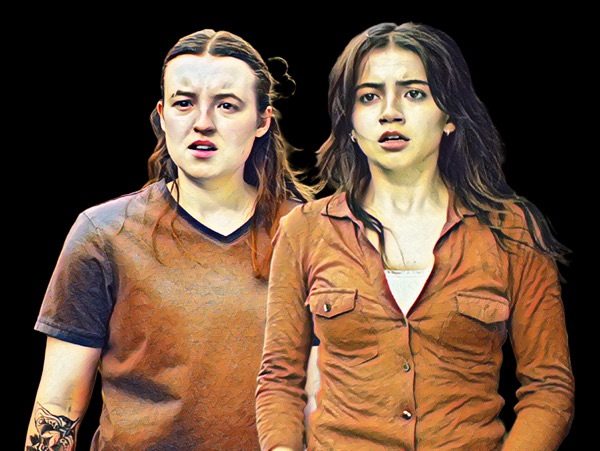
While Abby’s whereabouts remain a mystery and the Wolves prove to be terrifying, it is Isabela Merced who has been standing out to bring chemistry, sympathy, and talent in the difficult vacuum of Pedro Pascal‘s absence. He will still have his long-awaited flashback (singing Future Days), and the story is still in its infancy.
With all these elements — pain, memory, affection, trauma, and survival — The Last of Us continues to weave a narrative that, although it does not break with certain conventions of the post-apocalyptic genre, knows exactly where to find humanity within barbarity. It is not about iIt’s not about renewing the plot, but about executing it with emotional precision, sensitivity, and intensity. Episode 4 is proof of this: it works almost as a reminder of the series’ potential, balancing action and intimacy with rare dexterity. If it’s not a phenomenon yet, it’s perhaps because its appeal isn’t universal, but for those who follow it, it’s a deeply immersive experience. And that, in itself, is already a remarkable achievement.
Descubra mais sobre
Assine para receber nossas notícias mais recentes por e-mail.

