
Olivia Cooke doesn’t hand out spoilers easily — but when she does, they shed light on the emotional core of House of the Dragon. In her most recent interviews, she nailed what, to me, feels like the key to season three: the unlikely pact between Alicent and Rhaenyra. “Alicent has made a bargain at the end of season two, so she’s desperately trying to enact that,” she said, with the serenity of someone who knows this promise breaks the logic of war consuming them both. The sentence may sound simple, but its weight is not. Alicent — once a young woman synonymous with duty and silence — now has to uphold a vow made to her rival, with all the risk, guilt, and consequences it implies.


And then comes the other pole: the epic machinery. Cooke describes season three with almost awed joy: “Oh my God, it’s going to be huge, season 3 is huge… they’ve really amplified everything this season and there are so many new characters, which is so much fun. It’s fantastic. Every single penny has gone on the screen.” In another interview, she added that she can’t wait for people to see the making-of: showrunner Ryan Condal keeps showing her bits and pieces of the “stunty stuff that’s been going on — it’s mad, it’s incredible.” Translation: HBO has taken off the brakes and gone all in on scale, practical effects, and an expanded cast. (When she said it, they still had “about a month and a half left” of shooting — you could still hear the set’s breath on her voice.)
This grandeur, however, doesn’t erase what I find most intriguing: the show continues to intentionally displace what George R.R. Martin wrote in Fire & Blood. The gesture of possible peace between Alicent and Rhaenyra — fragile, tense, but real — does not exist in the book. And Cooke insists on its importance. If Emma D’Arcy has already secured, rightly, action and negotiation scenes that weren’t in the source material, I confess I live with my “professional fear” that actors’ requests — legitimate, human, understandable — might alter the tragic choreography more than necessary. It’s the eternal game between collaborative creation and fidelity to the dramatic arc. When it works, we gain complexity; when it doesn’t, the narrative stumbles.


And it’s in this game that Olivia also shines off screen. On The Tonight Show Starring Jimmy Fallon, she was luminous and ironic. She admitted to feeling immense pressure with the new season while joking with the collective fantasy: she wants to “ride a dragon like a bucking bronco.” Fallon joined in, but Cooke herself laughed: “That’s not my character.” Still, she teased that one day she might ask for it “just for fun.” The provocation echoes the very first scene of season one, when Rhaenyra invited her for a dragon ride and Alicent confessed she was afraid. Since then, the image of Alicent flying has haunted the story symbolically: not because it will happen, but because it reveals what she was never allowed to live.
The behind-the-scenes anecdotes are equally telling. Olivia recounted how she slapped Tom Glynn-Carney (Aegon, her son on the show) for real: “He said, ‘Do it for real!’ I wasn’t sure, but the stunt coordinator said it was fine if he wanted me to… and then I walloped him!” It’s a small story that says a lot: about the cast’s physical commitment, the trust between partners, and the almost brutal intensity of filming. In the same intimate register, there’s her portrait of her mother: her biggest cheerleader, who never visits set but reigns at premieres and free bars; at midnight, slumped in a corner with a chicken tender in one hand and a margarita in the other, declaring: “This is my night.” Between real slaps and margaritas, the myth becomes human.
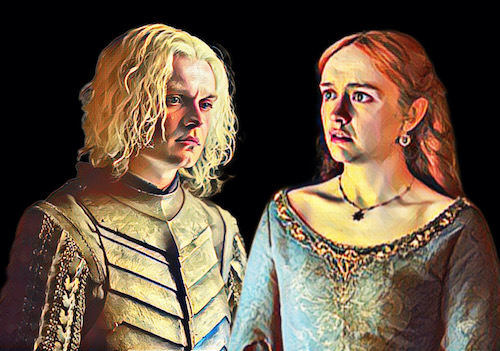

Beyond the laughs, there’s also the memory of the beginning: Cooke recalled that it was in 2020, during lockdown, after months of auditions, that she received the call that would change her life. Phone plugged into the wall, agents ecstatic, and she — honest as ever — feeling an “immediate pain” at the weight of what was to come. “It felt like a gargantuan job.” Today, with the show in full maturity and at the eye of the storm, she can laugh at her own anxiety — without losing it, because it’s from that anxiety that her Alicent is born.
There’s also the Spanish hyperbole, which I confess I love for its theatricality: “lo que el mundo entero está esperando” — the new season — “va a hacer volar muchas cabezas (literal y figuratively).” It’s the right exaggeration for a drama that makes metaphor a promise: heads will roll, yes, but what interests me are the heads that shift from within. Alicent’s pact with Rhaenyra, whether upheld or betrayed, has already unsettled the board. When a woman decides to honor a vow — and the world around her demands she break it — any move will come with interest.

And so, the dragon joke returns as a refrain: it’s funny to imagine Alicent flying; it’s sad to remember why she doesn’t. And this is where I, as a viewer, hold my caution: the expansion of female roles in the series has been a victory — Emma D’Arcy opening space for Rhaenyra’s physicality, Cooke carving the gray zone of guilt and affection for Alicent. I only hope that, in listening to the cast’s wishes (fair, legitimate), the writing doesn’t lose the cruel irony that makes House of the Dragon more than just an epic spectacle: the irony of choices that seem to liberate and, deep down, tighten the knot further.
If season three is “huge” and “every penny is on the screen,” as Olivia insists, may it also be huge on the inside. May the impossible pact between two women — so close to life, so different from the book — continue to be the high-voltage wire that makes the series vibrate. Between the fanfare of dragons and the whisper of a promise, it is there, in the space where guilt and courage live, that House of the Dragon finds its true fire.
Descubra mais sobre
Assine para receber nossas notícias mais recentes por e-mail.

