
There’s something lonely about watching a series you consider brilliant start to lose its way — and realizing you might be the only one seeing it. Hacks now feels like it’s chasing a sense of purpose, almost as a metacommentary on what its own protagonist is going through. Deborah Vance’s narcissism, with its touches of hysteria, pushes this final season into an intense spiral, into situations that are as bizarre as they are implausible, where it’s hard to smile, let alone laugh.
At its core, after self-sabotaging and wrecking lives, friendships, and careers, Deborah is now trying to undo the legal consequences of a contract that could sideline her for years, long enough to be forgotten. To disappear. Again, she created her own problem, and yet here she is, manufacturing new conflicts just to feel alive, in control, or whatever that still means. There’s a potentially great story there. What we actually get, however, is a sequence of orchestrated embarrassments led by Deborah Vance.
And it might get worse.

Hacks has always had Jean Smart as its greatest asset. But for some reason, the show has leaned into an ensemble dynamic in the worst possible way: everyone has to be everywhere, all the time. Why does Deborah need to go to a Madison Square Garden meeting with her writer, both agents, their assistant, and her own assistants? Walking through New York as a pack? At this point, it’s clear this recap comes from a place of irritation. And we’re only on episode two.
After announcing she’s going to perform at Madison Square Garden, Deborah is forced into a reversal: she has to apologize to the venue’s booker and, worse, convince her that she still matters. History, money, and ambition aren’t enough. To play that stage, you have to be at the center of the cultural conversation. And Deborah, despite everything, isn’t.
So she takes a step back and tries to reset the game. Deborah decides to mobilize her fans to pressure Amanda Weinberg. The Little Debbies move from background detail to narrative center. They’re going to get her into Madison Square Garden.
Back in Las Vegas, at a fan convention, what starts as a celebration quickly turns into a reckoning. What emerges isn’t devotion, but resentment. Deborah didn’t just drift away — she abandoned a community that had built part of its identity around her.
The complaints are absurd, specific, sometimes funny, but never irrelevant. They’re about newsletters that stopped, products that disappeared, and inside codes that lost continuity. The detail matters because it reveals the nature of the bond: it’s not just admiration, it’s belonging. And when that belonging is interrupted, what follows isn’t indifference, but betrayal.
It’s a two-sided critique of contemporary culture, where proximity between celebrity and audience has turned attention into something closer to a relationship. Fans don’t just want to watch. They want to be acknowledged.
Deborah spent years feeding that dynamic. Now she has to deal with the cost.

The turning point comes quietly, in one of the episode’s most striking moments. A fan presents a handmade portrait, created with her mother, who died before ever getting the chance to see Deborah in person. The object is awkward, even ugly, but it carries something Deborah has lost sight of: time, effort, care.
Deborah’s cynical shell cracks — the narcissism doesn’t — as she realizes that this relationship was never one-sided. There’s an implicit negotiation at play. They sustain her; she shows up. They project; she responds. When one side breaks that pact, the other reacts.
Because everything has to pass through her, Deborah ultimately owns her failure. She admits vulnerability and acknowledges that she needs them, not as a strategy, but as recognition.
The effect is immediate. The fans’ frustration at the idea of her losing relevance turns into defense. The same energy that once fueled complaints now drives mobilization. The “Deb for MSG” campaign spreads everywhere, from mailboxes to physical spaces, an almost absurd — and yet entirely plausible — demonstration of how fandoms operate as a collective force.
The episode could end there, but instead, it deepens the conversation through Ava.
If Deborah represents the weight of a career built on an audience, Ava represents something else: the possibility of a more intimate, more direct, more dangerous connection. Throughout the episode, she briefly experiences what it means to be seen, admired, followed — and understands, almost immediately, how fragile that can be. Because in the end, the fan who seemed to want her really just wanted access to Deborah.
Taking advantage of Ava’s 30th birthday, Deborah — still carrying guilt from their harsh conversation in Thailand — organizes a party in her honor.
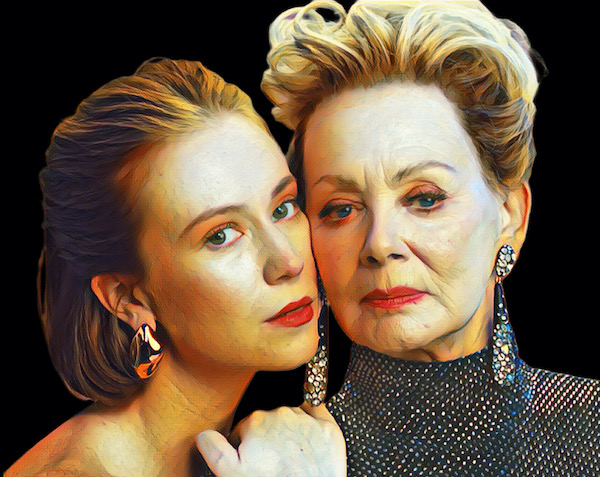
Their relationship has always been symbiotic: at times maternal, at times neurotic, never romantic. And in that moment, Deborah admits she drifted from her fans because Ava filled an old void. For years, she had no relationships that weren’t mediated by work or admiration. Ava becomes the exception. And, like any exception in a system built on exchange, she disrupts the balance.
The fact that Deborah has earned Ava’s admiration over time carries real emotional weight for her. When Ava calls herself her “number one fan,” it doesn’t land as a simple gesture of affection. It reframes everything we’ve just seen.
Because, ultimately, that’s what this episode is about. Not fans, not career, not Madison Square Garden. But the difficulty of sustaining relationships that aren’t built on exchange, projection, or need.
Hacks has always been a series about work, ego, and survival. Here, it moves into something more delicate: what happens when affection enters that system.
And, more importantly, what happens when it starts replacing everything else.
It’s a shame it’s still stumbling.
Descubra mais sobre
Assine para receber nossas notícias mais recentes por e-mail.

