
Once again, I should say upfront that I know I’ll be in the minority in thinking that Beef’s second season feels narratively fragmented, but there is one element that remains surprisingly consistent from beginning to end: the score composed by Finneas O’Connell.
And this is not simply a matter of taste or song selection. It is a matter of understanding.
Finneas grasps something essential about Beef that the season itself, at times, seems to forget. This is a story about quiet tension, about resentments that do not immediately explode, about a world in which discomfort is constant, almost structural. That is precisely what his music translates.

From Disclaimer to Beef: the path to this moment
Although many still associate Finneas O’ Connell primarily with his work alongside his sister, Billie Eilish, Beef 2 is far from an isolated experiment.
His first major work as a television composer was Disclaimer (Apple TV), in 2024, an experience that already revealed his interest in dense, psychological atmospheres, where music does not simply accompany a scene but actively heightens its tension. Before that, he had already composed for film, in The Fallout and Vengeance, consistently orbiting emotionally unstable characters, fractured relationships, and narratives in which silence carries as much weight as dialogue.
In that sense, Beef 2 feels like a natural continuation, but also a leap in scale. Here, he works with more time, more layers, and a greater demand for internal coherence. The result is a set of 32 original tracks, built on an electronic, dense, and fragmented approach developed over hundreds of hours of experimentation.
His involvement was not merely strategic, but deeply emotional. Series creator Lee Sung Jin came to Finneas through a direct connection to his music, particularly after hearing What Was I Made For? in Barbie. That was the moment he recognized in Finneas the ability to hit the precise emotional nerve he was searching for, especially for the season’s conclusion.


The logic of the score: anxiety as language
The most compelling aspect of Finneas O’ Connell’s work lies not only in the sound itself, but in the logic that structures it. He does not begin with beautiful themes, but with dramatic ideas.
There is a clear progression throughout the season. The music starts with a kind of naive optimism, slightly out of place, and gradually becomes contaminated by tension, noise, and instability. This “dumb optimism,” as he describes it when thinking about the younger couple, becomes a sonic language. It is not only what the characters say, but what the score suggests about them.
This takes shape through very specific choices. The use of imperfect, almost amateurish synthesizers connects directly to Oscar Isaac’s character. Real-world sounds, such as golf course sprinkler systems, are transformed into rhythmic elements. Textures that evoke swarms create a sense of constant tension, something that never fully resolves.
Even before the season was fully written, Finneas was already operating at this level of construction. Based on the first scripts, he composed Vicious Thoughts, a piece that did not simply accompany the narrative but helped define it. Upon hearing it, Lee Sung Jin immediately visualized the season’s final moment, as if the music had anticipated the image itself.
This is not a score seeking elegance. It is a score seeking friction.
Hot Chip, LCD Soundsystem and emotional curation
If the original score builds the atmosphere, the curated songs perform a different function, one tied to situating the characters emotionally within a recognizable world.
The second season moves away from the grunge of the first and into a more contemporary space, where electronic, indie, and pop coexist naturally. Hot Chip emerges as a recurring axis, and not by accident. Within the narrative, Oscar Isaac’s character is a fan of the band, which turns the choice into something diegetic rather than purely curatorial.
What makes this approach particularly compelling is how deeply it is embedded in the writing itself. Unlike many productions, where songs are chosen in post-production, Beef 2 builds its needle drops from the very beginning. Lee Sung Jin writes with these tracks in mind, incorporating them into the structure of each episode, while Finneas is given the songs that close each chapter in advance, allowing his score to interact directly with them.
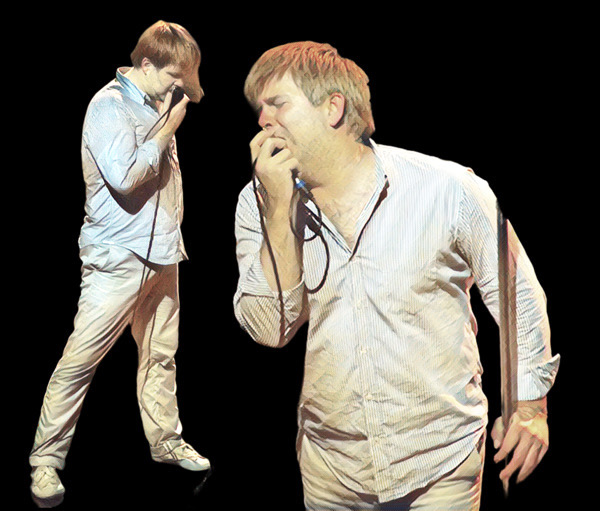

This helps explain the sense of cohesion. LCD Soundsystem appears in moments of emotional suspension, while Disclosure and Zedd point toward a more polished, almost aspirational world. Billie Eilish operates in layers, at times intimate, at times ironic, creating an unavoidable meta dimension. Father John Misty, Phoenix, and Future Islands enter when the series slows down and allows for a degree of contemplation.
There is also a clear generational dimension at play. The season engages with a form of recent nostalgia, treating the 2010s in much the same way previous generations treated the 1990s. For the older characters, references like LCD Soundsystem and Hot Chip do not belong to a distant past, but to a time that still feels uncomfortably close, creating a subtle dissonance between memory, identity, and the perception of aging.
Hot Chip’s presence, in this sense, extends beyond the soundtrack and into the narrative itself. The band appears on screen, performing alongside Oscar Isaac’s character in a moment that blends nostalgia, excess, and emotional collapse, transforming a musical choice into a dramatic device.
This is not a playlist designed to feel “cool.” It is a selection that exposes contradictions.

The smartest detail: Billie Eilish as commentary
Billie Eilish’s presence could easily feel excessive. It does not, because Finneas understands the humor and discomfort of his own inclusion.
There is a particularly revealing moment in which he appears in the series himself, and Billie’s music plays in a way that feels almost awkward, self-aware, and ironic. At that point, the score stops being mere accompaniment and becomes commentary.
And perhaps this is the kind of layer the narrative itself is missing at times.
A score that understands more than the series itself
Ultimately, what makes Beef 2’s score so effective is something simple to articulate and difficult to achieve. It knows exactly what story it is telling.
While the season oscillates between ambition and dispersion, the music maintains a clear axis. It builds tension, sustains discomfort, and, above all, avoids over-explaining. It preserves space, and it is within that space that the series, at its best, is still able to breathe.


At its core, there is an interesting reversal at play. While the series attempts to organize its tensions in multiple directions, the music moves in the opposite way, concentrating, anticipating, and at times even guiding the emotional experience.
That may be why it works so well. In a season that often feels overly calculated, Finneas’ score comes across as the only truly organic element.
And, ironically, it is what restores to the series something the first season had more naturally: the sense that chaos is not an effect, but the permanent state of these lives.
Descubra mais sobre
Assine para receber nossas notícias mais recentes por e-mail.
 miscelana.com
1 comentário Adicione o seu