
After the massive success of its first season, expectations for the second season of Beef were enormous. Smartly, it doesn’t try to replicate step by step what made the first a phenomenon. That said, the inciting conflict — the “beef” that triggers obsession — is still there, but now the series shifts into a different territory, closer to a collage of references, somewhere between Black Mirror, The White Lotus, and even The Beauty. And it fully embraces, without compromise, that its goal is not to please, but to unsettle.
And that becomes especially evident in the ending. Here is my take, with spoilers.

First things first: what’s at stake in Beef 2
Forgive my irritation, but it’s a reaction to the material itself. What made the first season compelling was precisely its everyday premise — a road rage incident that escalates into something tragic and becomes an emotional spiral. Here, we get a mystery, a touch of dystopia, and motivations that don’t quite feel grounded.
The second season completely abandons the original characters and introduces a new story, centered on two couples occupying opposite ends of the social hierarchy.
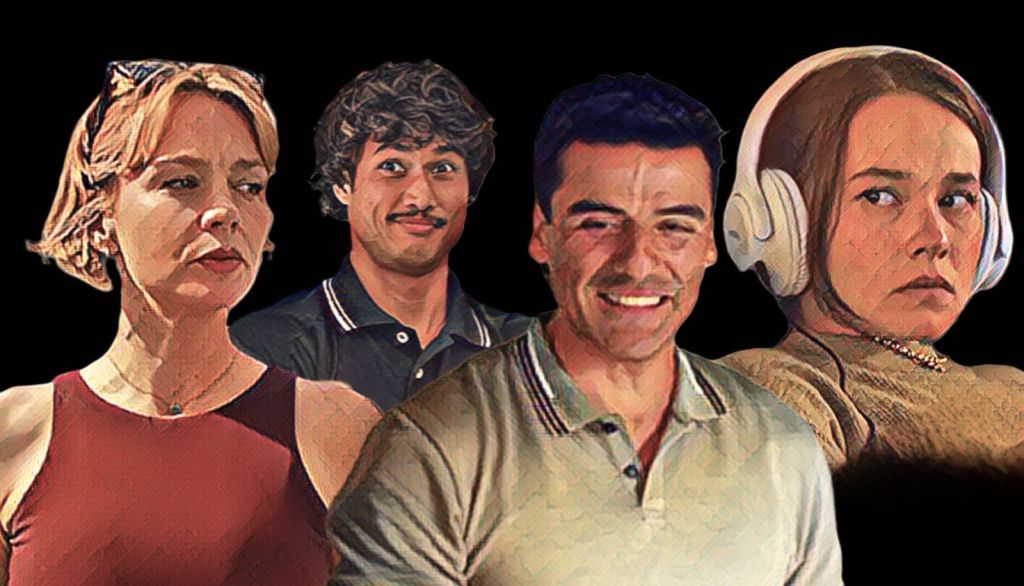
Ashley (Cailee Spaeny) and Austin (Charles Melton) are a young couple working at an elite country club in California. There, they witness a pivotal moment: a violent argument between their boss, Josh (Oscar Isaac), and his wife, Lindsay (Carey Mulligan), a wealthy couple whose relationship is already unraveling.

What could have remained a private incident becomes the starting point for the entire season. Ashley and Austin decide to use what they saw as leverage — initially as a way to move up, to improve their standing in that world. But it quickly turns into a blackmail game.
From there, the narrative spirals. Josh and Lindsay, already fragile, begin reacting to the threat while trying to maintain appearances. At the same time, control slips from everyone’s hands, as each character starts acting out of personal interests — financial, emotional, or simply destructive.
Things become even more complicated with the arrival of the club’s new owner, billionaire Chairwoman Park (Youn Yuh-jung), who adds another layer to the conflict. She is also in an unstable marriage and carries her own set of issues, expanding the scope of the story.
And this is where the spoilers truly redefine the season: Park is not just a distant figure of power. As the episodes unfold, it becomes clear that her marriage to her doctor husband is entangled with financial interests, dependency, and secrets that can also be exploited. Just as Ashley and Austin try to use what they know about Josh and Lindsay, Park herself becomes vulnerable to a similar game.

What begins as localized blackmail within the country club spreads outward. Control starts circulating among everyone: Ashley and Austin pressure Josh and Lindsay, who fight back to protect their positions, while Park operates on another level, manipulating situations to preserve her image and empire, all while dealing with the possibility of being exposed herself.
In the final stretch of the season, this network expands even further as the story moves from the United States to Seoul, connecting Park’s business interests to the personal collapse of the other characters. The conflict stops being merely intimate or social and takes on a broader dimension, involving large-scale money, global reputation, and consequences that go far beyond that initial microcosm.
At this point, the series reveals what it’s really doing: this is no longer just about a fight or a blackmail scheme, but about a system in which everyone, to varying degrees, is trying to exploit each other’s vulnerabilities — and inevitably being consumed by it.
And that becomes especially evident in the ending.
The ending explained (with spoilers)
The final episode offers no catharsis — and that is essential to understanding what Beef is doing here.
Throughout the season, characters are pushed into increasingly extreme situations, with twists that feel deliberately excessive. Secrets are revealed, alliances collapse, relationships are rebuilt only to be destroyed again. There is a sense of structural repetition, as if everyone is trapped in patterns they cannot break.
In the final episode, instead of resolving these tensions, the series does something more unsettling: it reveals that there is no possible resolution within that emotional universe.
The final confrontations — physical or psychological — do not lead to real transformation. At most, what we see is a fleeting recognition of their own emotional misery.
And even that is unstable.
For a moment, the characters seem to understand what drives them — resentment, envy, frustration, the need for validation — but that awareness does not translate into change. There is no redemption. No learning in the traditional sense.
The ending, then, does not close the story. It deliberately leaves a bitter aftertaste.
And perhaps that is precisely the point: the conflict in Beef is not solvable because it is structural, not circumstantial.

The “message”
Here, Beef 2 comes close to The Beauty, though without the deliberate camp of Ryan Murphy’s series. In the conspiracy surrounding the beauty industry, the engine of consumption lies in each character’s unresolved trauma. That is what makes them vulnerable; that is what drives them, even when they are not fully aware of it.
It would absolutely be worth a separate piece to unpack each of these traumas. But by choosing this path, Beef 2 reduces what could have been more complex. Instead of working with discomfort as something diffuse, recognizable, almost intimate, it opts for a more direct, more organized explanation — and therefore, a less interesting one.
The ambiguity disappears. And with it, the impact.
The ending doesn’t unsettle because it reveals something inevitable. It unsettles because it feels predetermined.
Still: performances and awards
Even with this emotional distance, it is impossible to ignore the level of the performances.
The cast works with difficult, often deliberately unlikable material, and still delivers nuance that sustains the series. There is an impressive command of tone, especially in how they move between the absurd, the tragic, and the almost grotesque.
This is the kind of work that tends to be recognized.
And looking at the current landscape, the question becomes inevitable: what series, in 2027, competes directly with Beef in this field?
Very few.

Finneas O’Connell’s score: emotion where the narrative refuses it
There are moments when the music suggests an emotional depth the characters cannot access. As if the score were always one step ahead of them.
And perhaps that is where Beef 2 finds its most interesting gesture: emotion exists, but it is not available to those living the story — only to those watching it.
Between admiration and distance
In the end, the second season of Beef is coherent in its intent to unsettle, but it is also colder, more fragmented, and less engaging than the first.
It is possible to admire what the series is doing — its refusal to offer comfort, its deliberately deconstructed structure, its performances — and at the same time not connect with it. Or even reject it, as I did.
And perhaps that is the central contradiction: in trying to expand its scope, Beef moves closer to paths other series have already explored with greater precision. It loses part of its singularity in the process.
Even so, it remains one of the most interesting shows of the moment.
It just stopped being one of the most engaging.
Descubra mais sobre
Assine para receber nossas notícias mais recentes por e-mail.


1 comentário Adicione o seu