
At first glance, “No New Tricks” plays like a lighter detour, even as what’s at stake runs deeper: Hacks precisely dismantles the idea that Deborah Vance can sustain any relationship that isn’t mediated by calculation.
The entire episode revolves around encounters. Deborah with Nico Hayes, a rising young artist and “international rock star,” in residence at the Palmetto in Las Vegas. Ava with Eli, a sex worker. Marty is yet another marriage. All of them begin with the promise of transformation, and all collapse at the exact point where intimacy demands something these characters don’t know how to offer.
Deborah enters the game already protected. She decides that her meeting with Nico isn’t a date but a strategy. An image move. An extension of the logic that organizes her entire life. When she calls a paparazzo before the first dinner even happens, it’s not just cynicism — it’s method.
The problem is that, for the first time in a long while, the game slips out of her control.

Because Nico isn’t playing exactly the same game. He understands the logic of fame, but still believes in some form of authenticity within it. When he discovers that Deborah staged her own exposure, what breaks is not just the romance but the possibility of a relationship that isn’t transactional. And the punishment arrives in the same register: public, cruel, unmistakably contemporary. He throws her out of the car in front of photographers.
Hacks doesn’t romanticize this moment. There is no redemption. There is embarrassment.
And something even more revealing: Deborah’s reaction is not restraint but loss of control. She texts, insists, and exposes herself, behavior that contradicts everything she has built as a persona. For the first time, we see not only the woman who controls the narrative, but the one who cannot bear not being chosen.
In parallel, Ava lives a mirrored version of the same movement, but in a different register. Her encounter with Eli begins as an ideological fantasy. She wants to prove, to herself, that she can live what she preaches: that she can uphold the idea that sex work is work, that she can move through the experience without judgment.
But the episode pivots when he reveals he wants to be a magician.
It’s a brilliant turn because it completely shifts the moral axis. Ava doesn’t fail when she has to accept sex. She fails when she has to accept desire. When the other stops being something she can theorize and becomes something she simply doesn’t take seriously.
She cannot tolerate the ridiculous.
And here Hacks is surgical: Ava is not hypocritical in the field where she believes she is being tested. She is limited in another — one she doesn’t even perceive.
The rupture between them is as inevitable as Deborah’s, but for opposite reasons. Deborah destroys the bond through excessive control. Ava, through an inability to sustain the other’s desire once it escapes her framework.
In the middle of this, Marty functions as a kind of displaced emotional axis. His marriage ends before it even begins, in one of the episode’s most absurd and, at the same time, most coherent moments, when the bride is arrested for fraud at the altar.
It’s almost a joke about the very idea of commitment within the series.
And it’s in this setting that the episode’s most revealing proposal occurs. Marty asks Deborah to marry him. And she refuses — not with coldness, but with a lucidity rarely seen in her trajectory.
She recognizes something the entire episode has been building toward: the value of risk is not in the outcome, but in the fact that it is still possible to feel. It is still possible to expose yourself. It is still possible to fail.
This is the turning point.
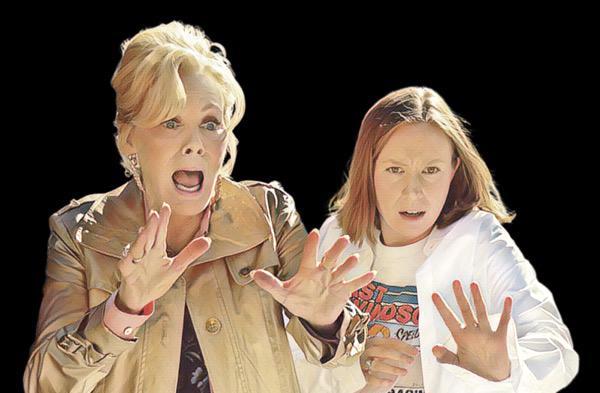
Because from there, Deborah makes the only truly transformative move of the episode: she reverses her decision about the Paradiso and chooses to invest with Marcus.
It’s not just a business move. It’s an attempt to rebuild a relationship that isn’t based on absolute hierarchy. A gesture that suggests, however subtly, that she might be capable of learning something from the sequence of emotional failures she has just gone through.
But Hacks doesn’t let this become comfortable.
The episode ends by reminding us that, today, no narrative is private. Nico turns the story into music. His version circulates. Her image is torn apart. And Deborah’s response is not to retreat, but to strike back.
To turn pain into material.
To turn humiliation into performance.
In the end, “No New Tricks” is not about dates gone wrong. It’s about the impossibility, for these characters, of living anything that cannot, at some point, be used, shaped, or re-staged.
And perhaps that’s why the title is so ironic.
There are no new tricks.
Only different versions of the same inability to sustain the real once it slips out of control.
Descubra mais sobre
Assine para receber nossas notícias mais recentes por e-mail.

