
Grupo Corpo’s work is among the most acclaimed both in Brazil and abroad. For fifty years, the company has captivated generations. And on its anniversary tour, which had already passed through Rio de Janeiro before traveling the world, the Belo Horizonte-based dancers return to the city for a short and highly sought-after season, bringing the classic 21 and the recent Piracema together in the same program.
When I spoke with Rodrigo Pederneiras in 2025 for Bravo, he was not simply outlining a historical timeline. By dividing those fifty years into three phases, he described a process of gradually taking control over the company’s own creative direction, beginning with the narrative works choreographed by Oscar Araiz, moving through the 1980s as a period of learning and appropriation, and arriving at the early 1990s as the moment when the company discovers what would become its language. It is at this point that 21 emerges, not as just another title, but as a turning point that reorganizes the way they create, because it marks the moment when the group begins working with original music composed in direct collaboration with musicians. What changes from that moment on is not only the result, but the internal logic of construction: dance stops responding to music and begins to be created alongside it, in a process where there is no hierarchy between sound and movement, but a constant attempt at fusion.

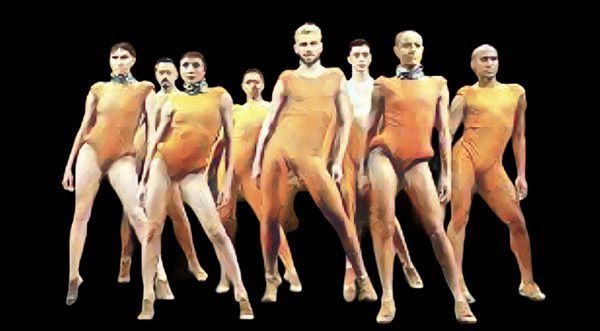
This shift helps explain why 21 continues to function as a kind of axis within the repertory, even after more than three decades. There is an almost mathematical organization of time within it, built from the number that gives the work its title, translating into repetition, progression, and structure, but never imposing itself as rigidity. What one perceives is not the calculation, but the effect of that calculation transformed into movement. Repetition, in this case, does not appear as a visible device, but as an internal method that sustains the choreography and allows it to unfold without losing cohesion. It is a ballet that feels precise without ever sounding mechanical, precisely because the logic that organizes it does not need to be made explicit to be felt.
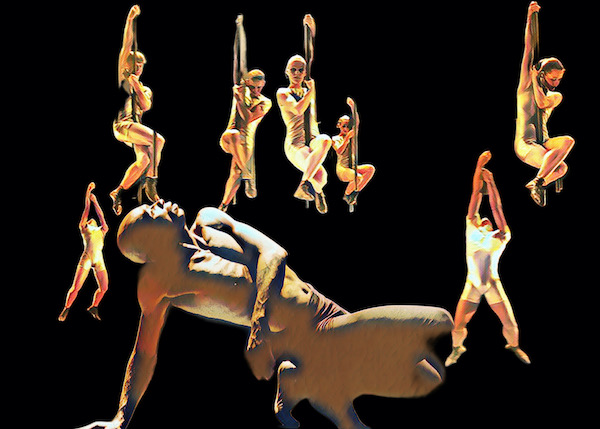
If 21 marks the moment when Grupo Corpo comes into being as a language, Piracema, created in 2025 as part of the company’s fiftieth anniversary, shifts that language into a different relationship with time. The title itself already points toward a path that is more than metaphorical. Piracema refers to the movement of fish swimming upstream, a displacement made against the current, out of necessity, persistence, and continuity. By bringing this image to the center of the work, Grupo Corpo is not simply proposing a theme, but a logic of movement that runs through the choreography. What appears on stage is no longer the fragmentation that organizes 21, but a continuous, collective flow in which movement seems to pass through the bodies rather than break into recognizable units.
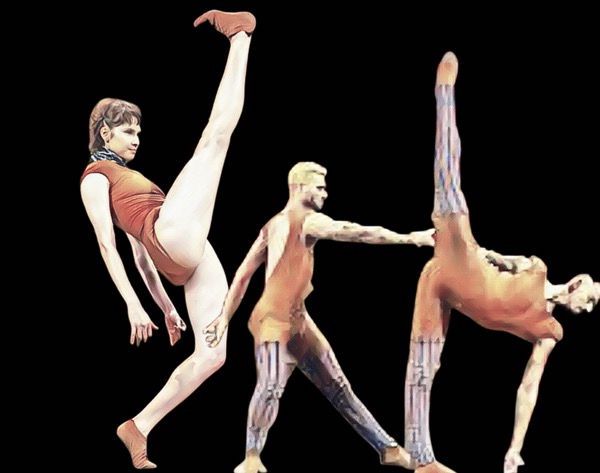
This difference does not signal rupture, and this may be the most important point of the program presented in Rio. By placing side by side a work that consolidated its language and another that emerges from fifty years of practice, Grupo Corpo does not propose a linear reading of evolution, but a coexistence of layers. This becomes even clearer when one considers the way Rodrigo describes his creative process throughout the interview, insisting on the idea that dance is not organized around narrative and that the goal is not to tell a story with a beginning, middle, and end, but to produce an experience built in direct relation to the audience. When he speaks about the difficulty of moving people, and even more about the rarity of making them feel something new, he shifts the axis of analysis toward a field in which understanding does not depend on translation, but on perception.
This key is fundamental to understanding why 21 and Piracema function together without one explaining the other. Instead of establishing a clear progression, the program creates a kind of field in which different ways of organizing time coexist. In 21, time presents itself as structure, as an internal count that organizes movement. In Piracema, it manifests as flow, as continuity that resists interruption. Between the two, what one perceives is not a change in language, but a change in the relationship to that language, which stops being constructed in front of the audience and begins to appear as the result of a process accumulated over decades.
The context in which this program arrives in Rio reinforces this reading even further. After an international run, in which the works have already been shaped by other audiences and other modes of reception, the return to Brazil does not present itself as a premiere, but as a re-encounter. Between May 6 and 10, 2026, at Teatro Multiplan VillageMall, the company presents precisely this dialogue between past and present, with sold-out performances, confirming the direct relationship it has built over time with Brazilian audiences. This is not simply recognition, but continuity, a presence that does not need to be reintroduced because it has never truly disappeared, even during periods when the company was more concentrated in the international circuit.
This constant circulation, alternating between Brazil and abroad without a clearly defined beginning or end, is also part of how Grupo Corpo understands its own trajectory. New works do not replace earlier ones, nor do they reorganize the repertory through rupture. They accumulate, creating a field in which different moments of the language remain active. 21 does not appear as memory, nor Piracema as conclusion. Both operate in the present, as parts of a system that moves without dissolving.
It is at this point that the idea of repetition, so present in the way Rodrigo describes his creative process, gains another weight. Movement does not emerge fully formed, but is built through rehearsal, adjusted, and repeated until it reaches a level of refinement where it no longer appears as repetition. This work, which is not directly visible on stage, sustains both the precision of 21 and the fluidity of Piracema, allowing apparently opposing structures to coexist within the same vocabulary.
What Grupo Corpo does with time, by placing these works side by side, is not simply revisiting its history, but making it visible as a process. Time ceases to be a line separating past and present and becomes a field in which different moments coexist. There is no rupture, nor permanence in a static sense, but a continuous movement that allows the language to shift without losing its base.
Perhaps this is the most precise way to understand what unfolds on stage after fifty years. Not as the celebration of a completed trajectory, but as evidence that this trajectory remains in motion, operating within the works themselves and in the relationships they establish with one another. Grupo Corpo does not return to the same place. It makes that place move with it.
Descubra mais sobre
Assine para receber nossas notícias mais recentes por e-mail.
 miscelana.com