
Few voices in pop music remain as instantly recognizable as Bonnie Tyler’s. There is something immediate about that raspy, dramatic, and emotionally overwhelming tone that transformed romantic ballads into grand-scale experiences. Bonnie was never an artist associated with restraint. Her career was built on the opposite: songs that sound like emotional explosions, gigantic choruses, and performances that always seem on the verge of collapse.
Born Gaynor Hopkins in Skewen, Wales, Bonnie Tyler grew up in a working-class family connected to the coal mining industry. Before international fame, she sang in pubs and clubs across Wales until she was discovered by talent scout Roger Bell during a performance in Swansea. From there, she officially launched her music career and released “Lost in France” in 1977, her first major hit.
Her story, however, would ultimately be shaped by an unexpected event. After undergoing vocal cord surgery in the late 1970s, Bonnie was instructed to remain silent for several weeks. She was unable to fully follow medical recommendations, and the recovery permanently altered her voice. What could have ended a career instead created her defining artistic signature. The rasp became her identity.
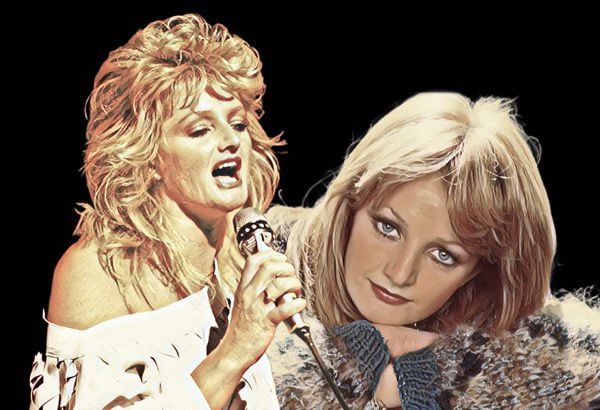
During her early years, Bonnie Tyler had already gained attention with songs like “It’s a Heartache,” but her transformation into a global star happened when she began working with Jim Steinman, the songwriter and producer associated with Meat Loaf and known for turning emotion into massive pop operas. It was Steinman who gave Bonnie “Total Eclipse of the Heart,” released in 1983.
The song did not simply redefine her career. It changed the scale of her fame. “Total Eclipse of the Heart” topped both the UK and US charts, turning Bonnie Tyler into an international phenomenon. The album Faster Than the Speed of Night cemented that moment, earning Grammy nominations for the singer, the album itself, and tracks such as “Here She Comes.”
There is something remarkable about “Total Eclipse of the Heart”: it seems capable of surviving every cultural shift imaginable. Decades after its release, the song continues to be rediscovered by younger generations through films, television series, viral videos, memes, and streaming platforms. Bonnie Tyler became one of those artists whose music never fully disappears because Hollywood, television, and the internet constantly return to it.
That success was followed by other defining hits, including “Holding Out for a Hero,” tied to the Footloose soundtrack and endlessly reused in films and television. There has always been something deeply cinematic about Bonnie’s performances. Even in her most intimate songs, she sings as if she is inside the emotional climax of an epic movie.
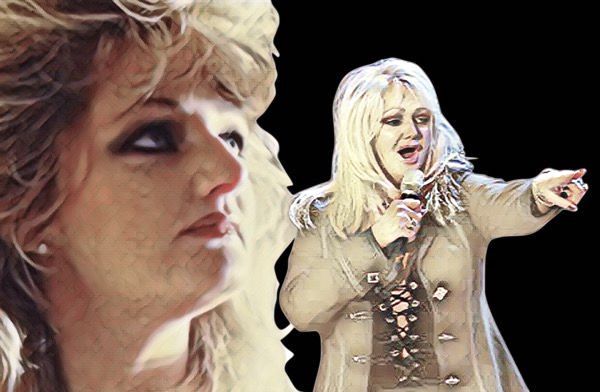
Unlike many artists associated with the 1980s, Bonnie Tyler never completely disappeared from the European touring circuit. She may have left the center of the American mainstream, but she built an extremely solid international career, especially in the UK, Germany, and Scandinavian countries. Instead of radically reinventing herself to follow trends, she embraced her own legacy. She continues to perform with the same emotional intensity that made her famous in the first place.
In recent years, Bonnie Tyler has also experienced a cultural rediscovery. Part of that comes from nostalgia for the 1980s, but also from the constant circulation of her songs on social media and streaming platforms. There is now an entire younger audience familiar with “Total Eclipse of the Heart” without necessarily connecting it to its original release era.
In 2013, she represented the United Kingdom at the Eurovision Song Contest with “Believe in Me,” finishing 19th out of 26 contestants. The participation reinforced something important about her trajectory: Bonnie Tyler never stopped working and never fully disappeared from music.
Institutional recognition arrived more recently as well. In 2023, Bonnie Tyler was appointed an MBE, Member of the Order of the British Empire, for her music services, officially recognizing a legacy that had already existed in British pop culture for decades.
Now, in 2026, the singer faces a delicate moment. Bonnie Tyler, now 74, was hospitalized in Faro, southern Portugal, where she has long maintained a residence, after requiring emergency intestinal surgery. Her team initially stated that the procedure had been successful and that she was recovering well.
Hours later, however, new reports from British and European media outlets indicated that Bonnie had been placed in an induced coma to assist her post-operative recovery while remaining under intensive monitoring. So far, her representatives have requested privacy and stated that further updates will be provided when her condition evolves.

The situation is especially concerning because Bonnie Tyler was preparing to launch her “Jubilee Tour,” a series of concerts celebrating 50 years since “Lost in France.” The first shows were scheduled to begin later this month in Malta and Germany, although there has not yet been official confirmation regarding possible cancellations or postponements.
There is something deeply symbolic about Bonnie Tyler’s trajectory. Her defining characteristic emerged from a physical imperfection transformed into artistic power. Her career survived profound changes in the music industry without depending entirely on trends. And her songs continue to resonate because they belong to an era when pop music was unafraid of melodrama, grandiosity, and emotion pushed to its absolute limit.
Bonnie Tyler was never a singer of subtlety. That may be exactly why her voice remains impossible to forget.
Descubra mais sobre
Assine para receber nossas notícias mais recentes por e-mail.

