
After a hiatus long enough to make many people wonder whether a second season would even happen, Citadel has finally returned to continue its chaotic mission inside today’s increasingly crowded spy-franchise universe. The original cast picks up exactly where the story left off, although there is one considerable problem: remembering what happened before already requires more effort than the series probably realizes. Since nobody is trustworthy, identities constantly shift, and alliances are endlessly rearranged, emotional engagement always feels one step behind the avalanche of twists and turns.
There are traces of 007, Mission: Impossible, Jason Bourne, and now even shades of Ocean’s Eleven. Does it sound exhausting and confusing? Quite often, it is.
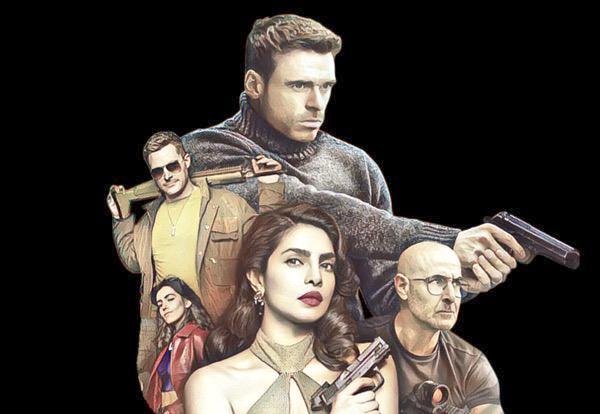
In the first season, we were introduced to Citadel, a global spy organization that operates independently of governments and national interests. In theory, its agents exist to protect global balance above political borders. Its rival is the criminal syndicate Manticore, equally international but driven entirely by money and power. The story follows agents Mason Kane, played by Richard Madden, and Nadia Sinh, portrayed by Priyanka Chopra Jonas, who are betrayed, attacked, and stripped of their memories while barely escaping with their lives.
Eight years later, Mason is living under the identity of Kyle Conroy, married and completely disconnected from his past as an agent. Bernard Orlick, Stanley Tucci’s character, is forced to reactivate him to stop Manticore from gaining access to information capable of destabilizing the entire world. Nadia also reappears hidden under another identity, forcing the duo back into action while dealing not only with global threats but also with secrets tied to their own relationship.
When Citadel premiered in 2023, it felt less like watching a television series and more like witnessing an industrial power move from Amazon. From the beginning, Prime Video positioned the project as its answer to the cultural dominance of major cinematic franchises, attempting to combine international espionage, blockbuster aesthetics, expanded-universe storytelling, and cosmopolitan glamour through a formula that felt very close to Marvel, only with a Bond-like finish. The goal was never simply to launch a standalone series, but to build an interconnected global franchise with spin-offs produced in different countries sharing the same narrative universe.
The ambition was enormous. Produced under the banner of Joe and Anthony Russo, the filmmakers behind some of Marvel’s biggest successes, including Captain America: The Winter Soldier, Civil War, Avengers: Infinity War, and Endgame, Citadel arrived carrying massive industrial expectations. After helping establish the MCU as the defining blockbuster model of the 21st century, the Russo brothers became associated with gigantic narratives, sprawling casts, and projects designed from the start for global expansion. Citadel was born entirely out of that logic.


But the behind-the-scenes chaos quickly became almost as talked about as the series itself. The first season faced creative conflicts, internal changes, extensive reshoots, delays, and such an astronomical budget that it became one of the most expensive streaming series ever made. At times, it felt less like a spy thriller and more like a symbol of the post-pandemic streaming wars, when platforms were pouring absurd amounts of money into manufacturing the next inevitable pop-culture franchise.
The problem is that money, scale, and star power never guarantee narrative coherence. Especially when the proposal often feels like a collage of formulas borrowed from other successful franchises. Trying to transform Citadel into a global universe before it had even established its own identity only exposed its weaknesses even further.
The good news is that the second season seems to understand this better. Not because Citadel has suddenly become a great spy series, but because it has finally started accepting what it actually is. Instead of insisting on a sophistication it never fully managed to sustain, the production embraces exaggeration, artificiality, and even the almost cartoonish side of its action sequences. Curiously, that honesty works far more in the show’s favor than all the prestige-driven posturing of the first season.
If the story still operates within a hyper-stylized form of international espionage where distances barely exist, cities explode without major consequences, and global conspiracies appear around every corner, the decision to inject more humor into the narrative was a welcome change.
In the middle of all this chaos, Stanley Tucci naturally becomes the season’s gravitational center. While the main trio remains relatively bland, Tucci turns absurd dialogue into genuinely entertaining moments purely through delivery and ironic timing.
For Brazilian audiences, there is also the curiosity of seeing Gabriel Leone appear as antagonist Paulo Braga shortly after the impact of Senna. His character attempts to develop technology capable of controlling people through a brain chip, a premise so outrageous that the series itself seems aware of its absurdity, multiplying unnecessary twists around an idea that ultimately traces back to The Manchurian Candidate.

The action sequences remain exaggerated to the point of absurdity. Stabbings and gunshots rarely feel like real obstacles, especially for Nadia Sinh. Priyanka Chopra Jonas moves through endless chases, explosions, and shootouts as if trapped inside a luxury video game where physical consequences simply do not exist.
Meanwhile, Richard Madden remains attached to the series’ more Bourne-like dimension, balancing agent Mason Kane and the identity he built as Kyle Conroy. The season attempts to weave family conflict, guilt, resentment, and identity crises into the middle of its relentless barrage of action scenes. It does not always work, but at least there is a more visible effort to create something beyond endless spectacle.
Perhaps the biggest change is happening behind the camera. Joe Russo now directs the entire season, and while the series remains excessive, there is finally a clearer identity guiding the chaos. Citadel is still superficial, but it now feels more aware of the kind of entertainment it wants to offer.
Interestingly, many critics believe the spin-offs, Citadel: Diana and Citadel: Honey Bunny, worked better precisely because they had smaller budgets and less obsession with scale. By prioritizing characters instead of visual gigantism, the spin-offs found something the flagship series often lacks: emotional rhythm.
Unfortunately, for me, Citadel remains part of a broader contemporary fatigue surrounding spy franchises. Over the past few years, Hollywood has recycled essentially the same narrative structure across multiple platforms, changing only the names of the agencies, the agents, and the countries visited. Independent organizations, ethical mercenaries, glamorous spies traveling between private jets, luxury hotels, and generic global threats. Everything begins to blur together.
The second season does not solve all of the series’ problems, but it is more entertaining precisely because it feels less desperate to prove its own grandeur. Maybe, by finally stopping its obsession with becoming the definitive modern spy franchise, Citadel might eventually discover a personality of its own along the way.
Descubra mais sobre
Assine para receber nossas notícias mais recentes por e-mail.
 miscelana.com