
There is something deeply unsettling about the tragedy of the five Italian divers found dead inside an underwater cave in the Maldives. Not only because of the deaths themselves, but because accidents like this tend to dismantle a very contemporary illusion: the belief that experience, preparation, and technology can transform extreme environments into something manageable.
And the deep ocean rarely accepts that logic.
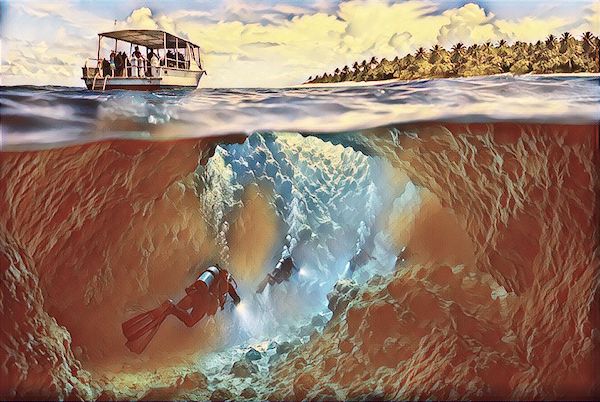
The victims disappeared during a dive in Vaavu Atoll, in the Maldives, inside a submerged cave system located around 50 to 60 meters below the surface. The bodies began to be recovered after days of searches in an operation involving local teams and foreign divers. Authorities are still investigating the case, including whether the group exceeded operational limits, whether they had the proper authorization for that kind of dive, and how sea conditions contributed to the tragedy.
Among the victims was Monica Montefalcone, a professor at the University of Genoa, a marine researcher, and a specialist in biodiversity and climate change. She had more than 20 years of diving experience in the Maldives and over 5,000 dives to her name. Her daughter, Giorgia Sommacal, 22, and researcher Muriel Oddenino, 31, also died. The tragedy expanded further during the recovery effort when a Maldivian military diver died during the rescue operation, reportedly from complications related to decompression.
Just hours before the dive, Monica wrote a message to a colleague that makes the story even more melancholic: “It is fundamental to observe the underwater environment — which remains far too unknown to the general public — whether with our own eyes or through the lens of a robot.”
It is a sentence that completely changes the tone of the tragedy.
Because this is not simply a story about someone seeking adrenaline or turning danger into spectacle. A researcher is defending the importance of direct observation, of human presence in front of an environment that still escapes ordinary understanding. That does not erase the risks or make the decision less serious. But it prevents the story from being reduced to a caricature of recklessness.
At a distance, the deaths can initially seem like a small event within the endless succession of global tragedies. An experienced group. A diving expedition. A deep cave in Vaavu Atoll. But the details make everything far more disturbing. They were between 50 and 60 meters deep inside an underwater cave system considered challenging even for technical divers. Among the dead were researchers and professionals accustomed to extreme environments. A Maldivian military diver also died during the rescue operation.
And perhaps that is precisely what feels most frightening.
These were not people completely ignoring the risks. They were people who knew the ocean well enough to believe they could handle it.
There is a tendency to imagine danger as something obvious, almost cinematic. The moment someone makes a clearly irresponsible choice. But many extreme accidents happen in a far more ambiguous space. They emerge precisely when experience begins to create familiarity.
The impossible stops feeling impossible.
In diving, 30 meters is not an arbitrary limit designed to scare tourists. It is the point where physics begins to drastically alter the relationship between the human body and the environment. Every 10 meters underwater significantly increases pressure. At 50 or 60 meters, divers are already exposed to conditions involving nitrogen narcosis, accelerated gas consumption, cognitive changes, and strict decompression requirements.
And inside a cave, there is an especially brutal complication: you cannot simply ascend.
There is a rock above you.
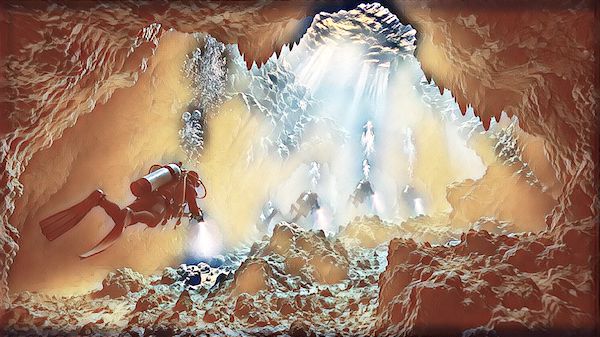
The caves described during the recovery operation appear to involve narrow corridors, internal chambers, and areas of almost complete darkness. In cave diving, even small movements can disturb sediment and destroy visibility within seconds. Orientation depends on guidelines, spatial memory, and absolute emotional control.
The yellow weather alert issued in the region before the expedition also helps explain how operations like this can spiral out of control quickly. Strong currents, heavy winds, and rough seas not only affect the surface. They alter energy consumption, stability, and water circulation inside the caves. At extreme depths, any extra physical effort reduces the margin of safety.
There is something particularly melancholic about accidents like this because they often emerge from an understandable impulse: the desire to see more closely. The belief that some experiences still need to be lived directly by human beings and not only observed through machines or images.
In a different context, that same fascination with the deep ocean reappeared in the global obsession surrounding the Titan submersible, which imploded during an expedition to the Titanic wreck in 2023. Not because the cases are equivalent, but because both reveal how extreme environments continue to exert an almost philosophical attraction over us.
Perhaps because there are still very few places on Earth capable of reminding human beings that some physical limits do not disappear simply because we have learned how to reach them.
Descubra mais sobre
Assine para receber nossas notícias mais recentes por e-mail.

